Artistic Perception and Creation
Narcissus and GoldmundArtistic Perception and Creation is the way Goldmund learns to see, transform, and give form to experience. Set against the certainties of abstract reasoning, it begins in the close study of natural and carved forms, develops through imaginative drawing and sculptural practice, and culminates in works made for religious spaces. Art is not separate from life in this account: it gathers memory and sensation into images, and gives those images a place in the world.
A Second, Silent Nature
At Mariabronn, Goldmund is drawn to the carved figures, columns, capitals, and ornaments of the monastery. He imagines that the saints and other figures stand in a secret bond with him, like protectors who guide his life. The carved plants and creatures seem to him a second, silent, human-made nature alongside the living world. He spends free hours copying figures, animal heads, and leaves, and sometimes draws flowers, horses, and human faces. His attention is therefore both devotional and artistic: he looks at religious ornament not only as decoration, but as a world of forms with which he feels personally connected.
That affinity belongs to a broader contrast between Goldmund and Narcissus. Narcissus describes Goldmund as a dreamer and artist whose nature is rooted in the senses and in the maternal world, whereas Narcissus belongs to reason and ideas. The distinction is not simply a division between feeling and thought. Goldmund’s sensual perception gives him a particular capacity to receive the world in its fullness, but it also leaves him vulnerable to being overwhelmed by it. Art becomes one means of shaping that abundance without denying its sensuous source.
Transforming Letters and Lines
Goldmund’s account of letters makes his artistic imagination especially clear. A flower petal or a tiny worm, he says, may contain more than books; a slight tilt of the pen can make a Greek letter turn into a fish, bringing to mind rivers, Homer’s sea, and the waters associated with Saint Peter. The letter may then become a bird and seem to take flight. For Goldmund, forms are not fixed signs with one settled meaning: they can open into natural shapes, memories, and entire landscapes. He concludes that God wrote the world with such letters.
Narcissus recognizes the magic of this way of seeing but distinguishes it from the purposes of scholarship. The mind depends on stable symbols and definite forms; it cannot let an omega change into a serpent or bird. Their exchange makes the artistic and intellectual temperaments complementary but structurally different: Goldmund’s perception attends to what a form might become, while Narcissus’s learning depends on what can be defined. Goldmund has already come to accept that he will not become a scholar, and his account of changing letters gives imaginative form to that acceptance.
The same principle appears in Goldmund’s childhood memory of drawing on a writing tablet. A line begun as one figure might become a leaf, a tree, a fish’s snout, a foxtail, or an eyebrow. He also invented creatures by putting eyes and mouths into flowers or shaping figures in clusters of leaves. Drawing gave him sustained pleasure because the line could surprise him and become something other than its apparent beginning. His wish to transform himself into a woodpecker grows from this experience of transformation: he imagines living in the treetops, climbing trunks, and communicating in the bird’s language. The imagined metamorphosis and the changing line belong to the same desire to cross the boundaries between human perception and the life of other creatures.
The Image and the Search for the Mother
On his journey, Goldmund’s encounter with a wooden Madonna gives this way of seeing a decisive direction. After confession in a cloister, a shaft of sunlight leads his attention to a statue in a side chapel. The Madonna’s blue cloak, inclined posture, delicate hand, and living expression draw him back repeatedly as he tries to leave. He feels that the figure resembles something he has encountered in dreams and long desired. The priest explains that the image, donated only a year earlier, was made by Master Niklaus, though some people dispute its worldly, modern character and question whether it represents the Mother of God truthfully. Goldmund’s response is immediate and affirmative: he recognizes the statue’s beauty and wants to find the carver.
For Goldmund, the mother-image is not a portrait of one woman. His hoped-for figure gathers his mother’s remembered presence with the faces of Lise, the gypsy, Lydia, and other women, each experience changing the image. He wants to make visible the source of life itself, an original mother whose features he cannot fully describe. What he can identify is the intimate relation he wants the image to express between ecstasy, pain, and death. Artistic creation thus works through memory without merely reproducing it: lived encounters accumulate and alter an image that remains larger than any individual model.
Sculpture, Devotion, and the Work of Form
Under Master Niklaus, Goldmund becomes an able draftsman and is sometimes allowed to model in clay as well as carve wood. His first successful work is a clay figure of Julie, Lydia’s sister, a little over two spans high. Niklaus praises it but refuses Goldmund’s wish to have it cast in metal, judging it too worldly and unchaste to sponsor as a work. The episode establishes that artistic perception and artistic judgment do not always coincide: Goldmund’s attraction to a figure can produce a successful work, while the master still decides that it does not suit the religious commission or his own standards.
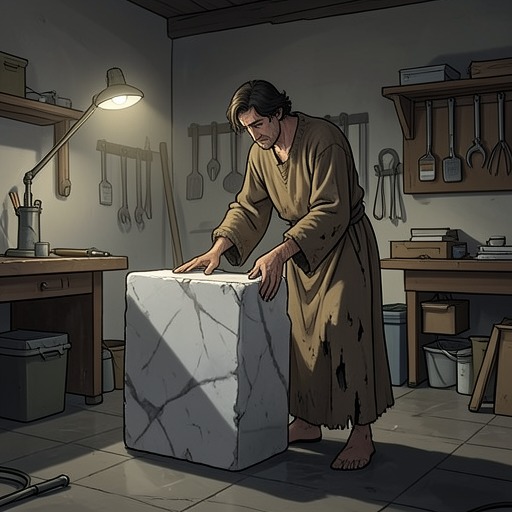
Goldmund next carves a wooden figure of Narcissus as the Apostle John for a crucifixion group. He works on it with profound love, finding his skill and sense of self again whenever he loses his way. His distractions—love affairs, dances, drinking, dice, and quarrels—can keep him from the workshop or leave him unable to concentrate. Yet he returns to the carving only in hours of readiness, when work becomes an act of devotion rather than an extension of appetite or ambition. In those moments, he feels that the image of Narcissus is emerging through his hands, as though his friend’s being were finding a form beyond the passing changes of life. The carving turns friendship into a durable artistic presence.
When Goldmund returns to the monastery later in life, he again makes the work answer to its setting. Rather than create an arbitrary object, he seeks a place where his carving can belong to the monastery’s architecture and daily life. The refectory has an unornamented reading niche from which a young brother reads from the lives of the saints during meals. Goldmund proposes carved panels for the steps and lectern, combining half-relief figures with figures that stand almost free. The Abbot accepts the plan. The work’s intended location and use are integral to its design: it is meant to become part of the communal space, not simply an object admired in isolation.
The design divides the lectern into the world below and the word of God above. Its lower stairs grow from a sturdy oak trunk and wind around it, bearing images of creation, nature, and the simple lives of patriarchs and prophets. The upper parapet carries the four apostles. Goldmund plans for their faces to preserve the likenesses of Abbot Daniel, his successor Father Martin, and Master Niklaus among the evangelists. Natural forms, biblical history, the monastery’s leaders, and the master who taught him are gathered into one structure. The design makes the lectern at once functional furniture, a religious image-cycle, and a record of relationships.
Mortality and Artistic Significance
The Black Death gives Goldmund another way to understand the work of images. In a cloister, he studies a recently painted Dance of Death in which a skeleton leads people of every rank—king, bishop, abbot, earl, knight, doctor, peasant, and soldier—toward death, accompanied by skeletal musicians. He recognizes the painting as a forceful lesson in the universal obligation to die. Yet it does not match what he has experienced. For him, death is not only a stern judge or warrior: its call can also seem maternal and seductive, bound to the intensification of life as death approaches. The contrast does not cancel the fresco’s meaning; it reveals that a single image of death cannot contain every experience of it.
Goldmund’s response shows how artistic seeing can remain open to competing truths. The Dance of Death makes mortality visible through shared fate and social breadth, while Goldmund’s own hoped-for mother-image joins death to intimacy, pain, and life’s source. His refectory design likewise brings distinct orders of meaning together: nature and scripture, the human community and its devotional practice, transient lives and figures preserved in wood. Across these works, creation is neither escape from the world nor the mind’s fixed explanation of it. It is a way of receiving change, making it perceptible, and giving fleeting experience a form that can endure.