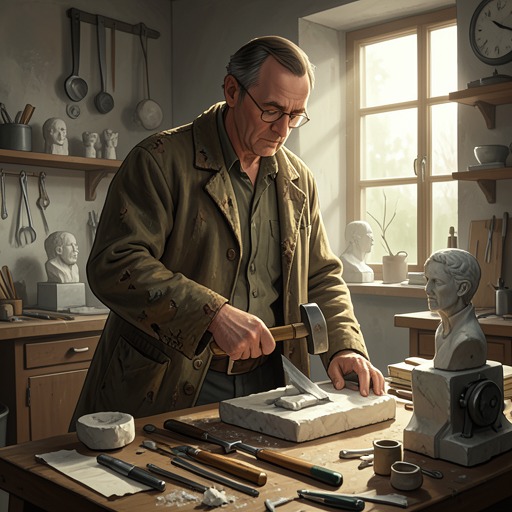
Goldmund Completes the Statue of Saint John
Narcissus and GoldmundGoldmund Completes the Statue of Saint John is the turning point at which Goldmund’s apprenticeship under Master Niklaus produces its first major work and earns him recognition as an artist. The wooden figure, modeled on Narcissus as the beloved disciple, embodies the intimacy of their friendship; when it is finished, however, Goldmund experiences not only achievement but the loss of the work that had given his life direction. Master Niklaus sees a future for him in the guild, while Goldmund increasingly feels drawn away from the security of the workshop.
The work and its apprenticeship
Goldmund’s path to the statue began outside the ordinary rules of the sculptors’ guild. When he approached Master Niklaus, the master explained that customary apprenticeship lasted at least four years, required the apprentice’s father to pay, and usually began in adolescence. Goldmund was already an adult, and Niklaus did not want either to keep an apprentice in his house or to make the newcomer submit to the usual subordinate role. Yet he recognized beauty in Goldmund’s drawing and offered him an informal chance to learn in the workshop, without contract or obligation. Goldmund could leave whenever he chose; he could also fail and turn to another skill.
That arrangement made the statue possible without making Goldmund a conventional apprentice. Over the course of a year, he developed as a draftsman and tried modeling clay as well as carving wood. His first successful sculpture was a clay figure of Julie, Lydia’s younger sister. Niklaus praised it but would not sponsor its casting in metal, judging it too worldly. Goldmund then began a wooden figure of Narcissus, portrayed as the Apostle John. Niklaus hoped to include it in a commissioned Crucifixion group, on which his assistants had been working while he reserved the final touches for himself.
Narcissus in the wood
Goldmund’s work on the Saint John did not proceed as a steady routine. Love affairs, drinking, dances, games, and fights repeatedly drew him away from the workshop; sometimes he missed a day or more, and sometimes he returned distracted. But he approached the statue in periods of readiness, with patience and devotion. As its features emerged, he felt that he was recovering his own skill and soul through the work, and that he was not simply imposing an image of his own will. He experienced the figure as Narcissus taking shape through the artist’s hands, a portrait of his friend’s essential character made visible in wood.
The statue gave artistic form to a friendship that had already shaped Goldmund’s youth. He envisioned Narcissus as the beautiful, favored disciple: still and attentive, reverent and devoted, marked by youth and inward music. The figure could suggest suffering and death without despair, disorder, or rebellion; its emotional register remained clear and harmonious. In Goldmund’s contemplation, the statue became at once a likeness of Narcissus and a monument to their friendship and to the years in which Narcissus had guided him.
Completion and recognition
Goldmund finished the statue in a small wooden shed behind the assistants’ workshop. After completing the final delicate work on its face and hands, he swept the shed carefully and brushed away the remaining sawdust. He then stood before the finished figure for a long time, absorbed in the gravity of having reached an experience that might never come again. His response joins pride in the work to apprehension about its ending: once the statue is complete, it will no longer await his hands or provide the refuge and purpose he found in making it.
When Goldmund invited Niklaus to see the finished statue, the master examined it in silence. His stern expression softened, and he told Goldmund that the figure was very good. He declared Goldmund’s learning complete and said he would present the statue to the guild, arguing that its maker deserved to be admitted as a master. Goldmund did not greatly value the guild itself, but he welcomed the recognition because it came from Niklaus, whose judgment mattered to him.
Niklaus read the figure as grave yet filled with joy and peace, and as a work of piety and light. The master’s response also confirmed the difference between Goldmund’s achievement and ordinary workshop production. Although Niklaus had criticized Goldmund’s unreliability and behavior, he had continued to tolerate him because he believed this particular statue could be a work beyond the reach of his assistants and uncommon even among major masters.
What the statue changes
The finished work altered the prospects of both artist and master. Niklaus persuaded the guild to issue Goldmund a master’s diploma and planned to bind him to the workshop as an associate rather than an assistant. He hoped they would share important commissions and earnings. Growing older and concerned that his renowned workshop might decline into ordinary craftsmanship, Niklaus saw Goldmund’s talent as a possible continuation of its standing. He also considered enlarging the workroom, giving Goldmund an attic room, and providing clothes for his guild recognition. Lisbeth was not opposed to the prospect of Goldmund settling down.
Goldmund, however, felt the completion as a separation. The statue would remain after he had to leave it, while his own hands could no longer develop it. He became acutely conscious of impermanence and questioned whether he could continue making smaller decorative work after having given himself to the Saint John. The figure’s permanence therefore carries a cost: the achievement survives its maker’s immediate need for it, but cannot itself settle him into a new purpose.
Artistic and narrative significance
The statue brings together practical labor and inward vocation. Its making depends on a workshop, wood, tools, instruction, and the possibility of guild recognition; Goldmund’s artistic freedom is not separate from these material and professional conditions. Yet the unusual terms of his learning also preserve the possibility of leaving, and the completion that proves his ability does not resolve the conflict between his work and the settled life proposed by Niklaus.
The Saint John also gives Goldmund a way to preserve an image of Narcissus beyond the changing circumstances of friendship and time. The narrative first makes the statue an act of concentrated making, then a completed object recognized by the master, and finally the occasion for Goldmund’s sense of emptiness and departure. Its success is thus both a culmination and a release: Goldmund has demonstrated that he can create a powerful work, but the finished work does not make the workshop his permanent home.