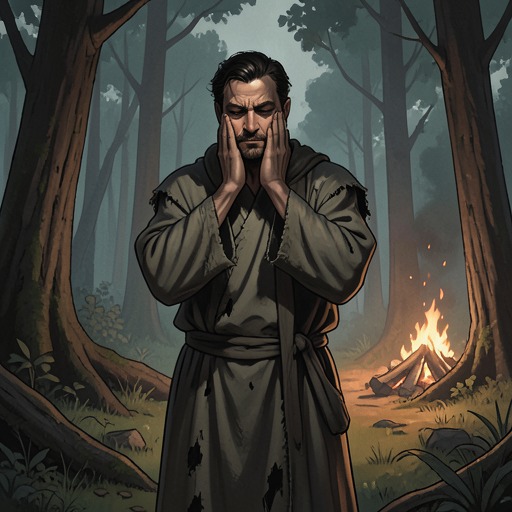
Goldmund Kills Viktor and Flees the Forest Camp
Narcissus and GoldmundGoldmund Kills Viktor and Flees the Forest Camp marks a turning point in Goldmund’s wandering: when Viktor attacks him in the night, Goldmund kills his companion while fighting to survive, then runs from the camp. The immediate escape does not end the episode. Alone in the winter landscape, he struggles through hunger, cold, and despair, and the encounter leaves him with a lasting awareness of both death’s nearness and life’s fierce persistence.
The Attack in the Forest
After Viktor wakes and urges Goldmund to take his turn sleeping, Goldmund lies down but remains awake, troubled by his distrust of the man. He regrets having told Viktor about Lydia and wonders how he might get away from his companion. About an hour later, Viktor bends over him and searches his pockets and seams. Goldmund opens his eyes and tells him to go away, saying he has nothing worth stealing.
Viktor responds by attacking him. Goldmund fights back, but the struggle leaves him in immediate danger and unable to free himself. He reaches into his pocket, draws his small hunting knife, and stabs Viktor. When Viktor releases him, Goldmund can breathe again. Only then does he fully take in what has happened: Viktor lies dying, and Goldmund recognizes that he has killed a man.
Flight and Survival
Unable to remain beside Viktor, Goldmund retrieves his knife, wipes it on the woolen vest Viktor is wearing—the garment Lydia had knitted for her beloved—and runs away. The killing weighs on him as daylight comes. He washes away the blood in the snow, then wanders for another day and night, directionless and distressed.
As he loses his way in the deserted, snow-covered landscape, hunger and exhaustion drive him toward despair. He has no shelter, food, or path, and almost no sleep. At moments he closes his eyes and wishes to die in the snow; again and again, however, the impulse to stay alive forces him onward. He eats dried berries from juniper bushes and pine needles, and takes handfuls of snow to quench his thirst. His flight continues until he collapses in the village where he had recently encountered a traveling charlatan.
The Killing’s Aftermath
The encounter becomes more than an episode of escape. In the village, the warmth of a stable, sleep, and goat’s milk restore Goldmund, but the experience remains as a painful, indelible impression. He has learned the extremity of homeless life—its loneliness and freedom, its exposure to hunger and cold—and remembers the struggle to stay alive as both terrifying and strangely powerful. The immediate aftermath of Viktor’s death thus marks a lasting change in Goldmund’s knowledge of mortality: he has faced death at another man’s hands, survived, and carried that awareness onward.
The Killing’s Aftermath
The village brings Goldmund back from the edge of collapse. A woman whose love he had enjoyed recognizes him, takes pity on his condition, and pulls him into a stable despite the possibility that her husband will scold her. Warmth, sleep, and the goat’s milk she gives him restore his strength. The ordeal recedes from his immediate awareness, as if it belonged to a distant past, but it has not disappeared: it remains as something horrible and precious, an experience that has left its mark on him.
Recollection and Moral Reckoning
The episode later returns as part of Goldmund’s account to Narcissus. When Narcissus asks whether he had witnessed Jews being burned and whether he had tried to prevent it, Goldmund answers that he had seen it and had not intervened. He then tells the story of Rebekka in detail, growing heated as he recalls helping her gather and bury the bones of her father, who had been burned with fourteen other Jews by order of the town authorities. His account brings the killing of Viktor into a broader landscape of mortality and violence: survival had taught Goldmund that he could fight for his own life, but witnessing persecution also forced him to confront the suffering he had been unable to stop.