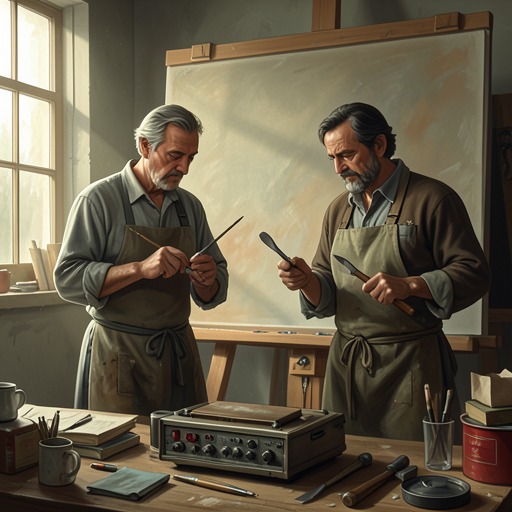
Goldmund Refuses to Stay in Niklaus’s Workshop and Leaves Again
Narcissus and GoldmundGoldmund Refuses to Stay in Niklaus’s Workshop and Leaves Again is the decisive break between the sculptor’s first completed work and the settled professional life others hope to build around him. Master Niklaus recognizes Goldmund’s exceptional ability and prepares an unusually generous place for him in the workshop, but Goldmund insists that he must leave, travel, and gather further experience before attempting the more distant work he imagines. The departure closes a formative artistic relationship without resolving the opposition between the security of craft and the freedom of the road.
The Offer and the Choice
Goldmund’s place in the workshop had never followed the ordinary route. Guild custom expected an apprentice to begin at thirteen or fourteen, with his father paying for the training; the apprentice then spent years running errands and serving the master before advancing. Goldmund was already an adult, had no conventional apprenticeship behind him, and, as Niklaus observed, did not seem suited to being ordered about. Yet Niklaus judged the drawing that had brought Goldmund to him beautiful despite its faults, and offered to teach him informally, without a contract or obligation to stay. Goldmund could leave whenever he chose. That unusual freedom made the workshop possible for him, but it also left open the question of whether he would ever accept the life of a settled artisan.
The answer emerged when Goldmund completed his statue of Saint John. He told Niklaus that he had no immediate plan for another statue, though a distant image of a saint remained in his mind. He might be ready to make it in three or four years, in ten, or perhaps never; first he needed to see and experience much more. He rejected a life spent lacquering statues and carving pulpits for money, and wanted instead to roam, encounter the world’s beauty and horrors, and test himself through hardship. His distinction was not between art and idleness, but between making work as a routine trade and living in a way that might prepare him for a work of greater depth.
Niklaus’s Investment in Goldmund
Niklaus’s patience with Goldmund was repeatedly tested. He disliked his pupil’s restlessness, indifference to property and money, impulse to spend, romantic entanglements, and quarrels. He also noticed Goldmund’s interest in his daughter, Lisbeth. Still, the Saint John changed the balance: Niklaus watched it take shape slowly and unpredictably, but with persistence and assurance, and believed it would become a work beyond the abilities of his assistants. The statue gave the master a reason to endure the disruptions of the maker’s life and to recognize a kinship he did not fully acknowledge.
Goldmund’s declaration that he would not become an artisan did not lead Niklaus to dismiss him. Rather, the master began planning a permanent future for him. He persuaded the guild to issue Goldmund a master’s diploma and considered making him an associate, not a subordinate: the two would discuss and execute important commissions together and share the earnings. Niklaus was growing older and worried that his celebrated workshop might decline into ordinary craftsmanship; Goldmund’s talent seemed capable of sustaining its distinction. He also considered enlarging the back workroom, giving Goldmund an attic room, and providing new clothes for his acceptance by the guild. Lisbeth was not opposed to the possibility that Goldmund might settle and become a master, so Niklaus saw no obstacle on her side.
The Farewell
When Niklaus presented his proposal, Goldmund was taken by surprise and could not answer at once. He thanked the master for his goodwill and, especially, for the patience with which he had taught him, but said that his decision had already been made before he knew of the offer. He had accepted Niklaus’s invitation without intending to remain permanently. He would go back on the road; nothing, he said, could change that need to travel and be free.
Niklaus’s response turned the disagreement into a painful separation. He grew pale, refused Goldmund’s offered hand, and paced in anger before ordering him to leave at once and not make him see him again. Goldmund tried once more to offer his hand, then left quietly, brushing the carved heads on the stairway as he went. In the courtyard workshop he stopped before the Saint John that had joined them, and departed with a deeper pain than he had felt when leaving the knight’s castle and Lydia. The completed sculpture remained the material record of their intimacy and disagreement: it had helped create their bond, but could not persuade Goldmund to stay.
Meaning of the Departure
The refusal pits a concrete professional future against Goldmund’s conviction that artistic creation depends on continued exposure to life. Niklaus offers recognition, secure work, shared commissions, and a place within the guild; Goldmund refuses not because he dismisses the master or the craft, but because he fears that settling into production would make him repeat forms of work he no longer wants. His ambition remains real, but it is not yet attached to a finished plan. The future saint exists only as a remote image, and Goldmund accepts uncertainty rather than substitute routine for the experience he believes he still needs.
The choice also repeats a pattern of departure while changing its emotional weight. Goldmund leaves the knight’s household and Lydia behind earlier in his life, but this farewell costs more: Niklaus has taught him, recognized his gift, and hoped to make room for it within a lasting workshop. Goldmund’s exit therefore does not simply reject security; it breaks a relationship formed through artistic trust. The road becomes both his chosen freedom and the unfinished condition of his vocation, while the Saint John stands behind as proof that his wandering has already produced a work worthy of the master’s faith.