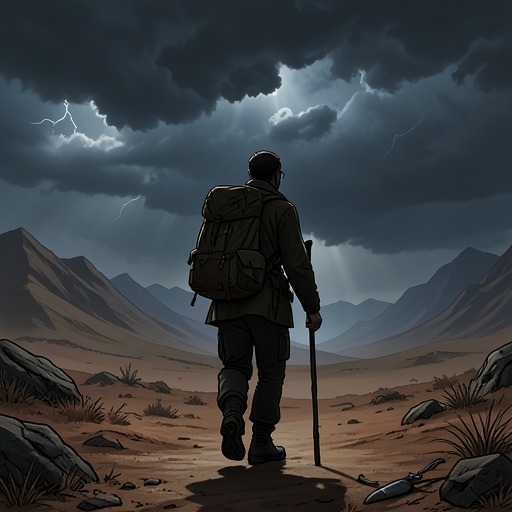
Goldmund kills Viktor
Narcissus and GoldmundGoldmund kills Viktor during a night in their forest camp, when suspicion between the two traveling companions becomes a fight for survival. The killing ends their companionship and sends Goldmund into the snow alone; later, as he recounts Rebekka’s story to Narcissus, the memory belongs to a wider reckoning with violence, fear, and the limits of individual resistance.
Suspicion and confrontation
Goldmund has come to distrust Viktor. He regrets having told him about Lydia and wonders how to separate from his companion. When Viktor wakes and offers him a turn to sleep, Goldmund lies down but remains awake, unsettled by the man beside him. About an hour later, Viktor bends over him and searches his pockets and seams. Goldmund opens his eyes and tells him to go away, saying he has nothing worth stealing.
Viktor responds by attacking him. Goldmund struggles to rise, but Viktor holds him down. As Goldmund fears he is about to die, he reaches into his pocket, draws his small hunting knife, and strikes Viktor repeatedly. Viktor releases him, and Goldmund survives. The reversal is immediate: the companion whose presence had become a source of distrust is dead, and Goldmund is left to confront what he has done.
Flight and aftermath
Goldmund recognizes the killing as murder and addresses the Mother of God in shock. He wipes the knife on the woolen vest Viktor is wearing, puts it back in its wooden sheath and in his pocket, and runs away. The act of flight does not resolve his distress. As daylight comes, he washes Viktor’s blood from himself in the snow, then wanders for another day and night, anguished and without direction.
The killing also marks a distinction between dangers Goldmund believes he can resist and those he cannot. In the later account of his journey, he remembers the night when Viktor threatened his life as a danger he could fight and escape. Plague, by contrast, seems impossible to oppose by personal strength. The recollection therefore makes Viktor’s death a brutal turning point in Goldmund’s encounter with mortality: survival has required violence, but surviving does not deliver him from grief or from the larger devastation that follows.
Recounting the killing amid the plague
The later recollection places Viktor’s death within Goldmund’s passage through a landscape where plague has overturned ordinary life. He distinguishes the winter struggle with Viktor from the disease spreading through the region: that earlier danger could be fought, and he had defended himself and escaped, whereas plague could not be met by individual resistance. This contrast does not make the killing a triumph. Goldmund’s survival in the forest remains bound to the death of his companion, while the plague brings him into contact with suffering on a scale no single act can master.
The distinction becomes morally unsettled as Goldmund witnesses people blaming Jews, foreigners, the poor, or doctors for the disease. In one town he sees a ghetto burned and its fleeing inhabitants driven back into the fire; he watches the violence with rage and revulsion. The episode broadens the significance of the forest encounter without making the events equivalent: Goldmund killed Viktor while struggling to save his own life, while the burning of the ghetto is violence against an innocent group under the cover of collective fear. Both enter a world in which death is no longer remote, but the later scene makes clear that fear can also be turned outward and organized into persecution.
Rebekka’s story and the question of complicity
The contrast between self-defense and violence against the vulnerable sharpens when Goldmund meets Rebekka, a Jewish survivor mourning her father. The town’s authorities had ordered her father and fourteen other Jews burned; she escaped, then returned and blamed herself for not dying with them. Goldmund helps her gather her father’s bones from the ashes and bury them in a hiding place in the field. The scene gives the persecution a particular human cost: not an abstraction about plague-era disorder, but a daughter’s grief and the precarious act of burying the dead.
Goldmund offers to protect Rebekka and promises not to touch her, but she rejects his courtship. She accuses Christians of first helping her bury a father murdered by their people and then expecting his daughter to belong to them. Her rebuke forces Goldmund to recognize that his intended kindness does not erase the assumptions behind his offer. He acknowledges that she may be right and asks forgiveness. Her refusal also distinguishes her grief from his attempts to answer surrounding death with companionship or desire; she insists on the right to mourn without being hurried toward consolation.
When Goldmund later tells Rebekka’s story to Narcissus, he recounts it in detail and grows passionate. Narcissus asks whether he prevented Jews from being burned; Goldmund admits that he did not. The exchange shifts the question from whether one person can command or stop every cruelty to what it means to witness violence and remain powerless to prevent it. Goldmund’s own killing of Viktor arose from an immediate threat to his life, but the later conversation refuses to let that private struggle stand for the persecution of a whole community. Rebekka’s story makes the difference visible, while leaving Goldmund’s anger at a world he calls hell in tension with the fact that he, too, had watched and failed to intervene.