Goldmund leaves Mariabronn and begins wandering
Narcissus and GoldmundGoldmund’s departure from Mariabronn is the moment when a forbidden escape becomes a chosen life: he leaves the cloister without permission, parts from Narcissus, and enters a world in which his direction and fate are no longer governed by the monastery’s bells and routines. The departure is at once an intimate farewell, a break with institutional order, and the beginning of his wandering existence.
The Decision to Leave
The decision comes suddenly. Goldmund tells Narcissus that he has come to say farewell and will leave that very day. His father has neither arrived nor sent a message; Goldmund intends to go without paternal approval, accepting that his flight will bring shame upon Narcissus. He describes the choice not as a plan arranged in advance but as something life itself has brought to him. The absence of a sanctioned reason or destination makes the departure a break with the authority that had placed him at Mariabronn.
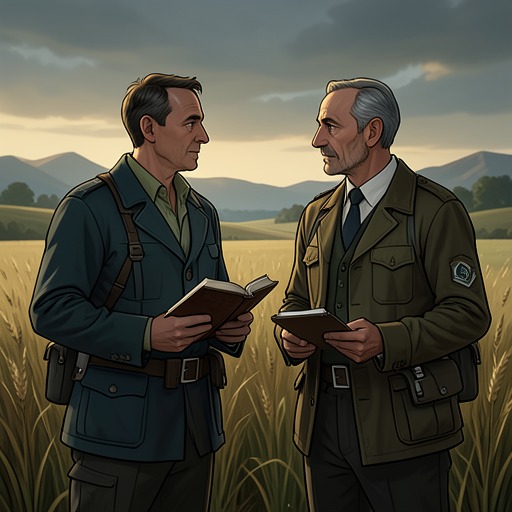
Narcissus is exhausted and has only a short interval before the first vigil, but he gives Goldmund that time. Goldmund apologizes for disturbing him and thanks him for his friendship and patience, especially for listening rather than trying to detain him. Narcissus says he would not hold him back. His response makes the farewell a recognition of Goldmund’s need to go, not an attempt to preserve their companionship by keeping him within the cloister.
Goldmund has no settled goal. He will go with Lise, a woman he describes as a stranger and perhaps a gypsy, but he tells Narcissus that she is not the ultimate reason for leaving. He expects their road together may be short and does not mistake her for a secure destination. Instead, he says he is going because he must, because he has heard a call. The distinction between travelling with Lise and leaving because of that call gives the departure its larger meaning: attachment begins the journey, but does not define its purpose.
Farewell to Narcissus
The conversation places two forms of love side by side. Goldmund speaks of loving a woman through surrender and mutual absorption, and of this sensual experience as a road toward life’s meaning. He knows that the road may be hard, even while he hopes it will be beautiful. Narcissus, by contrast, is preparing for a life of prayer, fasting, and obedience. Their differences are not resolved; the scene lets their affection persist across a deep divergence in how each understands the life worth pursuing.
Narcissus promises that he will never forget Goldmund, expects him to return, and tells him to seek help if he is ever in need. As they part, Goldmund embraces him but, knowing Narcissus’s aversion to caresses, does not kiss him; he strokes his hands instead. The restrained gesture gives physical form to their closeness while respecting the difference between them. Narcissus then returns toward the church, while Goldmund follows him with his eyes until the figure disappears into the darkness of its doorway.
Goldmund sees the contrast clearly: Narcissus is devoted to spiritual discipline, while he himself is leaving in the wake of a day of love and intends to find Lise again. Yet the contrast does not make one affection false and the other genuine. Goldmund understands both his love for Lise and his love for the praying Narcissus as real, though they belong to different modes of life. Their friendship remains powerful precisely without making them alike.
Crossing the Threshold
Goldmund leaves by a secret route he had used before when going to the village with Konrad. The earlier outing had been a small forbidden adventure, undertaken with excitement and fear; this time he is leaving for good. He no longer worries about the porter, the Abbot, or the teachers. Recalling the same path makes the change in scale legible: a route once associated with a temporary violation now leads away from the institution itself.
There is no plank bridge beside the brook, so Goldmund removes his clothes, throws them to the opposite bank, and wades chest-deep through the cold, swirling water before dressing again. This is the departure’s most concrete threshold. The practical obstacle forces him to cross without the ordinary passage, and the episode gives physical shape to the risk and irreversibility of leaving. Once across, he recognizes with painful clarity that Narcissus had understood the direction of his life before Goldmund himself could act on it. The old cloister remains behind him as a place he loved and had grown used to, but one that had only seemed a home.
A few hundred steps from the walls, Goldmund stops on the stony road and gives an owl call. A call answers from downstream: Lise is waiting. Their encounter proceeds with almost no conversation. Goldmund reaches for her, and she leads him through the forest without his asking where they are going. The movement from a final, articulate exchange with Narcissus into a largely wordless meeting with Lise renders the change in Goldmund’s immediate world through the form of the scene itself: he has left dialogue and monastic routine for movement guided by bodily presence and another person’s knowledge of the way.
The Open World
After a night with Lise, Goldmund wakes alone in the hay. She has run away, and he is left tired, briefly abandoned, and uncertain about what has happened. Yet the separation does not undo the departure. When he gets up and begins walking, the memories of the night remain with him as part of the experience that has opened new longings and possibilities. Lise is a companion at the outset, not a guarantee that the journey will be settled or permanent.
The countryside now appears to him in a way it could not from within Mariabronn. He is no longer a student who sees the world through a window or takes a walk that inevitably ends in return. The fields, heath, forest, and whatever may lie beyond them form an open world that can do him good or harm and that contains his fate. He is small within it, and no bell summons him to bed, Mass, class, or meals. The change is both practical and inward: he has lost the protections and schedules of the cloister, but the world beyond it has become real as the place where his life will happen.
The first days make that freedom tangible through ordinary needs and encounters. Goldmund eats half-ripe corn from a field, pockets green hazelnuts, and later rests and eats blueberries in the forest. After two days and two nights in the woods, he recognizes cultivated land, barley and oat fields, meadows, and a footpath as signs of human habitation. He kneels at a roadside crucifix, drinks from a well whose water runs through a wooden pipe into a trough, and hears a cow near a hut. These details mark the passage from wilderness toward human company without returning him to the ordered, enclosed life he has left.
Significance of the Departure
The departure turns Goldmund’s life from a course set by the monastery into an uncertain journey. It is not a triumphant escape from all ties: he leaves with affection for Narcissus and with the memory of a place to which he had become accustomed. Nor does he depart with a practical destination. His conviction that he has heard a call coexists with uncertainty about Lise, the road, and what lies ahead.
The scene establishes a tension that will shape the journey: Narcissus represents disciplined spiritual life, while Goldmund moves toward experience, love, and the open world. Their farewell does not decide that one path cancels the other. Instead, Goldmund carries his love for his friend beyond the cloister even as he refuses the life Narcissus has chosen. Crossing the brook makes that divergence an action; the world beyond it supplies no promise of safety, only the freedom and exposure of a life now lived on the road.