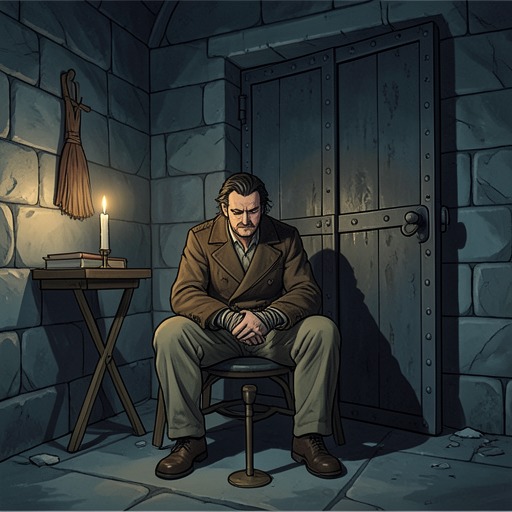
Goldmund's Final Return and Dying
Narcissus and GoldmundGoldmund's Final Return and Dying is the closing movement of Goldmund’s wandering life and the final intimacy of his friendship with Narcissus. He returns to Mariabronn not as the vigorous traveler who left, but as a man worn down by injury and illness; in the workshop and sickroom, his arrival becomes both a homecoming and a farewell. His last conversations give Narcissus the open declaration of love he had withheld, while Goldmund’s final question turns their difference in experience into a parting challenge.
Return to Mariabronn
After the summer’s flowers had wilted and the birds were preparing to depart, Goldmund came back on foot in a light rain. He did not enter the cloister first: from the portal he went directly to the workshop. Erich recognized him, but the returning man seemed altered beyond recognition, with a dusty, gray face, sunken cheeks, and tired, suffering eyes. He moved painfully and dragged himself forward, though his expression held a patient, kind-hearted smile. The changed season frames his return as a threshold: the world’s brief abundance has passed, and the wanderer arrives carrying its cost.
Goldmund explains that the pain began near the start of his journey. While riding through a forest, he and his horse fell into a brook, where he remained in cold water through the night. He believed he had broken several ribs and continued to suffer chest pain. Though he was still not far from Mariabronn, he refused to turn back, thinking that doing so would make him look foolish. When the pain eventually made riding impossible, he sold the horse and spent a long time in a hospital. The account makes his return the consequence not of a single sudden decision, but of an injury he had continued to carry while pressing onward.
Illness and the end of wandering
Goldmund tells Narcissus that he will remain at Mariabronn and will not ride away or wander again. He says that he had expected to stay away much longer, perhaps for years, but saw that joy was no longer waiting for him on the road. Before his strength failed altogether, he wanted to draw more and make a few more figures; creation remains a pleasure he still hopes to reach. His return therefore does not erase his former life. It marks the point at which he recognizes that the life of movement has run its course and turns, briefly, toward the work that still matters to him.
As he speaks, Narcissus puts a hand on Goldmund’s arm. Goldmund stops, closes his eyes with a smile, and falls asleep peacefully at the drawing table. The Abbot fetches Father Anton, the house physician, and the sleeping man is carried to a sickroom; the physician finds him hopelessly ill. Erich keeps constant watch. Goldmund’s story of the final journey remains incomplete: he shares only some details, others are inferred, and his condition shifts between listlessness, feverish delirium, and lucid moments. Narcissus is summoned whenever he is lucid, making their final conversations a recurring vigil within the larger, unfinished account of Goldmund’s travels.
Narcissus’s confession
The return changes the emotional balance between the friends. Narcissus had missed Goldmund and thought of him every day, fearing that he would never come back. Goldmund answers that his absence would not have been a great loss, but Narcissus’s response is an act rather than an argument: overcome by grief and love, he bends down and kisses Goldmund’s hair and forehead. It is the first time in their many years of friendship that he has touched him in this way.
Goldmund understands the gesture. Narcissus then speaks plainly of a love he had not previously managed to confess. He says that Goldmund has been the one person among men whom he could love, and that this friendship kept his heart from drying up and left a place within him open to grace. He contrasts his own austere life, marked by an inability to love others, with Goldmund’s experience of being loved. The confession does not make the friends alike; it allows Narcissus, at the end, to name what their difference had made difficult for him to express.
Last words and death
In his final exchange, Goldmund speaks of a beautiful statue he can still see in his mind: the image of the great mother-Eve. He feels that he no longer has the strength to carve it and believes that the figure does not want its secret made visible, but wants him to die. He says he is glad to die and that she is making death easy for him. The artistic image thus remains vivid even as the bodily power needed to give it form has ebbed away; the work he cannot complete becomes part of the farewell.
Goldmund then looks for a long while into Narcissus’s face and says farewell with his eyes. He asks how Narcissus will die when his time comes, since he has no mother, and concludes, “Without a mother, one cannot love. Without a mother, one cannot die.” What he murmurs after that cannot be understood. For the last two days, Narcissus sits beside the bed, watching Goldmund’s life ebb away, and the final words remain burning in his heart. The novel closes not with a full account of Goldmund’s last moments, but with the friend’s vigil and the question Goldmund leaves behind: whether Narcissus, whose life has been governed by discipline and spiritual vocation, can meet death without the maternal experience that Goldmund sees as inseparable from love and dying.