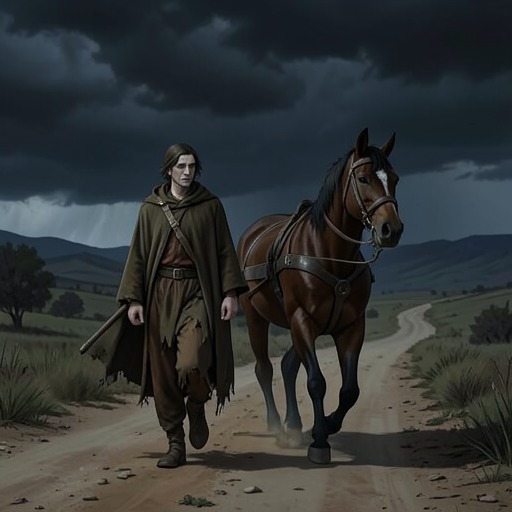
Goldmund’s final journey and sick return
Narcissus and GoldmundGoldmund’s final journey and sick return begins as a chosen departure from Mariabronn and ends with Goldmund gravely ill among the people he had left behind. The journey’s failure to fulfill his hopes becomes a turning point: Goldmund must confront physical pain, rejection by Agnes, and the prospect of death, while Narcissus receives the fragments of his story and cares for his returned friend.
Departure and the journey’s concealed purpose
Goldmund’s leave-taking from Narcissus was difficult for both men, though Goldmund concealed his feelings behind brusque indifference. He had made up his mind during the night and arrived in new clothes and a new cap to say goodbye and receive a blessing for the road. He had confessed and taken communion earlier. His departure followed a period of preparation, during which he had completed a figure of Mary with careful attention to its hands, face, and hair. The work’s lingering final adjustments had delayed him, but he now set out on his own terms.
The journey was not, as Goldmund initially let Narcissus believe, simply a decision to roam. He later admitted that he had heard a rumor that Count Heinrich had returned to the region and that Agnes was with him. The news had fixed his thoughts on Agnes, whom he remembered as the most beautiful woman he had known and loved. He rode in the hope of seeing her and being happy with her again. He found her after about a week and had the chance to speak with her, but she no longer wanted a relationship with him. She considered him too old, no longer attractive or amusing enough. Goldmund identified this rejection as the real end of the journey, though he continued onward rather than immediately returning to Narcissus.
Injury, delay, and return
Goldmund’s reluctance to come home was bound up with shame. He felt that he had promised himself too much and did not want to appear ridiculous by returning almost as soon as he had left. He told Narcissus that he had fallen ill during the first days of the journey but kept going rather than turning back. In a forest, his horse fell with him into a brook, where he remained overnight in cold water. He believed he had broken several ribs, and chest pain continued afterward. When riding became too painful, he sold the horse and spent a long time in a hospital.
The full course of the journey remained incomplete: Goldmund offered only some details, and other parts had to be inferred. He sometimes lay listless or feverish and delirious, and at other times was lucid enough to speak with Narcissus. His explanations connect the physical setback to his earlier refusal to return: although the accident happened not far from Mariabronn, he kept traveling because he feared looking foolish. The journey thus became a prolonged departure from the simple possibility of turning back, until pain and exhaustion made that possibility unavoidable.
Earlier encounters with pain, birth, and death
The journey’s significance reaches beyond its final illness. Earlier in his wandering, Goldmund had been present at a birth in a poor village, where the peasant family had only gruel and no bread. Woken from the straw to help, he held a light while the midwife worked. He watched the woman’s face and recognized a resemblance between the expression of labor and the expressions of women in the ecstasy of love. The experience gave him a new understanding of how closely pain and joy could appear to meet.
His attention to death also shaped the sensibility he carried into the last journey. In a plague-stricken farmhouse, he studied the bodies of five people, noticing the different expressions and postures preserved in death. He did not answer Robert’s anxious calls from outside, giving himself instead to observing the scene with both compassion and the detached attention of an artist. The open, ordinary rooms made visible the physical process that graves usually conceal. For Goldmund, the sight was terrible but also compelling: it confronted him with suffering and fate in an uncompromising form.
During the later weeks of Lene’s illness, Goldmund experienced care not as an abstraction but as a sustained obligation. He wanted to leave and resume wandering, yet could not abandon her while she was dying. He rarely went outside, gave her drops of water when she could no longer drink milk, and tended the goat that shared their shelter. When Lene died, he remained beside her, then burned the hut and left with only his flint. These earlier episodes make the final journey part of a longer history in which Goldmund encounters birth, suffering, death, and the limits of his ability to escape them.
Agnes, the vision of his mother, and acceptance
Goldmund’s account of the fall gives it a meaning beyond injury. After Agnes rejected him, he continued riding, though he said that his strength, youth, and intelligence had already deserted him. When he fell into the stream, he felt something break in his chest and, in that moment, felt relief rather than resistance. He understood himself to be close to death, yet unlike his earlier experience in Count Heinrich’s prison, he no longer found death unbearable.
In the midst of the chest pain, Goldmund described a dream or vision of his mother. He heard her voice, which he had not heard since childhood, and saw her holding him in her lap. In the vision, she opened his chest and drew out his heart; Goldmund said that once he understood what was happening, the pain ceased to feel like an enemy. He later interpreted the recurring pain in the same maternal terms, as his mother’s fingers drawing his heart out. The vision links the physical wound of the journey to the maternal memory that Narcissus had helped awaken earlier in Goldmund’s life.
Back at Mariabronn, Goldmund told Narcissus that he was ill and confessed how soon the illness had begun. He explained that he had continued traveling because he was ashamed to return after such a short time and because the journey had not gone as he had expected. He now said he would stay and would never ride away again: no more wandering, dancing, or women. He acknowledged that he would otherwise have remained away much longer, but when he found no joy in the world outside, he wanted to draw and make a few more figures while he still could. His return is therefore neither a triumphant completion of his travels nor a simple restoration of his former life; it is a weary decision to stop roaming and turn again to art and friendship.
Narrative significance
The journey’s ending gathers together experiences that had long marked Goldmund’s life: attraction to movement and new encounters, a deep responsiveness to the body, artistic attention to faces, and the recurring presence of death. His earlier reluctance to leave Lene alone shows that wandering can yield to an immediate responsibility; his continued travel after Agnes rejects him, by contrast, reveals how shame delayed his return. The fall finally makes the body’s limits impossible to ignore.
The account also changes the meaning of the departure scene. Goldmund’s promise that he would see Narcissus again becomes a return under radically altered circumstances: he comes back sick, diminished, and conscious that he cannot resume his former life unchanged. The story is not fully preserved in a continuous account. Goldmund speaks in fragments, sometimes feverish and sometimes lucid, and Narcissus records only parts of what he says. That partial transmission suits a final journey whose significance lies less in a complete itinerary than in what Goldmund discloses at its end: the failed hope of finding Agnes, his changed relation to pain and death, and his wish to make art before his remaining strength is gone.