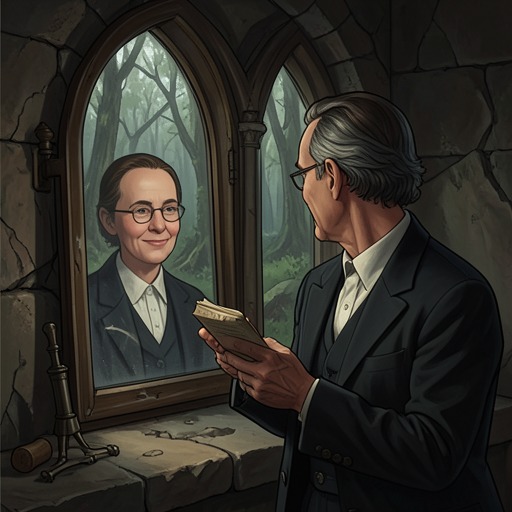
Goldmund’s recovery of his mother’s memory
Narcissus and GoldmundGoldmund’s recovery of his mother’s memory is a crisis of recognition: Narcissus’s words bring a lost childhood image into consciousness, separating Goldmund’s own love for his mother from the condemnatory story he inherited from his father. The painful return of that image changes his understanding of himself, dissolves his imagined obligation to atone through monastic life, and marks the beginning of a path Narcissus can help uncover but cannot follow for him.
Background: A childhood obscured
Goldmund had little independent knowledge of his mother. The account he knew came chiefly from his father, who described her as a beautiful woman of noble but impoverished birth, once a dancer, whom he had taken from poverty, baptized, instructed in religion, and married. According to that account, after several years of domestic life she resumed her former ways, caused trouble, and disappeared after her husband had brought her home more than once. Her reputation as a witch endured in the stories told about her.
That account did more than explain her disappearance: it shaped Goldmund’s sense of what he owed the world. His father educated him in place of the absent wife and instilled the belief that he must give his life to God to expiate her sins. The story of a wayward, shameful mother displaced Goldmund’s own living memory of the woman he had loved as a child. He had almost forgotten that original image, and had learned to treat his mother as a forbidden subject.
Narcissus names the forgotten wound
After an earlier conversation had perplexed and hurt Goldmund, he returned a few days later willing to hear more. Narcissus described their contrasting natures and defined wakefulness as the ability to recognize one’s inner forces and weaknesses through conscious reason. Goldmund, he said, had forgotten his childhood, which was still calling to him from the depths of his soul. Narcissus regarded this recognition as a possible reason the two friends had met: Goldmund needed to understand himself, while Narcissus could help him do so.
Narcissus went further, contrasting Goldmund’s sensuous, artistic nature with his own life of thought. He portrayed Goldmund as belonging to life, feeling, and the maternal world, and himself as a thinker oriented toward ideas. This account overwhelmed Goldmund. At the words about forgotten childhood, Goldmund flinched, though Narcissus did not see his reaction; later, Goldmund told him that the conversation had struck him deeply and asked to be left alone. Narcissus, realizing that his words had hurt his friend, withdrew.
Crisis and recognition
Goldmund’s distress did not resolve in tears, as it had on an earlier occasion. He felt an unbearable inner pressure and fled through the quiet parts of the cloister into the court of the cross. There, images associated with the experience pressed on him: the carved heads of dogs and wolves above the garden arches seemed to take on an alarming significance. The episode left him with a sense of having encountered something terrible and important, though he could not yet name it.
When Goldmund later came to, he could not place himself or recover what had happened. He remembered a distant experience that had seemed both sublime and frightening, but its meaning remained out of reach. Images of dogs’ heads and the scent of roses returned, followed by the pain of the episode. In the narrowing interval between waking and sleep, he found the image again: a tall, radiant woman with glowing hair and a full mouth. He recognized her as his mother, and Narcissus’s words about forgotten childhood came back to him. With that recognition, the old memory returned, displacing the accumulated stories and rumors that had obscured it.
The recovered mother and its consequences
Goldmund understood his mother not through his father’s moral judgment but through the intensity of his own childhood attachment. He told Narcissus that he had loved and admired her more than anyone, and that she had been sun and moon to him. The contrast is decisive: the remembered mother is a radiant, beloved presence, while the inherited account had gradually turned her into an evil and shapeless figure. Recovery restores not a new account of her later life but Goldmund’s own lost relation to her.
The change reaches beyond memory. After the crisis, Goldmund seemed to have shed what had been unformed and inauthentic in him, including the belief that monkhood was his vocation and that he owed God a special service to make amends for his mother. He appeared both younger and older: released from a false obligation, yet newly conscious of a self and destiny still taking shape. The narration presents Narcissus as having helped Goldmund reach this point, but not as the source of the inner life that follows. Narcissus recognizes that Goldmund has found access to something beyond his own experience; their friendship remains profound, yet Goldmund’s newly recovered self is ready to follow a path Narcissus cannot share.
Narrative significance
The episode is structured as a delayed recognition. Narcissus first supplies the words that touch the hidden wound; Goldmund then undergoes a crisis whose images he cannot interpret; only after the return of the mother’s image does the experience become intelligible. The passage moves from inherited testimony and imposed guilt toward personal memory and recognition. Its resolution does not erase the mother’s disappearance or verify the stories told about her. Instead, it establishes that the father’s account had displaced a different truth: Goldmund’s own remembered love.
That distinction redirects the larger shape of Goldmund’s life. The recovery breaks the connection between his mother’s alleged sins and his own supposed duty of religious atonement. Narcissus can name the division between Goldmund’s conscious understanding and buried childhood, but the memory that answers him belongs to Goldmund. The event therefore marks both a healing and a parting: the friendship has made recognition possible, while the life opened by that recognition leads beyond Narcissus’s guidance.