Goldmund’s repressed childhood memory
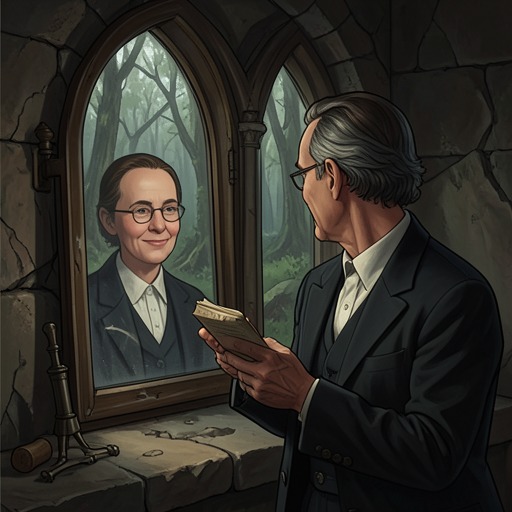
Narcissus and GoldmundGoldmund’s repressed childhood memory is the vanished image of the mother he loved before his father’s story recast her as a shameful, dangerous figure. Its recovery, precipitated by Narcissus’s insight and Goldmund’s ensuing crisis, overturns the belief that his life must redeem his mother’s supposed sins. The memory is not merely a recovered portrait: it releases Goldmund from an imposed identity and sets his life on a course beyond the cloister.
The Memory Beneath the Family Story
Before its return, Goldmund’s understanding of his mother is secondhand and blurred. He has a shadowy sense of his home, a father he venerates, and a mother reduced to a pale name and a story of disappearance. Narcissus gradually recognizes that part of Goldmund’s life has been lost; repeated questioning and rational explanation cannot restore what circumstances have effaced.
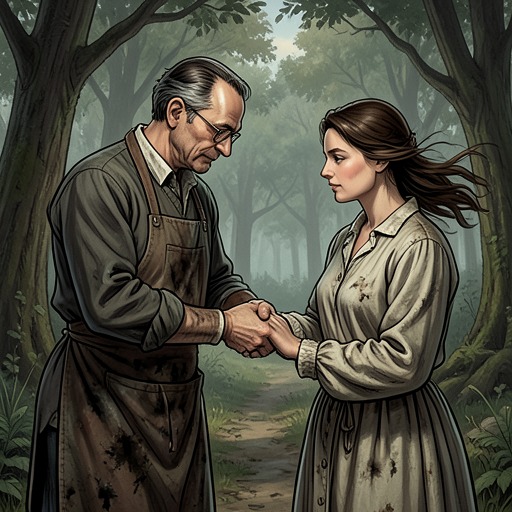
The father’s account supplies the story that has crowded out the memory. He says his wife had been a dancer, beautiful and of noble but poor birth; he had rescued her from poverty, arranged for her baptism, and made her respectable through marriage. According to his telling, she later returned to her former life, caused trouble, seduced men, stayed away from home, and acquired a reputation as a witch. After he had taken her back several times, she disappeared for good. The account is not a recovered recollection of the mother herself but the family legend through which Goldmund has learned to view her.
The legend shapes the father as well as the son. After years of disorder and shame, the father turns to educating Goldmund, who resembles his mother in appearance and build. He becomes nagging and bigoted, teaching the boy that he must dedicate his life to God to expiate her sins. This imposed purpose gives Goldmund’s apparent wish to remain at the monastery the force of an inherited obligation, though neither the Abbot nor the boy understands the lost maternal memory beneath it.
Narcissus and the Crisis of Recognition
Narcissus sees that Goldmund’s account of childhood contains an absence rather than a coherent past. Their affection and time together create a form of understanding that reasoning alone had not achieved. During a holiday conversation in the library, Narcissus eventually tells Goldmund that he is only partly awake to his own inner life: he has forgotten his childhood, and it continues to call to him. He believes that learning to recognize his own drives and weaknesses is part of why they met.
Goldmund flinches at the reference to his forgotten childhood, though Narcissus does not notice. As the conversation continues, Goldmund grows pale and asks Narcissus to leave him alone, saying that the words have wounded him. Narcissus realizes that he has touched something profound without knowing quite what he has done. Goldmund’s familiar inner pain returns with greater force, but this time it does not end in tears. He feels that he must free himself of something deadly within, and flees through the cloister to its quietest spaces.
The crisis turns on recognition that Goldmund cannot yet express. He is left with confused, partly forgotten impressions of pain and experience. In the interval between Narcissus naming the forgotten childhood and Goldmund recovering its central image, the memory appears not as a clear account but as something that has surfaced and then slipped away again. The narrative makes the gap itself consequential: Goldmund’s distress precedes his ability to say what he has lost.
The Mother’s Image Returns
When Goldmund awakens from the fading dreamlike state, he recognizes the tall, radiant woman with full lips and glowing hair as his mother. Narcissus’s words return to him, and with the image comes a rush of recognition: the lost woman is no longer an indistinct name or the figure of his father’s tale. Goldmund remembers the mother he loved and the force of that early attachment.
He tells Narcissus that he had loved and revered his mother more than anyone, and remembers her as sun and moon to him. He cannot understand how that radiant image could have been darkened and gradually replaced by the evil, pallid, shapeless witch of the story he had learned from his father and others. The contrast establishes what recovery means: not proof or correction of every claim about the mother’s later life, but a return of Goldmund’s own living memory and of his experience of loving her.
The recovered image changes the meaning of the family story without erasing its history. The father’s account had endured as a terrible legend, while the actual memory of the mother from Goldmund’s earliest years had nearly disappeared. Once it returns, the legend no longer has the power to define Goldmund’s whole identity or dictate the purpose of his life.
Consequences for Goldmund and Narcissus
After the crisis, Goldmund seems to have been healed. The fainting spell leaves no harmful consequences, and aspects of his identity that had been unformed or unauthentic fall away: his mistaken vocation to become a monk and his belief that he owes God a special service as atonement. Narcissus’s understanding proves essential to this change, and Goldmund sees his friend’s earlier words as accurate insight into his hidden wound.
The recovery also changes the friendship’s balance. Goldmund admires Narcissus more deeply, but Narcissus no longer approaches him as a superior instructor. He recognizes that Goldmund is drawing on inner sources to which he himself has no access. Though glad that Goldmund is freeing himself from his guidance, Narcissus senses that their friendship is nearing a parting: Goldmund has recovered his soul, but neither knows where its call will lead, and Narcissus understands that the path extends into regions he will not travel.
That movement beyond the cloister becomes visible in Goldmund’s later life. After years of wandering, he accepts a place at the home of a knight who is writing an account of a pilgrimage; Goldmund agrees to correct and copy the work and help complete it in return for clothes and shelter. Later, in the city, Master Niklaus recognizes the beauty in Goldmund’s drawing and offers to teach him without a formal apprenticeship contract. The guild’s usual route requires years of service and a father to pay for the apprenticeship, but Goldmund is an adult and does not fit that system; Niklaus lets him try carving without binding him to stay. These choices place him outside the monastic future his father prescribed, as he pursues a life formed by experience and artistic work.
The link between memory and that later life appears again in Goldmund’s resistance to settled ownership and his attraction to wandering. His mother’s blood, as he understands it, stirs in his disdain for proprietors and the settled life. When Master Niklaus attempts to secure his future by arranging a master’s diploma and proposing that he become an associate in the workshop, Goldmund is approaching departure rather than permanence. The remembered mother does not furnish a simple explanation for every later choice, but her recovered place in his inner life gives the novel a decisive counterweight to the father’s imposed story of guilt and redemption.