Goldmund's Return to the Bishop's City
Narcissus and GoldmundGoldmund’s return to the bishop’s city is a homecoming that cannot recover the past: after walking through a land devastated by plague, he reaches the place where he hopes to work again, only to discover that Master Niklaus is dead and Lisbeth has aged into a stranger. The return briefly restores his sense of belonging, then closes the possibility of resuming the life he left behind and makes loss newly personal.
The road through the plague
Goldmund’s return is preceded by an encounter that establishes the death-haunted landscape he must cross. Near a village, armed peasants drive him and Robert away. The following morning, they find an isolated farmstead strangely deserted. Inside its darkened house, Goldmund discovers that the household has died: five bodies, including an old woman in a chair and a boy across the threshold. The neglected livestock and silence explain the villagers’ hostility; Robert recognizes the plague and tries to flee, fearing that he has been infected.
Goldmund prevents Robert from leaving him alone in the same danger. As they continue, they meet villages that exclude strangers and farms where the dead remain unburied, while abandoned animals wander or starve. They milk and feed livestock and find food and drink in empty places, but this material abundance does little to soften the journey. Robert repeatedly fears infection, even holding his head and hands over the campfire smoke as a supposed protection. Goldmund, by contrast, walks through the afflicted country with a mixture of fascination and sorrow, regarding death not as a distant possibility but as a condition shared by everyone.
The plague has also broken ordinary social bonds. Goldmund encounters deserted homes, children in need, and the dead left without care; he sees communities turn on alleged sources of infection and blame Jews, foreigners, the poor, or physicians. In one town, a mob burns the Jewish quarter. The journey thus brings him not only into contact with mass death but also with the violence and fear that shape people’s responses to it. He continues toward Master Niklaus’s city, drawn by the prospect of returning to the workshop, even as the road repeatedly delays him with scenes of suffering and encounters with survivors.
Death, art, and the road back
Goldmund does not understand death solely as an enemy or punishment. In a cloister he studies a painted Dance of Death, in which Death leads people of every rank away while skeleton musicians play. He recognizes the painting as a forceful lesson in mortality, but it does not match his own experience of the plague. For him, death also carries a maternal and seductive aspect: its approach makes life feel more intense, and its call can seem like an invitation home. This vision accompanies his journey without erasing the horrors he witnesses.
The contrast between the painted image and Goldmund’s response gives the return its particular weight. He does not travel back untouched by the catastrophe; he has been compelled to look closely at both death and the ways people live beside it. Yet the city and its workshop remain his destination. His hope of working again is a practical desire as well as an artistic one: Master Niklaus’s workshop had once offered him a place where his talent could take material form, and Goldmund has continued to imagine that place as a possible home.
Arrival and the shock of homecoming
By the time Goldmund reaches the city, the plague has subsided. Its bishop had left during the outbreak, and an imperial governor had been sent to restore order, enforce emergency laws, and protect life and property. The bishop is expected to return, and the townspeople anticipate a resumption of ordinary life. Goldmund has heard of the epidemic and unrest on the road, but he has cared less about the city’s political condition than about whether it, and the workshop, still stand.
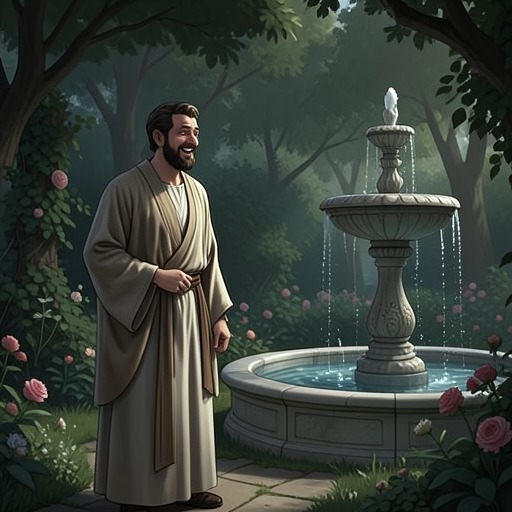
The familiar city initially answers that hope. Goldmund enters through the gate he had passed through years earlier and recognizes its portals, fountains, cathedral tower, church bells, and marketplace. The emotion of homecoming is new to him. He walks the streets close to tears, grateful that the place has waited for him, and envies the burghers their houses and secure belonging. In the evening light, the streets seem to have returned to ordinary life: two butcher boys push a calf while joking with a maid above them. The scene makes the speed of recovery almost startling. Not long before, plague fires and the work of disposing of the dead had marked the city; now people laugh and exchange jokes. For a moment Goldmund too feels warmth toward the townspeople, as though the deaths and losses on the road had receded.
That brief ease gives way as he approaches the familiar street and house of Master Niklaus. His heart pounds with worry: he needs to know whether the master is still there and whether the old rupture between them still matters. The door, usually left open in daylight, is bolted. An elderly woman who once received him does not recognize him and tells him coldly that Master Niklaus is dead. Goldmund presses past her into the house and calls for Lisbeth.
Loss behind the closed door
Lisbeth appears as someone Goldmund can scarcely reconcile with his memory. The proud, beautiful young woman has become a bent, fearful old maid in a plain black dress. The change makes the house feel not merely unfamiliar but ghostlike. The workshop is closed, and the person Goldmund had once imagined as part of a settled future has been transformed by time. His return therefore reveals the distance between the life he carried in memory and the life that continued in his absence.
After leaving the house, Goldmund goes back to the embankment where he had sat earlier, when the river’s depths still seemed to promise reverie. Now night has fallen; the water is dark, and the earlier shimmer is gone. He sits for an hour before he can weep. His grief gathers several losses together: Master Niklaus, Lisbeth’s vanished youth, Lene, Robert, Rebekka, and his own squandered youth. The return has made these absences newly tangible, not by bringing the dead or the past back, but by setting them against the city he had hoped would still be waiting.
That night he finds a tavern where he once drank with friends. The owner recognizes him and offers bread and wine, but he cannot eat or drink until the next morning. He then visits the fish market, where the sight of fish in barrels recalls an earlier sadness whose cause he can no longer remember. The experience extends the meaning of the homecoming: not only joy and beauty but also pain and despair lose their sharpness with time. The city remains physically recognizable, yet it cannot restore the old meanings attached to its places or people.
Significance of the return
The return reverses the expectation built into Goldmund’s journey. He reaches the city seeking the master and workshop that once gave direction to his art, and the familiar streets briefly make it seem that he can resume that life. Instead, the central figure of that past is dead, the workshop is closed, and Lisbeth embodies the passage of time. Homecoming becomes an encounter with irrecoverable change rather than a restoration.
The return also brings Goldmund’s experience of collective catastrophe back into intimate focus. In the countryside, plague has turned homes into abandoned spaces and communities toward fear and violence; in the city, ordinary laughter resumes quickly enough to make the recent devastation seem almost erased. Goldmund can take part in that renewed warmth only briefly. The closed door and the news of Niklaus’s death expose what public recovery cannot undo for an individual: the loss of particular people, opportunities, and versions of himself. His return is therefore both an arrival at a desired place and the discovery that the life he associated with it has already passed.