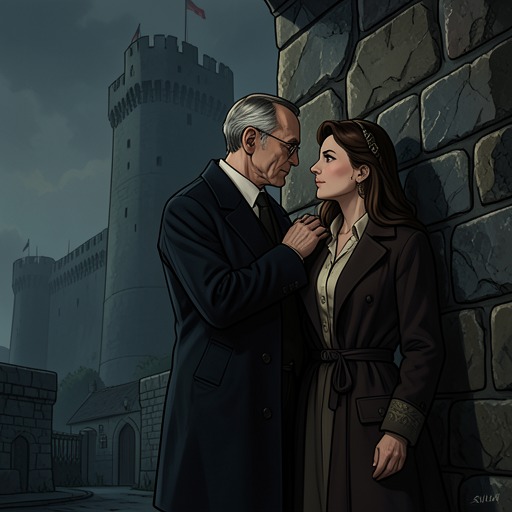
Julie
Narcissus and GoldmundJulie, the younger daughter of a prosperous knight, is sixteen when Goldmund enters her family’s household. Goldmund initially finds her more beautiful and alluring than her older sister, Lydia, but his growing love for Lydia changes how he understands his attraction to Julie. As Lydia’s secret affair with Goldmund becomes increasingly precarious, Julie moves between apparent innocence and knowing attention, unsettling the lovers’ privacy. Later, her likeness becomes the subject of Goldmund’s first successful clay figure, giving her a distinct place in both his emotional life and artistic development.
Identity and Introduction
Julie lives with her father and her eighteen-year-old sister, Lydia, in a prosperous household where Goldmund arrives seeking food and a night’s lodging. The knight welcomes Goldmund to his own table after learning that he has studied Greek; the sisters keep their eyes down. Their ages and beauty shape Goldmund’s first impressions, and he considers both potential objects of courtship. He eventually agrees to remain in the house to help the knight correct and copy the account of a pilgrimage, with the prospect of staying near the two sisters also drawing him.
Goldmund’s attraction to Julie is not simply a lesser version of his attraction to Lydia. He recognizes that Julie’s striking beauty and precocious, childlike manner arouse desire, while his attachment to Lydia deepens into love. Although he sometimes courts Julie with elaborate flattery, he comes to distinguish wanting her from loving her sister. That distinction does not remove Julie from the relationship’s tensions: his awareness of her charms remains visible to Lydia, and the household gives the younger sister opportunities to observe the lovers.
Presence in Lydia and Goldmund’s Secret Affair
Julie senses that Lydia is absorbed in a secret love affair. Curiosity draws her toward the forbidden intimacy, but she also resists admitting what she knows. At times she treats Goldmund with conspicuous coolness; at others she watches him with admiration and desiring curiosity. She visits Lydia in bed, approaching the atmosphere of the secret relationship without openly joining it, and sometimes makes her knowledge of Lydia’s transgression unmistakable through blunt disapproval.
This alternating manner gives Julie influence over the lovers even when she is not present. She can seem innocent and unaware, then abruptly knowing; Lydia is particularly troubled by the possibility that Julie will reveal the affair. Lydia also notices Goldmund looking at Julie with appreciative delight, but the secret and its dangers make it difficult for her to address his attraction directly. Julie thus becomes both a possible witness and a source of rivalry, intensifying the lovers’ fear that their concealed relationship may be discovered.
Goldmund, meanwhile, finds his position increasingly difficult. He is attached to Lydia but has not secured the relationship he desires, and his attraction to Julie complicates his attempt to respect Lydia’s limits. His occasional efforts to court Julie do not undo his love for Lydia; instead, they expose the difference between desire and attachment while adding another uncertainty to an already dangerous household secret.
The Nighttime Confrontation
On a winter night, after Julie and Lydia have quarreled during the day, Lydia comes to Goldmund’s room as she customarily does. She is apprehensive that Julie may betray her, but does not tell Goldmund the reason for her sadness. Their quiet meeting is interrupted when the door opens and Julie enters. Lydia recognizes her sister and recoils, while Goldmund is initially too startled to identify the visitor.
Julie makes the situation explicit: she says she does not want to remain alone in her room and gives Goldmund an ultimatum—he must let her join him and Lydia, or she will wake their father. Goldmund allows her into the bed. The sisters’ presence turns the concealed affair into an immediate confrontation, while Julie’s threat makes clear that she understands the risk of discovery and is prepared to use it to secure her entrance.
Goldmund tries to manage the encounter by attending to both sisters, but the arrangement becomes intolerable. He urges Lydia to stop denying what he believes their desire calls for; she withdraws. When Julie responds to his attention, Lydia hears her and is overcome by jealousy. She abruptly orders Julie to leave. The force of Lydia’s command makes Julie recognize the danger of attracting notice, and she gets up in silence. Goldmund, feeling rejected, directs a promise toward Julie instead, leaving the conflict unresolved rather than restoring the former secrecy. The episode makes Julie’s presence a turning point: her intrusion forces the lovers’ competing desires and their exposure risk into the same room.
Julie as an Artistic Subject
Julie’s importance to Goldmund later enters his work directly. During his year of learning in Master Niklaus’s workshop, he becomes an able draftsman and is occasionally allowed to model clay as well as carve wood. His first successful work is a clay figure, a little over two spans high, representing Julie. The master praises it but refuses Goldmund’s wish to have it cast in metal, judging the figure too worldly and unchaste to sponsor in that way.
The episode connects Julie’s earlier role as an object of attraction with Goldmund’s emerging ability to make images. The figure is evidence of his developing skill, but it also records the sensuous, worldly material that his art draws upon. Julie’s likeness is not the mature work around which Goldmund’s artistic vocation ultimately gathers: he next turns to a wooden statue of Narcissus as the Apostle John. Still, the clay figure marks her as the subject of his first successful modeling and shows how personal desire could enter his craft before his most sustained artistic achievement.
Place in the Wider Plot
The available episodes do not record Julie’s later decisions or establish her eventual fate. They instead define her through a concentrated set of roles: younger sister in the knight’s household, observant presence around Lydia’s secret affair, participant in the disruptive nighttime encounter, and model for Goldmund’s first successful clay figure. Her effect on the story lies in how her curiosity and knowledge unsettle the lovers’ fragile privacy, while her likeness briefly becomes part of Goldmund’s passage from attraction toward artistic work.