Lisbeth
Narcissus and GoldmundLisbeth, the daughter of Master Niklaus, is introduced as the beautiful young woman Goldmund sees at a window on the night he arrives in the city to seek the sculptor. Sheltered from the workshop and difficult for Goldmund to approach, she becomes at once a person he longs to know and an image he wants to transform through art. Her father’s later proposal that Goldmund settle as his associate rests partly on the prospect that the two might marry; the arrangement never comes to pass. After the plague, Goldmund returns to find Lisbeth alive but gravely changed, her father dead and the workshop closed.
Identity and Introduction
Goldmund first sees Lisbeth from outside Master Niklaus’s house. He has spent the day searching for the sculptor, and, arriving late, dusty, and impatient, waits rather than knock. As a light appears in a window, a beautiful blond girl steps into view. The glimpse is brief, but it gives the house a human presence before Goldmund has met its master.
The next morning, Niklaus brings Goldmund upstairs to eat. Lisbeth runs into the room when her father asks her to bring another plate for the guest. Goldmund recognizes her as the girl from the previous evening. The encounter places her within the household’s private, polished domestic space, distinct from the workshop where Niklaus’s artistic work is carried out.
Goldmund’s Perception of Lisbeth
Lisbeth rarely enters the workshop, and Goldmund seldom sees her. He cannot tell whether her reserve around men comes from her own disposition or from her father’s restrictions. He does know that Niklaus does not invite him to another meal and makes further meetings with Lisbeth difficult. In Goldmund’s view, she is a precious, protected young woman, and a marriage to her would require more than affection: a suitor would need a respectable family, standing in a higher guild, and probably money and a house.
Her beauty differs, in Goldmund’s perception, from that of the women he has encountered while wandering. It attracts him, but her composure also unsettles and irritates him. He reads a hidden coldness and condescension beneath her courtesy, and her innocence does not make him feel tenderly protective. These judgments belong to Goldmund’s gaze; the narrative does not establish Lisbeth’s private motives or confirm that his interpretation is accurate.
As her image becomes familiar to him, Goldmund imagines making a statue of her, not as the composed young woman he sees, but as an awakened, sensuous, suffering figure. He thinks of a Magdalene whose face might disclose its secret through ecstasy or pain. This imagined transformation reveals as much about Goldmund’s artistic desire as about Lisbeth: he wants to convert a person he cannot readily know into an expressive image. His imagined sculpture remains a wish, not a work he completes.
The Marriage Prospect and Niklaus’s Offer
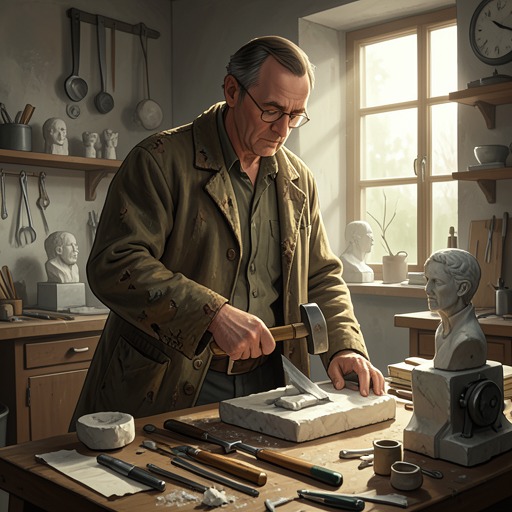
After Goldmund completes the Saint John carving, Niklaus tries to persuade him to settle permanently. He secures a master’s diploma for him through the guild and offers him an associate’s position, with a share in important commissions and the workshop’s earnings. Niklaus’s plan is both professional and familial: he believes Goldmund might become Lisbeth’s husband, and he hopes the young sculptor’s talent will keep the workshop from declining as he himself grows older.
Niklaus prepares for the proposed settlement by planning to enlarge the back workroom for Goldmund, give him an attic room, and provide clothes appropriate to his acceptance into the guild. He quietly gauges Lisbeth’s response. She is not opposed to the match if Goldmund can be persuaded to establish himself as a master; Niklaus’s plan therefore has her conditional acceptance, though the account does not show her pursuing the arrangement herself.
At a dinner to which Goldmund is invited, Lisbeth leaves the room before Niklaus presents his offer. He describes the unusually rapid promotion and comfortable future he has arranged. Goldmund, who had expected a reprimand and perhaps an assistant’s position, is surprised and saddened rather than persuaded. His response signals that the security Niklaus offers cannot make him settle. The projected partnership and marriage consequently remain a future imagined by Niklaus, not a life Lisbeth and Goldmund share.
Plague, Loss, and Return
When Goldmund comes back to the city after the plague, he first hears that Niklaus is dead. He pushes past the household servant and hurries through the darkened house toward the workshop, then calls for Lisbeth in the familiar upstairs room. The scene reverses the earlier impression of a beautiful, carefully protected daughter in a prosperous household: Lisbeth now appears bent, fearful, and much older, wearing a plain black dress, her face marked by illness.
Lisbeth recognizes Goldmund but meets him guardedly. She confirms that her father has died and that the workshop is closed, telling him that anyone seeking work must go elsewhere. Goldmund explains that he has not come to ask for employment. He had wanted to offer his respects to Niklaus and Lisbeth, expresses sorrow, and offers to help if a grateful pupil of her father can be of service. Lisbeth withdraws and declines the offer, saying that neither she nor her father can now be helped by him; the servant is to show him out.
Goldmund later learns from the former landlord’s family what happened. Niklaus did not die of the plague itself: Lisbeth became dangerously ill, and her father nursed her until he died a few weeks before she recovered. Lisbeth survives, but her beauty is gone, and the workshop stands empty. The news makes the cost of her survival inseparable from the loss of her father and the end of the household’s artistic enterprise.
Narrative Role
Lisbeth is seen chiefly through Goldmund’s attention and through the hopes her father attaches to his future. Her limited appearances mark a contrast between the image Goldmund constructs—a beautiful, enigmatic face he would reshape in art—and the vulnerable person he encounters after illness. The proposed marriage also tests the difference between a life of professional stability and Goldmund’s inability to be held by that prospect. By the time he returns, the imagined future has vanished: Niklaus is dead, the workshop is closed, and Lisbeth refuses his offer of assistance. The novel gives no later account of her life.