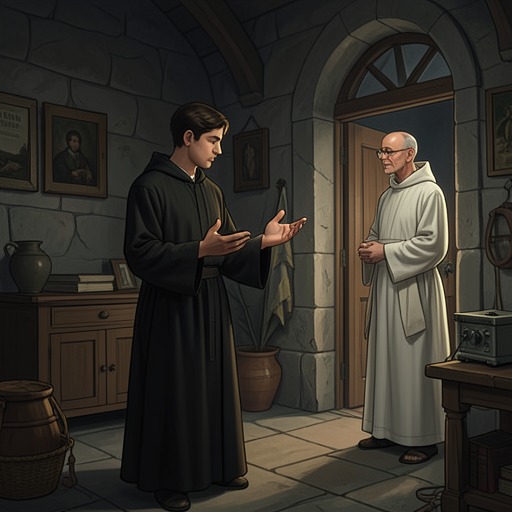
Mariabronn Cloister
Narcissus and GoldmundMariabronn Cloister is a monastery, school, and center of learning whose ordered life gathers many generations beneath one roof. Its stability is embodied by the chestnut tree at the entrance, while the different paths taken by its pupils are reflected in the contrast between Goldmund’s departure and his later return as a sculptor. The institution can accommodate study, worship, administration, and artistic creation; it also insists that obedience and order take precedence over individual judgment.
Setting and Institutional Life
Outside the rounded entrance arch, supported by slender double columns, stands a sweet chestnut brought from Italy many years earlier by a monk returning from pilgrimage to Rome. It is conspicuous among the native trees. It leafs later than its neighbors, flowers around the shortest nights of the year, and drops its nuts in October. The students scramble for the harvest, which Prior Gregory roasts in his room. The tree’s seasonal recurrence gives the cloister a visible continuity, while its foreign origin makes it a fitting image for newcomers who enter and eventually move on.
The people passing beneath it follow markedly different futures. Some boys stay, become novices and monks, and spend their lives reading, teaching, and growing old within the institution. Others finish their studies and return to their families, later entering the world through trades or other pursuits. A few come back as adults with their own sons to enroll. Faces change, but the institution continues to teach and to preserve its work across generations.
Inside, the cloister’s cells, halls, classrooms, and chapels sustain a broad range of activities. Its life includes teaching, learning, administration, and rule, alongside both religious and secular scholarship. Books are written and annotated; old texts are collected and new ones illuminated. Piety and erudition coexist with practical ingenuity and varied intellectual interests. The cloister’s reputation shifts with its leadership and circumstances: it may be associated with exorcism, music, a monk reputed to heal, or the food served in its refectory. This breadth makes it more than a place of seclusion: it is a community in which religious discipline, education, and institutional life continually meet.
Teachers, Authority, and Order
When Goldmund arrives, two figures stand out within the community: Abbot Daniel and the novice Narcissus. Daniel is loved for his kindness, humility, and simplicity, though scholars recognize that he is not himself a learned man: his Latin is modest, and he knows no Greek. Narcissus, by contrast, is a gifted young teacher appointed to teach Greek despite his novice status and against tradition. His scholarship, refinement, and reserve make him admired by many and resented by some.
The cloister’s hierarchy is not merely ceremonial; it determines who may act and whose judgment prevails. Narcissus argues passionately for changes to the teaching of grammar, but Father Lorenz, his superior, opposes them. Daniel hears both men out and recognizes Narcissus’s concern for improving the school. Even so, he tells him to obey his superior: no improvement is worth even a slight disturbance of the house’s order and obedience. The decision makes the institution’s priorities clear. Knowledge and talent can be acknowledged without conferring authority to disregard the chain of command. Daniel’s gentle handling of the dispute also shows his concern for restoring harmony, as he watches the teachers afterward to see whether they have reconciled.
Goldmund’s First Life at the Cloister
Goldmund enters as an adolescent in spring, arriving with his father beneath the still-bare chestnut tree. He notices its unfamiliar beauty, asks what it is called, and introduces himself to the porter, whom he likes immediately. At first, he is a model student and seems intent on scholarly distinction. Though he has no close friend among his classmates, he feels drawn to Daniel and Narcissus, the two men he most admires.
Daniel represents a life of humble service and devotion. Goldmund wishes to remain at the cloister indefinitely, serve the abbot personally, and dedicate himself to God. This intention also accords with his father’s wish and command. Yet his father’s hints about a hidden burden attached to Goldmund’s birth do not persuade Daniel to take on the role the father seems to imagine for his son. The difference between Goldmund’s apparent vocation and his father’s expectation is present from the beginning, even while Goldmund himself believes that remaining in the cloister is his duty.
Narcissus recognizes a kinship beneath their contrasting temperaments. He is a spare, analytical thinker; Goldmund is a radiant dreamer. Their friendship becomes the force that makes cloister life meaningful to Goldmund. When Narcissus tells him that their friendship has reached its immediate goal—awakening him—and urges him to seek his mother’s image, he also makes clear that his own path remains with the cloister. He has taken vows and intends to withdraw before consecration for fasting and spiritual exercises. The distinction is decisive: Narcissus belongs to an established religious order, while Goldmund has no settled goal that can hold him there.
Narcissus’s withdrawal makes that difference tangible. He stops teaching, becomes difficult to reach, fasts, and rises repeatedly during the night for spiritual exercises. Goldmund understands that his friend is still physically present but has entered a world in which their former intimacy cannot continue in the same way. As Narcissus becomes inaccessible, the rest of the cloister loses much of its importance to Goldmund. He revisits its meaningful places and objects—the chapel’s Madonna, the portal’s apostles, the choir carvings, the garden fountain, and the chestnut tree—aware that they are already becoming memories. He then leaves by a secret route he had once used on a forbidden visit to the village, crossing the stream without a bridge. The earlier youthful escapade has become a permanent departure.
The Cloister Beyond Goldmund’s Departure
The institution remains a point of reference even as Goldmund’s life moves into the world. His later training as a sculptor brings him into conflict with settled craft and ownership: Master Niklaus worries about his restless habits and his indifference to money, yet continues to tolerate him because of the exceptional work taking shape in his workshop. When Goldmund completes the Saint John statue, Niklaus tries to secure his future by persuading the guild to grant him a master’s diploma and proposing that they work as associates. Goldmund does not accept that settled future. His departure underscores the persistent tension between the stability offered by institutions and his inclination to keep moving.
On returning to Mariabronn years later, Goldmund sees the place with a changed eye. The church’s vaults, paintings, and figures have not changed, but he now recognizes their beauty and the shared spirit that unites them. He understands the buildings and artworks as creations that have grown from common roots across generations. In this changed perception, the cloister is no longer simply the school he once inhabited: it is a cultural and spiritual whole larger than any individual maker.
Narcissus, now Abbot John, governs that order. Goldmund feels small before the continuity represented by the institution and by its successive abbots: Daniel and John differ greatly in character, yet both serve the same order and give up something of themselves to it. Their enduring friendship draws Goldmund back into the cloister without making him a monk. He confesses to John and receives a month-long penance of moderation and chastity, attendance at early mass each morning, and prescribed prayers each evening. The discipline brings him peace, but it does not replace artistic work.
Instead, Goldmund finds an empty shed beside the courtyard gate and turns it into a workshop. He plans a drawing board and tools, orders materials, selects timber, and builds a roof under which the wood can dry. With Erich, a young man employed at the smithy, he makes the knives, chisels, drills, and planes he needs. The cloister thus provides a setting in which Goldmund can resume creation on his own terms. It offers both a larger order that steadies him and a physical place to work as an independent artist.
Significance
Mariabronn Cloister binds together institutional continuity and individual change. Its chestnut tree, recurring school generations, chain of authority, and inherited works all emphasize what endures beyond one life. Its rules, especially the insistence on obedience, also define the limits of personal freedom within the community. Goldmund’s first departure reveals the cost of trying to live by a vocation that is not his; his return shows that separation need not mean permanent estrangement. He can recognize the cloister’s spiritual and artistic unity, accept the benefits of its discipline, and still preserve the independence that led him away.