Master Niklaus
Narcissus and GoldmundMaster Niklaus is a renowned image-carver whose work gives Goldmund a direction for his artistic vocation, while his cautious, settled life exposes the tension between creative mastery and the freedom Goldmund insists on preserving. He accepts Goldmund without the customary apprenticeship, teaches him through practical work, and comes to recognize in his pupil a rare capacity for sculpture. Their relationship reaches its artistic height with Goldmund’s Saint John, but Niklaus’s offer of a permanent partnership cannot hold the wanderer; when Goldmund returns to the city, he learns that his former master has died.
Identity and Artistic Reputation
Master Niklaus is a sculptor and carver based in the bishop’s city, where he has an established workshop and a strong reputation. A priest introduces him to Goldmund as a gifted, high-minded artist, though not necessarily a saint. The priest also reports that Niklaus’s wooden Madonna has become controversial: some viewers consider it too modern and worldly to be a true image of the Mother of God. For Goldmund, the sculpture is not merely a disputed religious object. Its beauty and expression embody an image he had long sought, and seeing it prompts him to find its maker.
Goldmund first recognizes what may be Niklaus’s hand in a colorful figure of a lansquenet above a doorway, though he judges it inferior to the Madonna. The comparison suggests the range of Niklaus’s public work: the same maker can produce a robust worldly figure and a Madonna whose delicate form and sorrowful expression move Goldmund profoundly. The Madonna becomes Goldmund’s immediate reason for approaching the workshop and asking to learn from its maker.
Goldmund’s Entry into the Workshop
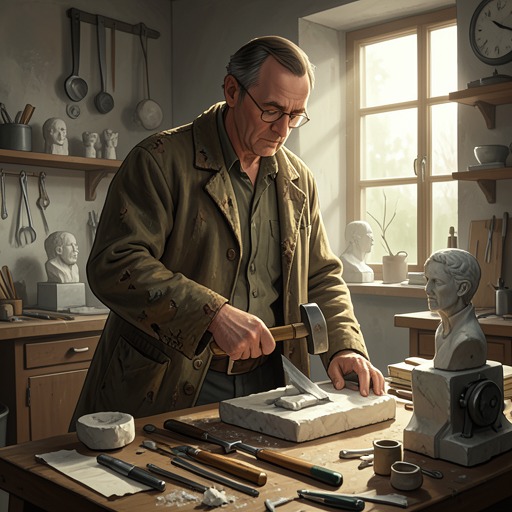
When Goldmund arrives, Niklaus is standing in the workshop wearing a leather apron. He scans the stranger and asks what he wants. Goldmund delivers Father Bonifazius’s greetings, then explains that the Madonna has stirred him and asks to become Niklaus’s pupil. Niklaus listens, but distinguishes eloquent talk about art from the work of making it: in the workshop, he says, what a person can produce with their hands matters more than what they can express in conversation. Since Goldmund has never modeled clay or wax, Niklaus tests him by setting him to draw, giving him paper and charcoal and leaving him to work until he is ready.
The drawing persuades Niklaus to make an exception to the guild’s normal route. He explains that an apprentice customarily studies for at least four years, with the apprentice’s father paying for the training; apprentices usually begin as adolescents and spend part of their term running errands. Goldmund is an adult, already older than many journeymen or masters, and does not seem suited to being ordered about. Niklaus also dislikes keeping an apprentice in his house. These practical and personal reservations do not make him dismiss Goldmund: the drawing has faults, he says, but it is beautiful. He offers to help Goldmund try to become an artist, without a contract or obligation, allowing him to learn in the workshop and leave whenever he chooses.
The arrangement places Goldmund outside the standard guild apprenticeship while still bringing him into sustained contact with the craft. Niklaus’s judgment rests on the work rather than on a formal credential: he is willing to take the risk because he sees artistic promise in the drawing. Goldmund, who briefly mistakes Niklaus’s explanation of guild custom for a refusal, is ashamed and moved when he understands that the master is offering him a chance.
A Demanding Teacher and a Complicated Household
Niklaus is not an uncomplicated model for Goldmund. Goldmund reveres the sculptures, especially the Madonna, but does not love the sculptor as he loves Narcissus. He sometimes takes pleasure in irritating or disappointing him. The difference between artist and artwork matters: Niklaus’s best figures seem to Goldmund to embody deep experience and intuition, yet the master himself is not a model for the life Goldmund wants.
In Goldmund’s perception, Niklaus contains two contrary selves. He is the seer whose hands transform experience into tangible form, and also a stern, fearful father and guildsman who has settled into a moderate, respectable existence. A widower, he lives quietly with his daughter Lisbeth and an unattractive servant, resists Goldmund’s strongest impulses, and keeps his domestic life private. Goldmund observes that Niklaus rarely goes out or invites guests, and that he protects his beautiful daughter with a jealous attentiveness. He also sees that Niklaus’s restraint is not simple freedom from desire: when work takes him away from home, the master can seem renewed, and Goldmund once observes him secretly visiting a sex worker during a stay in another town. The contrast intensifies Goldmund’s mixture of admiration, suspicion, affection, and resentment.
Niklaus, for his part, has reason to find Goldmund difficult. He knows of the young man’s indifference to money and property, his wish to spend freely, his love affairs and brawls, and his attraction to Lisbeth. Goldmund’s life is far removed from the order Niklaus has built. Yet the master keeps teaching him, despite scoldings and fits of anger, because he watches the Saint John taking shape. Goldmund works slowly and unpredictably, but Niklaus trusts that he will finish a figure unlike anything his assistants can make. The sculpture gives the master a reason to remain patient with the unruly pupil.
The Saint John and Recognition
Over the course of a year, Goldmund becomes a capable draftsman and is sometimes allowed to model in clay. His first successful piece is a small figure of Julie, Lisbeth’s sister, which Niklaus praises but considers too worldly to sponsor for casting in metal. Goldmund then begins a wooden Saint John for a crucifixion group commissioned for Niklaus’s workshop. The figure portrays Narcissus, and Goldmund approaches it with a different seriousness from his more distracted work. Love affairs, drinking, dice, and fights may draw him away from the bench, but when he is ready to work on the Saint John, he returns to it with devotion and humility. In the act of carving, he feels that the image of Narcissus is being brought into lasting form through his hands.
Niklaus does not often comment on the work as it develops, but his silence is not indifference. When Goldmund finally invites him to look, the master examines the completed figure closely. His stern expression lightens, and he tells Goldmund that the piece is very good. He announces that Goldmund has finished learning and that he will present the statue to the guild and demand that Goldmund be made a master. Goldmund does not value the guild highly, but he is glad of Niklaus’s recognition.
Niklaus’s response joins artistic judgment to professional advancement. He has previously made room for Goldmund’s exceptional circumstances by teaching him without a formal contract; now he is prepared to use the guild’s authority to recognize the achievement that the ordinary apprenticeship system did not produce. His praise also carries personal weight: he sees in Goldmund’s Saint John a work neither of his assistants could have made, and he does not let the pupil’s unreliability erase the evidence of his talent.
The Offer, Departure, and Death
After the Saint John is finished, Niklaus tries to give Goldmund a permanent place in the workshop. He persuades the guild to issue him a master’s diploma and plans to make him an associate rather than a subordinate, sharing important commissions and their earnings. Niklaus is growing older, believes his own creative force is waning, and fears that his famous workshop could decline into ordinary craftsmanship. Goldmund’s sculpture convinces him that the younger artist could preserve its distinction. He considers enlarging the back workroom for Goldmund, giving him an attic room, and providing new clothes for his acceptance by the guild. He also quietly tests Lisbeth’s feelings about a possible marriage; she would not oppose Goldmund settling down.
The offer would connect artistic opportunity to economic security, guild status, and a household in which both Niklaus and Lisbeth hope Goldmund might remain. But Goldmund has decided to leave before he knows the details. He thanks Niklaus for his goodwill and patience, then tells him that he will not stay: he must travel and be free. Niklaus turns pale and looks at him darkly, but Goldmund insists that his decision cannot be changed and asks for a friendly farewell. The departure marks the limit of Niklaus’s influence. He can recognize Goldmund’s ability and open professional doors, but he cannot make the artist accept a settled life.
Goldmund later returns to the city during the plague and finds the old household altered. A former landlord tells him that Niklaus did not die of the plague itself. Lisbeth caught the disease and lay gravely ill for a long time; Niklaus nursed her until he died, only a few weeks before she recovered. She survived, but her beauty had been lost. The workshop stood empty, and the landlord suggests it could become a good home for a skilled carver. For Goldmund, however, the possibility of returning to Niklaus’s workshop comes too late: the master who had recognized and trained him is dead.
The death changes how Goldmund encounters Niklaus’s legacy. Later, while planning the carved lectern for the refectory at Mariabronn, Goldmund intends one of its evangelist figures to preserve Niklaus’s likeness. When he completes the figures, he is dissatisfied with the statue bearing the master’s features, even though Erich admires it most. To Goldmund, it expresses discord and sadness, lofty creative ambition shadowed by an awareness that creation cannot restore a lost unity or innocence. Niklaus thus persists in Goldmund’s art not as a simple image of mastery, but as a remembered person whose discipline and artistic power remain inseparable from the limits of the life he chose.