Rebekka
Narcissus and GoldmundRebekka is a Jewish survivor of persecution during the plague who encounters Goldmund while mourning her murdered father. Their brief meeting brings together a concrete act of anti-Jewish violence, the limits of Goldmund’s attempted aid, and his later effort to preserve what he has witnessed through art. She refuses to let his sympathy erase the injustice behind her loss, and her accusation forces him to see the distance between intending kindness and recognizing the position from which he speaks.
Identity and Circumstances
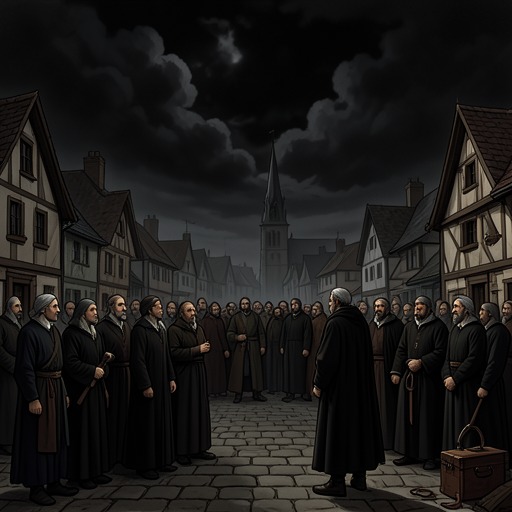
Goldmund finds Rebekka outside a small town, crouched beside rubble and grieving her father. Town authorities have ordered the burning of her father and fourteen other Jews. She had escaped, but returned in anguish, reproaching herself for not having died with them. The outbreak of plague has intensified fear and scapegoating, but her father’s death is not merely one more anonymous loss: it is a targeted act of collective violence carried out under local authority.
The narrative presents Rebekka in a state of acute bereavement, not as someone ready to be rescued into a new life. Goldmund sees her distress and offers practical help; she asks him to help bury her father. Together they collect the bones from the still-warm ashes, carry them to a concealed place in the field, and cover them with earth. This burial is the immediate purpose of their encounter, and the work of mourning gives their contact a gravity that Goldmund’s later courtship fails to respect.
The Encounter with Goldmund
After helping with the burial, Goldmund arranges a place for Rebekka to sleep in a small oak wood and stays nearby while she grieves. In the morning, he tells her she cannot safely remain alone: she could be recognized as Jewish and killed, or exposed to other dangers on the road. He offers to take her with him and protect her. His offer combines concern for her safety with his attraction to her, and he begins to court her before she has left her mourning behind.
Goldmund tries to promise that he will not touch her and that she can choose when, or whether, to be happy. Rebekka rejects the premise. She says she wants pain, not joy, and tells him that Christians have first helped her bury a father whom their people murdered, only for the daughter to be expected to become their lover. Her rebuke identifies the unequal terms hidden inside Goldmund’s offer: he imagines himself as protector and admirer, while she sees a Christian man turning her vulnerability into an opportunity for intimacy.
Her refusal does not soften when Goldmund argues that death and misery are everywhere and that they should be kind to one another while they can. He falls silent when he realizes that argument cannot reach her. In the hatred and grief in her eyes, he recognizes not simply an awareness of death but a wish to be allowed to die. He admits that he is not a good person, asks her forgiveness, and bows deeply before walking away. The scene ends not in reconciliation or rescue but in his acceptance that he cannot make her accept his help.
Loss, Witness, and Responsibility
Rebekka’s father’s death becomes part of the larger record of plague-era violence that Goldmund carries with him. In a town he passes, he watches the ghetto burn, with a mob forcing people who try to escape back into the fire. The persecution of Jews is one element in a wider search for scapegoats during the epidemic, but the particular fate of Rebekka and her father gives that violence a human face and a survivor’s point of view.
When Goldmund later speaks with Narcissus, he tells Rebekka’s story in detail and grows passionate as he recounts it. He connects it with the burned Jews, mass burials, abandoned children, starved dogs, and the other horrors he has witnessed, asking what kind of world permits such suffering. Narcissus reminds him that he himself did not prevent the burning of Jews. That challenge exposes a limit in Goldmund’s moral outrage: he can witness, grieve, and condemn, but his encounter with Rebekka does not show him intervening to stop the broader violence. His departure from her likewise leaves her fate unresolved rather than transforming his offer into a successful rescue.
Memory and Artistic Afterlife
Goldmund remembers Rebekka for days and dreams of her after leaving. Her image becomes entangled with his recollection of Lydia, another woman whose love he associates with suffering. In this comparison, Rebekka remains distinct: her refusal and her grief arise from the murder of her father and from her distrust of a Christian man who approaches her in the wake of that crime.
The encounter also intensifies Goldmund’s sense that the images he has witnessed can be carried into art. When he returns to the city, he draws Rebekka repeatedly, including her sorrow and indignation. She is among the many faces and scenes from the plague journey that fill his drawings; their preservation in his work does not undo the violence or resolve her loss, but it gives the encounter a continuing place in his memory. Rebekka thus remains more than an object of Goldmund’s artistic attention: her accusation continues to test the moral meaning of his compassion and the distance between turning another person into an image and answering to her suffering.