Refectory Lectern and Its Carvings
Narcissus and GoldmundThe Refectory Lectern and Its Carvings is Goldmund’s major work for the refectory at Mariabronn: a two-part wooden ensemble planned around a spiral staircase and a reading stand, with creation and the lives of sacred figures brought into the monastery’s daily setting. The work is both a practical furnishing for readings during meals and an artistic world in its own right. Its design gathers natural forms, religious instruction, personal memory, and the different ways Goldmund and Narcissus understand knowledge.
Purpose and Place
Goldmund’s first commission at Mariabronn was intended as a contribution for the monastery that had given him hospitality. He did not want to produce an arbitrary object that could be placed anywhere merely to attract attention; the work had to fit the house’s existing art, architecture, and life. An altar or pulpit appealed to him, but neither was needed or had space available. Instead, he chose the raised niche in the refectory from which a young brother read passages from the lives of saints during meals. The niche itself was bare, making the reading place the natural site for an integrated sculptural work.
Goldmund proposed carved panels for the steps leading to the lectern and for the lectern itself, comparable to the panels around a pulpit. The figures were to range from half-relief to forms almost fully in the round. He explained the plan to Abbot Daniel, who approved it. The choice linked the ensemble to an actual communal practice: the carvings would surround the place where sacred lives were read aloud while the brothers ate.
Design and Imagery
The plan divided the work into two related parts, the world and the word of God. The lower portion, formed by stairs winding around a sturdy oak trunk, would represent creation. Goldmund envisioned images of nature and scenes from the simple lives of the patriarchs and prophets. Above, the parapet would carry the four evangelists. The scheme thus moved upward from the created world, embodied in the tree and its surrounding life, to the figures associated with the Gospels.
As the work advanced, the spiral stairs became the setting for a small, surging world of creatures, plants, animals, and people. Noah stood among grape leaves and grapes. The ensemble was conceived as a praise of creation and its beauty, yet its freedom of expression was held within what the narrative calls an inner order and discipline. Its abundance was not simply decorative: natural life and sacred history occupied a single continuous structure, so that the refectory’s reading place joined the visible world to religious meaning.
The evangelists gave that larger design a personal and commemorative dimension. Goldmund assigned the features of Abbot Daniel to one figure, those of Father Martin, Daniel’s successor, to another, and those of Master Niklaus to Luke. The statues therefore carried the likenesses of men who had shaped different parts of Goldmund’s life: the abbot who received him, his successor, and the master who had instructed him in sculpture. The identities represented in the wood made the work at once an image of religious tradition and a record of personal bonds.
Making the Ensemble
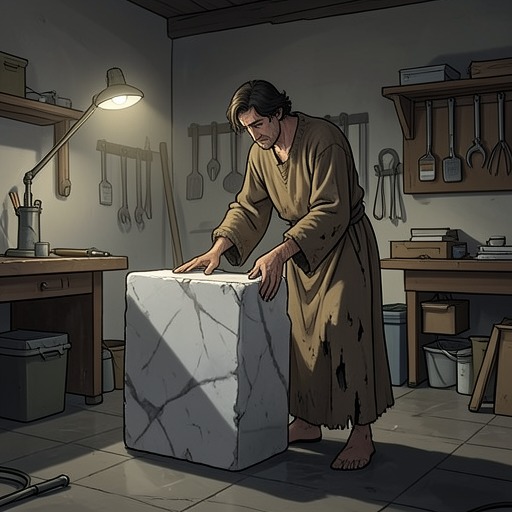
Goldmund prepared a place and materials for the labor before he began carving. He found an empty shed beside the courtyard gate that could serve as a workshop, ordered a drawing board and tools from the carpenter to his own specifications, and listed materials for the cloister carters to bring from nearby cities. He inspected felled timber at the carpenter’s and in the forest, chose the pieces he wanted, and stacked them on the grassy ground behind the workshop beneath a roof he built himself. At the forge, he worked with the blacksmith to make the cutting knives, chisels, drills, and planes required for the project.
Once the work began, Goldmund withdrew from much of the monastery’s ordinary social life. He took meals at the mill, admitted no one to the workshop except his assistant Erich, and sometimes worked in silence even when Erich was present. The carving advanced over two years. Erich was initially allowed to assist with small tasks; from the second year he was formally given to Goldmund as an apprentice. The work’s long duration depended on this close, selective routine, but Goldmund’s periods of solitary labor did not make the project an isolated undertaking: Erich helped it grow, and Narcissus came to see the statues as they took shape.
Goldmund experienced the work as difficult and absorbing. Its obstacles worried him, but he also welcomed them, treating each resistance as a lesson that made him more perceptive. The carving occupied him so fully that he nearly forgot the monastery and, for a time, Narcissus. His bouts of restlessness could still draw him out of the workshop into the countryside; after a day or two, he returned and resumed the work with renewed concentration. The project’s disciplined completion therefore emerged not from an unbroken temperament but from repeated returns to the wood.
Abbot Daniel and Recognition
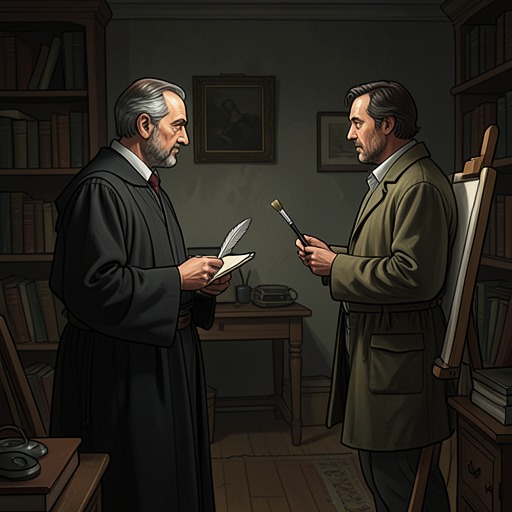
The figure bearing Abbot Daniel’s features became the first evangelist Goldmund showed to Narcissus. He hid the other statues and placed this one alone in the light, then waited until his friend could come to the workshop. While Narcissus examined it, Goldmund feared that the work might fail to communicate either its artistic achievement or the meaning of their shared past. Narcissus recognized Abbot Daniel at once, but what he recognized was more than an individual likeness: the statue brought back the dignity, kindness, and simplicity that Daniel had represented to them in their youth.
Narcissus told Goldmund that the statue had also revealed the sculptor himself to him. He understood the gift as both the return of Abbot Daniel and an opening of Goldmund’s inner life. The scene makes the carving an act of communication that does not depend on theoretical explanation. Narcissus disclaimed expertise in art, yet his response showed that he could read the work through memory and affection; Goldmund’s sculpture made visible what their friendship had not previously brought fully into words.
The other evangelist portraits carried more unsettled meanings. Goldmund felt especially successful with Daniel’s image, whose face expressed kindness and purity. He was less satisfied with the statue of Master Niklaus, although Erich admired it most. That figure seemed to Goldmund to combine ambitious creative purpose with awareness of creation’s limits, and to mourn a lost unity and innocence. The contrast between the two works gave the ensemble emotional range: the abbot’s image affirmed a remembered moral presence, while Niklaus’s bore the tension between artistic aspiration and the knowledge that making cannot recover an unbroken past.
Art, Faith, and the Work’s Significance
The ensemble developed alongside a change in Narcissus’s understanding of art. In an earlier view, he had treated art as less serious than thought and science, because he believed that the mind rose toward the eternal while matter bound human beings to transience. Watching Goldmund’s figures emerge from the wood altered that judgment. Narcissus came to recognize that the sensory path could reach the secret of being as deeply as intellectual inquiry and express it more vividly than most thinkers could. The carvings thus did not merely decorate the refectory; they helped make visible the difference between the friends’ approaches to knowledge and the possibility of honoring both.
Goldmund’s creation also gave the monastery’s architectural and devotional setting a new focal point. The bare niche became a structured image of creation and sacred history, integrated with the meal-time reading it framed. Its figures drew on the natural world, biblical narratives, and remembered people, while its intended use kept the art within communal life rather than apart from it. Through the Refectory Lectern and Its Carvings, Goldmund brought his unruly, sensuous responsiveness to the world into a form ordered for the monastery—and gave Narcissus an artistic language through which to recognize both his friend and the knowledge carried by the senses.