The Black Death sweeps through German lands
Narcissus and GoldmundThe Black Death sweeps through German lands as both a public catastrophe and a decisive trial of Goldmund’s way of seeing. The epidemic empties homes, interrupts travel, and turns fear into social violence; Goldmund encounters its dead and its survivors with a fascination that unsettles his companions, while his care for particular people exposes the ethical cost of treating suffering as spectacle.
Spread and Recognition
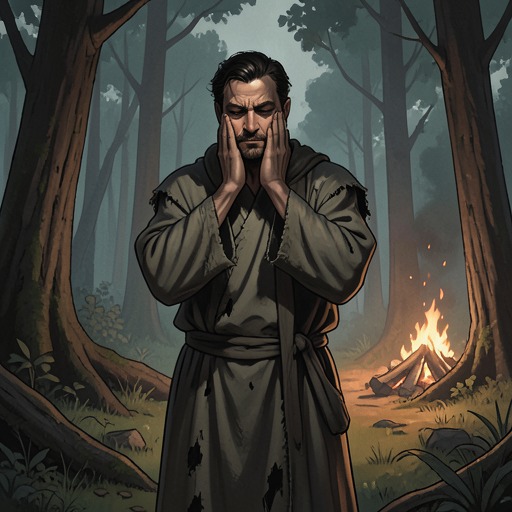
The danger first interrupts Goldmund and Robert’s journey at the edge of a village. Peasants armed with cudgels, poles, and flails threaten them and drive them away; Robert runs, while Goldmund stops to ask why strangers are being refused. The next morning, their discovery at an isolated farm supplies a terrible answer. The homestead is silent except for a cow left unmilked, and inside Goldmund finds the entire family dead. When Robert recognizes the signs and names the plague, he fears that Goldmund has been infected and tries to flee. Goldmund holds him back: if they share the danger, he insists, they must face it together rather than leave one another to die alone.
As the two continue, the disease is present in different forms from place to place. Some villages bar strangers; elsewhere the travelers pass through streets without obstruction. Farms stand deserted, bodies remain unburied in houses and fields, and livestock wander or starve. Goldmund and Robert milk and feed animals, kill some for food, and use provisions left behind in empty cellars. The abundance does not make their journey easy: Robert remains convinced he may have caught the disease, repeatedly examines himself for swellings, and uses campfire smoke as a supposed preventive. Goldmund mocks his fear but does not share it.
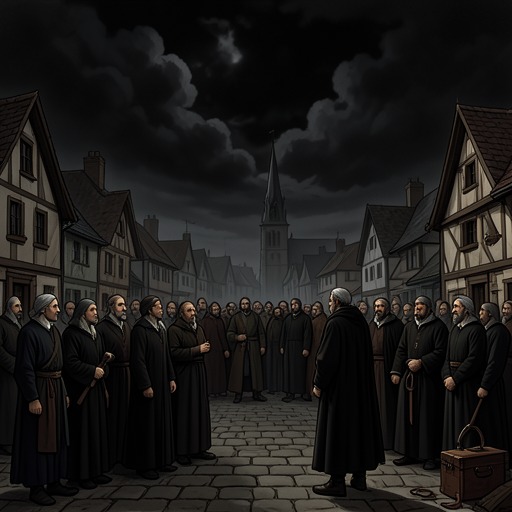
At a fortified town, the scale of death becomes public and organized. No sentinel guards the open gates; instead, a priest carrying a cross emerges behind three carts piled with corpses, accompanied by hooded men. Goldmund follows them to a vast pit on a deserted heath. The men unload the bodies with staffs and boat hooks, the priest blesses the dead, and fires are lit around the grave before the workers return to the city. Goldmund sees at least fifty bodies in the pit, many uncovered, with limbs raised above the heap. Robert cannot bear to remain, but Goldmund goes on alone into the town, drawn toward the very horror his companion wants to escape.
Death as Witness and Image
Goldmund’s attention to death begins with the farmhouse family. He studies the dead not as an indistinct mass but as separate figures whose postures suggest different encounters with the end: the parents in bed, the old woman still seated, and the boy lying across the threshold. The child’s clenched hands and position at the doorway make visible an unavailing struggle; a cat hole has been cut into the door beside him. The sight repels and attracts Goldmund at once. He gives himself to close observation, combining compassion for the dead with the artist’s impulse to attend to form and detail, while Robert’s anxious calls go unanswered.
The contrast between the men becomes a measure of the epidemic’s effect on their relationship. Robert fears contamination and recoils from the corpses; Goldmund believes that death in the hut is not a fate reserved for plague victims but an end awaiting everyone. During their travels, Robert’s dread repeatedly returns, while Goldmund walks through the stricken country absorbed by what he sees. He sometimes helps with practical needs, including feeding abandoned animals and carrying or covering the dead, but he also seeks out scenes of suffering rather than turning away. The plague thus intensifies a trait already central to his character: his wish to look steadily at experiences others cannot face.
A painted Dance of Death in a cloister gives Goldmund another way to understand what he has witnessed. The fresco shows Death leading people of every rank—including a king, bishop, abbot, knight, doctor, and peasant—toward the same end, accompanied by skeletal musicians. Goldmund recognizes the painting as an effective lesson in the inevitability of death, but feels that its severe, skeletal image does not capture the whole of his experience. For him, death is not only a judge or executioner: it also carries a maternal and intimate aspect, a return-call that can make the remaining light of life seem more vivid. The fresco therefore sharpens rather than resolves his response to the epidemic, renewing his desire to return to Master Niklaus’s city and artistic work even as new encounters delay him.
Social Breakdown and Persecution
The epidemic destroys more than households. Goldmund sees parents abandon sick children and husbands abandon sick wives; frightened people avoid one another, while others gather in feverish attempts to drink, dance, and seize pleasure. Some survivors mourn or curse outside cemeteries and empty houses. Amid this disorder, people search for someone to blame, accusing supposed criminals of spreading disease through corpses, wells, walls, or cattle. The suspected may be killed by legal authorities or by mobs. The account presents such accusations as products of collective misery and fear, while making clear that they turn uncertainty into a pretext for violence.
Jews become among the most vulnerable targets. In one town Goldmund watches the ghetto burn while a mob drives those trying to escape back into the flames. Elsewhere he meets Rebekka, who has returned to mourn after her father and fourteen other Jews were burned by order of the town’s authorities. She had escaped, but grieves that she was not killed with them. Goldmund helps her gather her father’s bones from the ashes and bury them in a hiding place in the field. His aid is concrete, but the encounter also exposes the limits of his understanding: he initially turns from burial toward courtship, and Rebekka condemns the Christians whose people murdered her father. Goldmund accepts that her accusation has force and asks her forgiveness.
Later, in conversation with Narcissus, Goldmund tells Rebekka’s story in detail and asks whether the world in which such things happen is hellish and revolting. Narcissus agrees that it is. The exchange connects the epidemic’s social violence to the novel’s larger question of suffering and evil: the plague does not merely kill indiscriminately; fear and existing hostility determine who is abandoned, accused, or attacked. The episode also recalls Goldmund’s own admission that he saw Jews burned without preventing it, a fact Narcissus uses to challenge his moral certainty.
Goldmund’s Passage Through the Plague
Goldmund has little fear of the epidemic itself. He distinguishes plague from dangers against which a person can fight, recalling the earlier mortal danger he survived at the hands of Viktor. Plague, by contrast, cannot be resisted in the same way; in the narration, Goldmund has already surrendered to its possibility. After leaving Lene behind, he seems less attached to preserving his own life, yet remains awake and indefatigable, driven by curiosity and a desire to witness the world’s extremity. He moves among empty houses, desperate revels, the dying, and the dead, sometimes finding food or shelter and sometimes helping in exchange for a meal or a few coins.
This journey is not simply a record of exposure. Its episodes test the difference between looking at suffering and responding to it. Goldmund’s attention can produce care, as when he restrains Robert from fleeing and helps Rebekka bury her father; it can also become so absorbed in observation that he neglects the needs or feelings of those around him. Rebekka’s rebuke makes that tension explicit. The plague’s scale invites a universal vision of mortality, but her grief insists on the irreducible particularity of the person killed and the community responsible.
The Black Death consequently alters both the landscape of Goldmund’s travels and the terms of his reflection. Abandoned farms, unburied bodies, mass graves, and the burning ghetto reveal a society where ordinary protections have weakened and fear can become persecution. Against that collapse, Goldmund’s recurring acts of companionship and burial are small but consequential. His journey through the epidemic leaves him with a vision in which death is at once collective destruction, intimate loss, and an image that the artist seeks to comprehend without being able to undo it.