The Mystery of True Art
Narcissus and GoldmundThe Mystery of True Art is Goldmund’s name for the quality that lets an image exceed its precise visible form and open onto possibilities the viewer can sense but never fully define. In his reflection beside a river, he distinguishes this mystery from technical perfection: a work may be beautiful and exact yet disappoint if it promises the highest and cannot fulfill that promise. His artistic ambition is therefore not simply to carve with precision, but to give visible shape to a mystery he recognizes in dreams, in fleeting appearances, and above all in the universal mother.
The River as an Image of Mystery
After finishing an important piece of work, Goldmund leaves dissatisfied with Master Niklaus’s kindly offer to discuss his future in a few days. He goes instead to a shallow stretch of river whose bed is strewn with shards and discarded objects left by fishermen. Sitting on the embankment wall, he watches through the moving water for indistinct glints: perhaps a broken plate, a worn sickle, a smooth stone, a polished tile, or a fish turning below. Their attraction lies partly in the fact that he cannot tell exactly what he sees. The river offers glimpses, not complete disclosures.
Goldmund makes this uncertainty a principle of perception. True mysteries and images of the soul, he thinks, have no precise contour; they can only be guessed at, as beautiful possibilities veiled in multiple meanings. A half-seen human profile may promise beauty and sadness at once, while a lantern beneath a cart can cast enormous revolving wheel-shadows that seem to contain a whole store of stories. Dreams, too, belong to this insubstantial medium: they appear as nothing, yet hold the ready possibilities of human, animal, angelic, and demonic forms. The river is not merely scenery in his meditation; its fleeting lights give him a model for how an image can suggest more than it shows.
The vision also recalls a youthful discovery at Mariabronn, where Goldmund saw comparable transformations in Greek and Latin letters and once discussed them with Narcissus. The memory makes the distance from his former companion feel immense: he longs to see Narcissus, speak with him, and hear his calm, intelligent voice, and says he would willingly give his two gold pieces for that encounter. Mystery thus joins artistic perception to memory and longing; the unseen is compelling partly because it cannot be possessed outright.
Mystery and Artistic Form
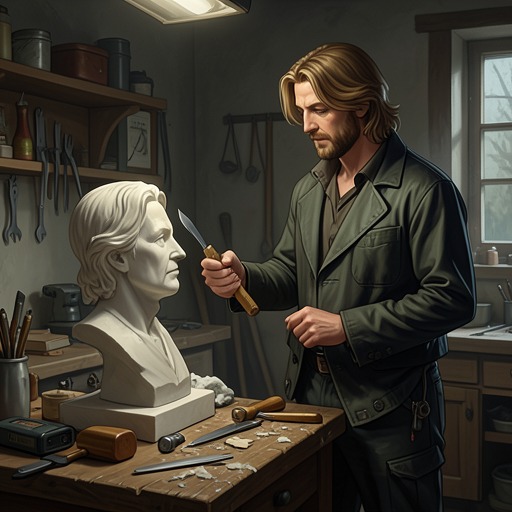
The river’s shifting shapes lead Goldmund to a contrast between two kinds of beauty. Underwater glimmers are indistinct and formless, while a carved figure has an exact, definite outline. He could retrace down to a fraction of an inch the underlip and eyelids of Niklaus’s Madonna; in such precision there is nothing vague or deceptive. Yet exactness alone does not account for the way either a form or a formless appearance can move the soul. Goldmund is trying to understand how these apparent opposites can produce a related depth of feeling.
That question explains his dissatisfaction with many polished works he has encountered in workshops, churches, and palaces, including some to which he contributed. Their beauty does not save them from feeling fatal, boring, or deeply disappointing: they awaken desire for the highest but do not satisfy it. For Goldmund, their failure is not a lack of finish. It is the absence of mystery, the quality that makes a work more than a clearly rendered object and gives its form inward reach.
He consequently places dreams and truly great art together, not because art should remain shapeless, but because both can contain more than their immediate appearance. His own craftsmanship gives him a measure of exactness, while the river teaches him that exact definition is not the same as fullness. The artistic problem is how to make form carry mystery without reducing it to a merely illustrative detail or dissolving it into vagueness.
The Universal Mother as a Possible Form
Goldmund identifies the universal mother, the great birthgiver, as the image in which he has seen mystery beginning to take shape. Her significance cannot be located in a single feature—neither a particular degree of voluptuousness or sparseness, coarseness or delicacy, power or grace. It lies in the fusion of the world’s greatest contrasts, which elsewhere cannot be reconciled but coexist in her: birth and death, tenderness and cruelty, life and destruction. Her image matters because it can hold these tensions together rather than resolve them by choosing one side.
Goldmund insists that this figure is not an idea he invented. He has seen her, and she lives within him, returning at intervals after periods when she remains remote. He recalls a winter night in a village when he was asked to hold a light over the bed of a peasant woman in labor; there the image came alive. The experience connects the mother figure to birth as a witnessed event, while his recollection of his own mother gives the image a deeply personal source. The memory of the mother he loved most has transformed into the larger figure, lying within it like the pit within a cherry.
The image therefore joins private memory to an expansive artistic vision. Goldmund does not claim to have completed it as a work, nor does he know whether he will ever be able to give it material form. He considers that it may remain a dream, an intuition, or a golden shimmer. Yet its incompleteness does not make it meaningless: its continuing pull gives direction to his life and to the art he hopes to create.
Artistic Vocation and the Unfinished Image
As Goldmund recognizes his situation, he is afraid to decide what to do next. The choice recalls the difficulty of leaving Narcissus and Mariabronn: once again, he understands himself to be at the beginning of an important road, now the road toward his mother. The uncertainty is not incidental to his idea of art. If mystery cannot be reduced to a definite contour, then the image’s future cannot be guaranteed in advance by a settled plan or a promise of success.
Still, Goldmund knows that he feels alive when he travels toward the mother image and allows himself to be drawn by it. Perhaps making her visible to others is his goal, or perhaps she will remain an inward possibility beyond his ability to carve. The passage leaves that question open while making his commitment clear: he must follow her and submit his fate to her, because she is his star. True art, in this account, is neither mere technical precision nor an escape from form. It is the attempt to embody a mystery whose force depends on its capacity to hold opposites and remain larger than any single, finished explanation.