The Wanderer's Homeless Life
Narcissus and GoldmundThe Wanderer's Homeless Life is both a condition of material exposure and a way of apprehending existence. Goldmund experiences it as freedom from roofs, ownership, and human authority, but that freedom cannot be separated from hunger, cold, uncertainty, and the ever-present prospect of death. The tension is especially consequential for him because the wanderer’s instinctive life draws him toward nature, while his artistic mind seeks to preserve what nature continually changes.
A life without shelter or fixed time
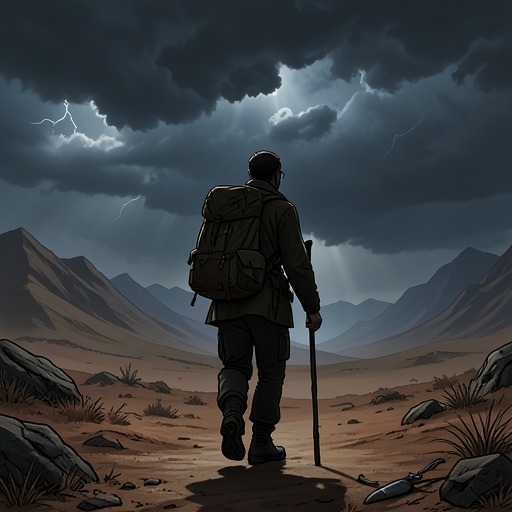
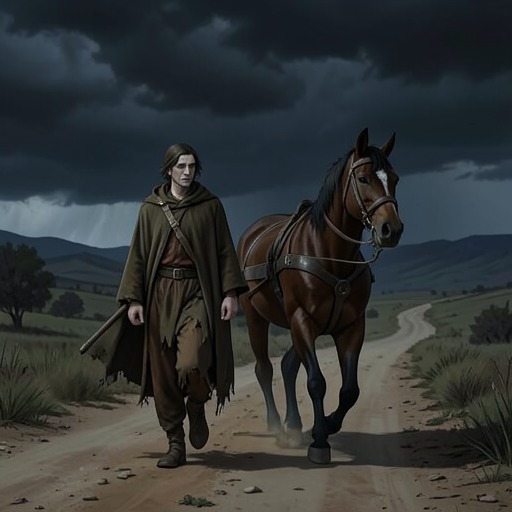
The wanderer’s life is defined by the absence of a home, a destination, and possessions. Its rhythms depend on weather and season rather than a settled schedule; each day brings whatever comfort or hardship happens to arrive. The passage imagines wayfarers as childlike and exposed, living close to elementary needs and accepting circumstances as they come. Their existence is not organized around ambition, history, or progress, ideals associated with people securely established as proprietors.
This freedom is never presented as comfort without cost. After leaving the knight’s household, Goldmund knows he can seek a night’s rest in a barn belonging to the knight or at a farmhouse where he is known, but those possibilities offer only provisional refuge. On a snowy winter day, the open world feels harsh and materially threatening. Cold and the need to find shelter take precedence over reflection: survival means reaching somewhere for the night without giving out in the fields. His sense of detachment returns, yet carries the unmistakable prospect of hardship and want.
Exposure, fear, and the natural world
A night spent with Viktor makes the emotional cost of homelessness unusually clear. While Viktor sleeps on a bed of pine branches beneath a simple windbreak, Goldmund keeps watch and feels himself exposed to the surrounding world. The night intensifies his sense of being alone without a house, castle, or cloister wall between him and fear. The passage places his living heartbeat against the silence and the watchfulness of animals and trees, making shelter’s absence feel existential as well as practical.
Goldmund recognizes that Viktor’s manner of enduring this life cannot become his own. Viktor meets hardship with jokes, brazen humor, and a shrewd ability to get by; Goldmund doubts that he could learn that defense, even if he wandered all his life. He imagines that he may eventually return behind some kind of wall, but knows that a building would not make him feel entirely protected. The world would still surround him with mystery and unease, and its silence would still make him conscious of how fleeting his life is.
Instinct, art, and contradiction
The narrative presents wandering as a return to a primal, pre-social condition: the wayfarer is likened to a child of Adam, an exile from Paradise and a brother to animals. This figure stands in opposition to the established proprietor, whose security depends on distinctions of ownership and whose fear of the wanderer arises partly from what that way of life reveals: existence is transient, and death surrounds it. Wandering thus challenges more than property. It exposes the fragility that settled life can obscure.
Goldmund has been deeply shaped by this instinctive, open existence, but it does not exhaust him. He is also an artist, and the coexistence of these dispositions makes his life difficult as well as rich. The passage frames life through such contradictions: reason gains meaning alongside intoxication, sensuality against the knowledge of death, and love against the conflict between the sexes. Wandering brings Goldmund close to the immediate, bodily conditions of life, while his reflective and artistic capacity prevents him from simply dissolving into them.
Passing seasons and the artist’s response
The span of Goldmund’s wandering is marked by seasons that recur and pass quickly: summer gives way to autumn; he struggles through bitter months and moves through spring; high summer sun descends again. Years pass as hunger, love, and the seasons seem to occupy his attention. The repetition conveys a life with no settled historical destination, but it also gives his days a pattern of ceaseless change.
At moments of rest or in dreams, Goldmund’s attention changes. Looking over a valley in flower or decline, he becomes wholly absorbed in seeing. The artist in him longs to halt life’s graceful but aimless drift and transform it into meaning. Homelessness therefore has a double significance: it exposes Goldmund to the transience he cannot escape, while also supplying the intense observation from which his art can arise. The wish to make sense of passing life does not cancel the wanderer’s uncertainty; it is a contrary impulse living within it.