The Wordless Language of Love
Narcissus and GoldmundThe Wordless Language of Love names the bodily and intuitive communication Goldmund discovers in intimacy: desire and recognition can pass through a look, a voice, a scent, a touch, or a shared silence before either person gives them words. The idea takes shape beside his friendship with Narcissus, whose life is disciplined by prayer and thought, and recurs in Goldmund’s encounters with women. It does not make speech worthless; rather, it reveals what speech cannot accomplish by itself, and why the wish to speak persists even where love seems to need no words.
Emergence beside Narcissus
Goldmund’s understanding begins in a sharp contrast. He has come to Narcissus with his heart full of a new love, while Narcissus is exhausted by fasting and vigils, preparing himself for a night of prayer. Yet the ascetic listens with lucid sympathy, surrendering a little of the rest allowed between penances to his friend. Goldmund recognizes this as a kind of love unlike the sensual happiness of the sunny field, but no less real. The two forms coexist without becoming the same: Narcissus offers a spiritual, self-denying attentiveness; Goldmund is drawn toward warmth, touch, and bodily delight.
That difference marks a change in their friendship as well as in Goldmund’s account of intimacy. He realizes that Narcissus is no longer his superior guide and awakener. He must find his own roads, and the knowledge brings both relief at leaving the dependence of his student days and pain at parting from the friend whose help he can no longer repay. When Goldmund calls to Lise in the dark, the exchange is an owl call answered from downstream. He thinks of lovers calling to one another like animals: after the afternoon’s caresses, they had exchanged almost no words, and those few came only at the end and meant little.
The body as a language
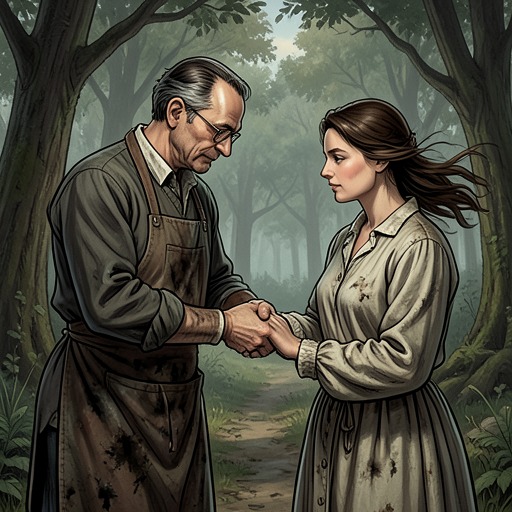
Lise’s meeting with Goldmund turns that insight into movement. She emerges from the forest; he reaches out to find her head, hair, neck, waist, and hips. They walk without asking where they are going, and she leads him confidently through the night, past roots and brambles, to a clearing, a meadow valley, and a small creek. The scene presents understanding not as a conversation but as shared bodily orientation: she knows the way, while he follows. He leaves behind, for the time being, both the cloister and thoughts of Narcissus, entering what he experiences as a blind, secret, wordless country.
After another encounter, Goldmund considers how the farmer’s wife had invited him to meet her. Her few words had named the place, but he believes the invitation was conveyed more fully through her eyes, the intonation of her slightly thick voice, and a subtle emanation of the skin. He has already accepted her offer to bring food to the hay behind the long barley field, where it will not be gathered until the next day. His anticipation of meeting her also makes him compare her with Lise: desire is immediate, but each woman’s looks, sounds, gestures, and body will be different.
The flower he studies in the grass extends this reflection beyond erotic experience. Holding its small purple chalice close, Goldmund sees fine veins and tiny organs, and imagines life and desire trembling there as in a woman’s womb or a thinker’s brain. He also attends to the delicate arrangement of leaves spiraling up the stem. Virgil’s verses remain beautiful to him, yet the plant’s order seems clearer and more intelligent than many lines of poetry. His wish to create even one such flower meets the recognition that no human power—not a hero, emperor, pope, or saint—can do so. The passage links the body’s mute eloquence with a living pattern that art may perceive but cannot simply reproduce.
Speech, intimacy, and its limits
Goldmund’s reflection does not end by dismissing words. Even human beings, he thinks, can hardly speak to one another; understanding depends on luck, a special friendship, and a readiness to meet. Love’s freedom from words can spare it misunderstanding and foolishness, but it also leaves knowledge difficult to communicate. The remembered image of Lise at the height of ecstasy makes the limit acute: her half-closed eyes seemed almost blind, and the visible slits of white could not be expressed by ten thousand learned or lyrical words. Yet the passage ends in tension rather than silence as an ideal. Again and again, Goldmund feels the urge to speak and think.
That tension returns in his conversation with Lydia. He asks whether she has noticed how the parts of her body—the forehead, shoulders, fingernails, and knees—blend and rhyme in their elongated, taut, slender form. Lydia admits that she had not noticed until he drew attention to it, then calls his manner seductive and suspects he is trying to make her vain. Goldmund answers that he wants to show gratitude for her beauty, not manufacture vanity. He says he could express that gratitude far better without words, and that words give him nothing: neither can learn from the other through them. The exchange makes speech itself part of intimacy, but also exposes its inadequacy. Goldmund’s verbal praise points toward a perception he feels language cannot deliver.
Meaning and recurrence
Across these encounters, wordlessness is not simply silence or an absence of thought. It is a form of attention grounded in bodies and particular circumstances: Lise’s sure steps in the forest, the farmer’s wife’s look and voice, the pattern of a flower, or Goldmund’s effort to describe Lydia’s proportions. Such signs do not communicate through a stable vocabulary; their meaning is felt and interpreted through proximity, desire, and responsiveness. The narrative repeatedly places that bodily knowing beside more articulate forms of understanding, especially Narcissus’s long conversations and religious discipline, without resolving one into the other.
The concept therefore holds together Goldmund’s sensual life and his artistic attention. He longs to make visible what he sees in nature and in human beauty, even as he recognizes that creation cannot equal the living source. Words can praise, remember, and invite another person to notice; they cannot substitute for touch or recreate the flowering life they describe. The Wordless Language of Love gives this limit its intimate form: people reach toward understanding through speech, but the most charged recognition may arrive before speech, in the silent exchange of bodies and perception.