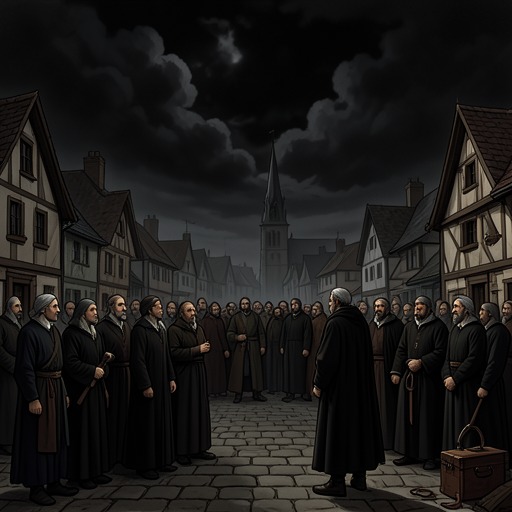
Winter
Narcissus and GoldmundWinter is more than a season in Goldmund’s life: it gives physical form to the cost of wandering and turns familiar landscapes into records of what he has lost. Its first snow falls as his secret life with Lydia is broken open, and its later chill accompanies both the loneliness of the road and his return to places where earlier versions of himself remain vivid.
First Snow and Separation
The first snow arrives late, with Christmas approaching. Goldmund wakes after a dream of his mother and Narcissus to find a bluish-white brightness beyond the small window. The landscape—windowsill, stable roof, courtyard gate, fields, and woods—is quietly covered. Against his agitated heart, the trees seem to accept sun, wind, rain, and snow with a grace he wonders whether he could learn. He walks into the courtyard, touches the snow, and looks over the garden fence at rose branches bent beneath it.
The day’s calm contrasts with what happens after nightfall. Lydia comes to Goldmund’s room as she customarily does, troubled by a quarrel with Julie and afraid that her sister may betray their secret. She cannot bring herself to warn Goldmund. While she rests against his chest, Julie enters the room, and Lydia recoils in pain. The snow-covered day thus frames the discovery of the clandestine relationship and the abrupt end of its fragile shelter.
The Cold Road
After leaving the knight’s household, Goldmund crosses a winter landscape he knows from previous rides. The knight’s barn beyond the frozen marsh and a familiar farmhouse offer possible places to rest, but freedom tastes of hardship, hunger, and want. On the deserted marshland he rests beneath a bare ash and thinks tenderly of Lydia. The cold soon forces him onward: reflection gives way to the immediate task of reaching shelter and staying alive in the open fields.
Lydia sends a bundle through Hans, who refuses Goldmund’s offer of money or an exchange for his jackknife. Inside are a thick gray knitted undervest, apparently made by Lydia, and ham concealing a gold piece in a slit. There is no note. Goldmund puts on the warm vest, hides the coin, and chooses a barn rather than a farmhouse, unwilling to answer questions or talk. He continues the next morning in frost and sharp wind, walking long distances to escape the cold. For many nights he dreams of the knight and the sisters; loneliness and melancholy accompany him for days.
Winter’s exposure also brings him into new human experiences. In a poor village where his hosts have only gruel, Goldmund is woken to assist during the peasant woman’s labor. He holds a light while the midwife works. Watching the woman’s face, he is struck by its resemblance to the faces he has seen in moments of sexual ecstasy: pain is more violent, but the expressions share a contraction and a sudden intensity. The cold journey has not merely stripped away comfort; it has carried him toward an insight into the closeness of pain and joy.
Winter as Memory’s Landscape
Years later, on a journey with Narcissus, Goldmund crosses a late-autumn landscape whose bare trees are thick with frost. The reddish moors, hills, elm wood, stream, barn, mill, and castle awaken memories of riding with Lydia and of the snowy day when he was banished. He recognizes the writing-room window where he corrected the knight’s Latin. The scene is a return to the same terrain, but not to the life he knew there: the knight and Lydia are gone, and Julie now lives in the castle with her husband.
Goldmund asks Narcissus to keep his name secret and eats with the servants. No one recognizes him. At evening he looks over the garden fence at wintery flower beds and visits the stable, then sleeps on straw with the groom. The memories that press on him make his life seem rich in images but broken into pieces and poor in love. He anxiously looks toward the windows when the travelers leave, as he had recently watched the bishop’s palace for Agnes; neither woman appears. Winter’s recurring landscape binds these departures together, making farewell and the prospect of being forgotten feel like patterns in his life rather than isolated losses.
Return and Renewal of Work
When Goldmund and Narcissus reach Mariabronn, they pass fallow, stony fields where Goldmund once gathered herbs for Father Anselm and first became a man with Lise. Under the chestnut tree, Goldmund touches the trunk and picks up a prickly, split husk, brown and withered. The winterward journey has brought him back to his youthful home, but the dead husk makes the return carry the weight of elapsed time as well as recognition.
Goldmund’s new work begins after snow has fallen and Christmas is over. He withdraws from ordinary cloister life, takes meals at the mill, and allows only his assistant Erich into the workshop. His planned refectory lectern joins creation and religious history: its oak-grown stairs are to bear images of nature and the lives of patriarchs and prophets, while the upper parapet presents the four evangelists. Winter here marks not simply exposure and loss but the beginning of concentrated artistic labor. Across its appearances, the season repeatedly strips the landscape to its essentials, exposing what Goldmund cannot keep while carrying him back toward the images from which he makes art.