
The Self-Taught Man’s War Memory
NauseaThis flow traces how the autodidact’s memory of captivity becomes the foundation for his belief in solidarity and universal human fellowship.
increasing Bearing strength in each event
 decreasing
Bearing strength in each eventdecreasingCaptivity and Confinement
Captivity and Confinement
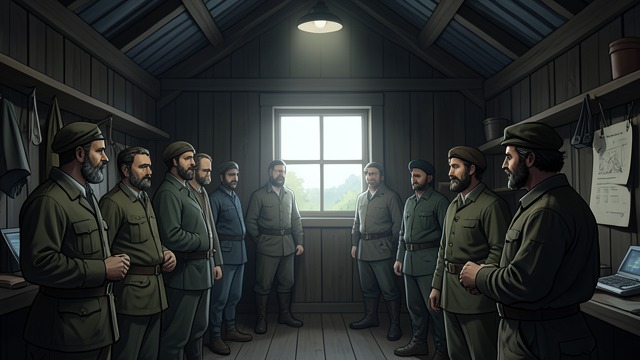
A crowded shed
The autodidact remembers being held with other prisoners in a dark, tightly packed wooden shed. The physical pressure initially makes him fear that he will suffocate.
A surprising release
The confinement suddenly gives way to a feeling of affection for the surrounding men. The memory becomes a rare experience of belonging that he carries into civilian life.
Memory Becomes a Principle

Memory Becomes a Principle
Searching for community
After returning to civilian life, the autodidact seeks the company of strangers and even follows an unfamiliar funeral procession. His earlier solidarity has become something he wants to recover.
A political home
He joins the Socialist Party, S.F.I.O., and interprets this affiliation as a life among people. The lived memory of the camp expands into a universal moral belief.
The Ideal Is Tested

The Ideal Is Tested
Affection meets skepticism
The autodidact offers his story as evidence that human beings can belong to one another. Roquentin asks whether the man loves actual people or only general human categories.
Solidarity remains vulnerable
The conversation does not erase the sincerity of the camp memory, but exposes the distance between a powerful past experience and a universal claim. The autodidact’s ideal cannot shield him from later social rejection.
During World War I, recalled at the Bouville lunch
After his release from captivity
During lunch with Roquentin
