
Habit Against the Unstable World
NauseaThis flow traces how habits and social routines make Bouville feel fixed, and how Roquentin’s perceptions reveal their fragile, human-made character.
increasing Bearing strength in each event
 decreasing
Bearing strength in each eventdecreasingRoutine Creates Reassurance
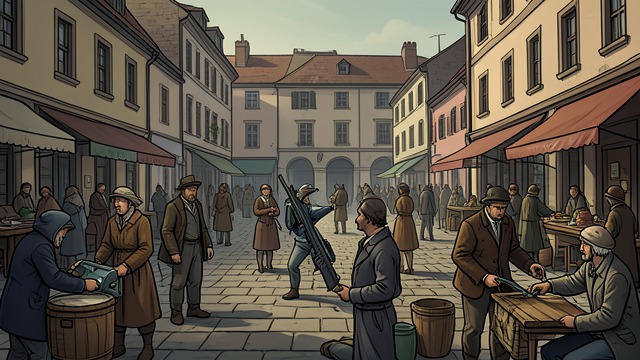
Routine Creates Reassurance
Repeated actions organize life
Cafés, tram schedules, library hours, and Sunday customs give residents a dependable pattern. Repetition lets the town appear settled and its institutions seem naturally ordered.
Stability is practiced
Roquentin recognizes that such order depends on people continuing to perform it. What feels permanent may be no more than a habit renewed each day.
The Fog Loosens Boundaries
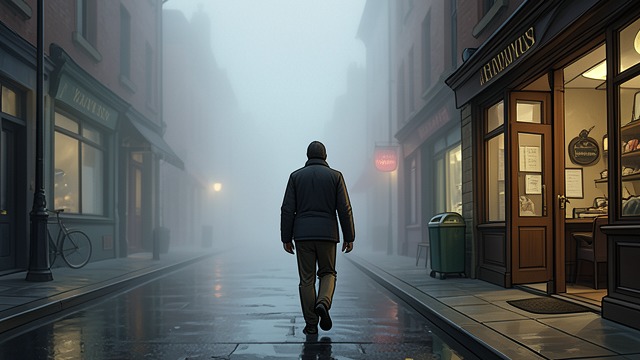
The Fog Loosens Boundaries
Familiar landmarks disappear
Fog obscures streets and faces as Roquentin moves toward a café. The environment no longer provides its ordinary visual cues, and small possibilities of danger multiply.
Habit cannot secure belief
The uncertainty makes him imagine a death upstairs and a changing world outside. His ordinary knowledge remains available, but it cannot compel the world to feel stable.
The City’s Rules Appear Fragile
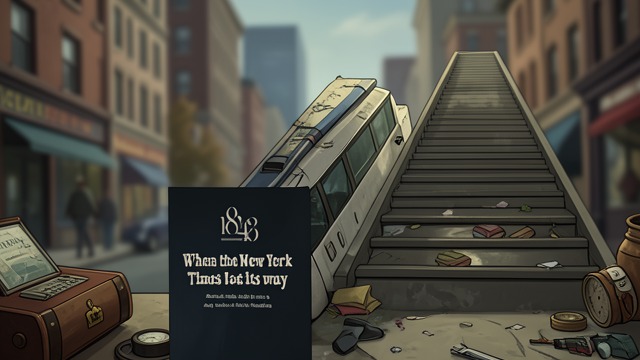
The City’s Rules Appear Fragile
Certainty is exposed
Roquentin considers residents who trust measurements, opening hours, and mechanical laws as proof that the world is stable. He sees how easily routine can be confused with necessity.
Change remains possible
He imagines the city’s familiar objects turning strange without warning. The vision shows that habit can soothe people, but it cannot guarantee that existence will continue in an orderly form.
Early in Roquentin’s stay
On the foggy Friday morning
Near the end, from the hill above Bouville
