
The Town That Believes It Is Persecuted
Needful ThingsThis flow traces the recurring language of persecution from Keeton’s real exposure through Gaunt’s delusion-building and the town’s collective loss of reason.
increasing Bearing strength in each event
 decreasing
Bearing strength in each eventdecreasingReal Wrongdoing Hidden

Real Wrongdoing Hidden
A concealed scheme
Danforth Keeton has embezzled public funds to sustain his gambling. The coming audit threatens the respectable public identity he has built.
Fear seeks an explanation
Keeton experiences genuine danger of exposure but cannot face it directly. His anxiety prepares him to accept an explanation that places responsibility elsewhere.
A Name for the Threat

A Name for the Threat
Gaunt supplies a conspiracy
Gaunt tells Keeton that “They” are pursuing him. The vague pronoun gives Keeton’s fear a shape while keeping the supposed enemies difficult to identify or test.
Suspicion hardens
Keeton begins seeing colleagues, police, and family as parts of an organized attack. His actual wrongdoing becomes harder for him to acknowledge.
The House as Evidence

The House as Evidence
Warnings are misread
Fake traffic slips accuse Keeton of embezzlement and insult him. He treats them as proof that his persecutors have entered his home.
An imagined enemy becomes real
Gaunt encourages Keeton to identify people as conspirators and to resist them. Keeton’s paranoia turns into violence against the people he believes are watching him.
The Town Joins the Pattern
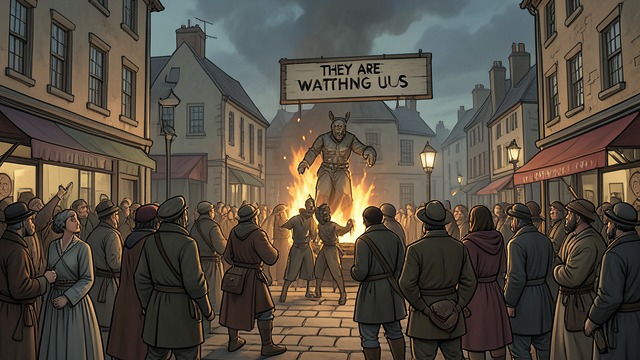
The Town Joins the Pattern
Accusations multiply
Letters, staged evidence, and damaged property convince residents that neighbors or religious rivals are acting against them. The word “they” begins to describe whole communities.
Paranoia becomes collective
Keeton is not the only person reacting to fabricated threats. Gaunt’s methods turn personal suspicion into a town-wide expectation of attack.
Evidence Restored

Evidence Restored
The machinery is identified
Alan and Polly recognize Gaunt’s role in connecting grievances and manufacturing apparent betrayal. Their understanding disrupts the town’s immediate spiral.
Responsibility remains specific
The false conspiracy does not erase actual crimes, including Keeton’s embezzlement and the violence residents chose to commit. The novel resists replacing accountability with a single explanation.
Before October 1991
October 11–14, 1991
October 13–15, 1991
October 15, afternoon and evening
Night of October 15, after Gaunt’s defeat
