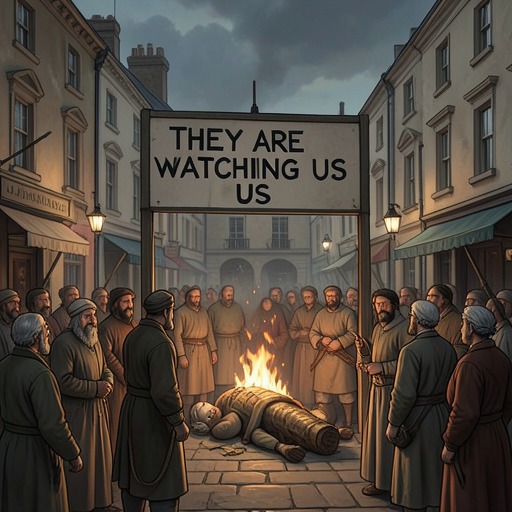
A sense of persecution
Needful ThingsA sense of persecution is the phrase Danforth Keeton uses as his suspicions deepen into a consuming conviction that unnamed enemies are closing in. The phrase first unsettles Alan Pangborn during a tense exchange; later, amid mounting trouble at the Municipal Building, Keeton turns the imagined threat into a reason to consider taking up a revolver. Its force lies in that progression: persecution begins as an insistently repeated explanation and ends as a category for the people Keeton fears.
The Phrase in Alan Pangborn’s Office
In a conversation with Alan, Keeton abruptly rises and insists that nothing is wrong, then says he is tired of “this persecution.” The word is not new to the exchange: Alan notes that Keeton has used it for the second time. The repetition makes the term more alarming than an ordinary complaint. Alan finds both the word and the conversation unsettling, sensing that Keeton’s account of his circumstances has taken on an intensity he cannot readily answer.
Alan tries to preserve their previously good working relationship and leaves open the possibility of helping. Keeton’s response is not to explain what he means or accept the offer. He goes to the door, answers Alan’s reminder about the handicap space with “Fuck the handicap space!”, and slams out. His anger gives the abstract accusation an immediate, practical consequence: even a routine reminder becomes part of an encounter in which he rejects Alan’s attempt to reach him.
From Complaint to Threat
The later scene places Keeton in his office early on a Saturday morning, with a terrible headache and the town’s tax ledgers and correspondence from the State of Maine Bureau of Taxation spread across his desk. He knows that everything is starting to come down around him, but feels helpless to do anything about it. The surrounding pressures are concrete, but the scene shows how the language of persecution reorganizes them: Keeton’s distress is no longer simply a response to difficult circumstances but a sense of being acted upon by a hostile force.
After a trip to Lewiston and a restless night pacing at home, Keeton’s thoughts repeatedly turn to a revolver hidden in his study closet. It is inside a carved wooden box made by his father, stored beneath old sweaters on a high shelf. The scene carefully connects this household hiding place to the threat taking shape in Keeton’s mind: he thinks of the weapon increasingly often, not initially for himself, but for “Them.” He then gives that imagined group a name: “The Persecutors.” The movement from a repeated grievance to a capitalized enemy sharpens the danger of his fixation.
The Imagined Persecutors and the Town
At quarter to six, Keeton leaves home and drives through the silent dawn streets to the Municipal Building. Eddie Warburton, there with a broom and a cigarette, watches him climb to the second floor; neither man speaks. Eddie has grown accustomed to Keeton appearing at odd hours, while Keeton has long since ceased to see him. The quiet passage gives the persecution theme a setting beyond the private office: Keeton’s increasingly isolated routine unfolds inside the ordinary civic workplace, among records and duties that continue while his attention narrows toward an imagined enemy.
The contrast between the two scenes is revealing. In Alan’s office, the word “persecution” is spoken aloud and meets another person’s concern; in the early-morning Municipal Building, “The Persecutors” exists in Keeton’s thoughts, attached to the revolver he keeps hidden. The term thus changes from a defensive explanation into a framework for possible violence. The available scenes establish the escalation of Keeton’s fear and his growing preoccupation with the weapon, while leaving the precise identity of “Them” undefined.