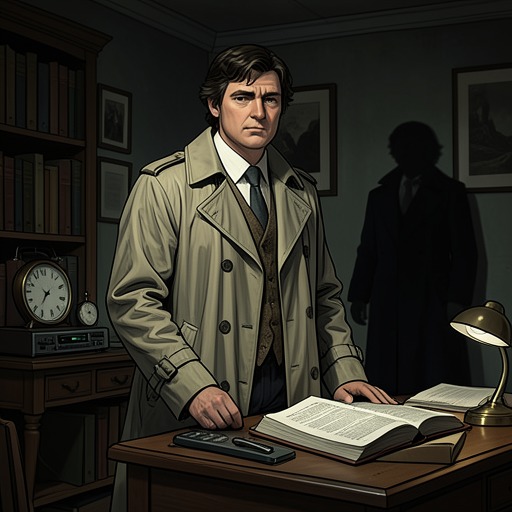
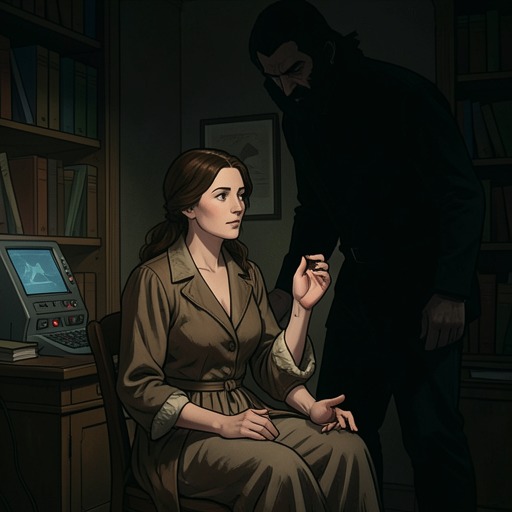
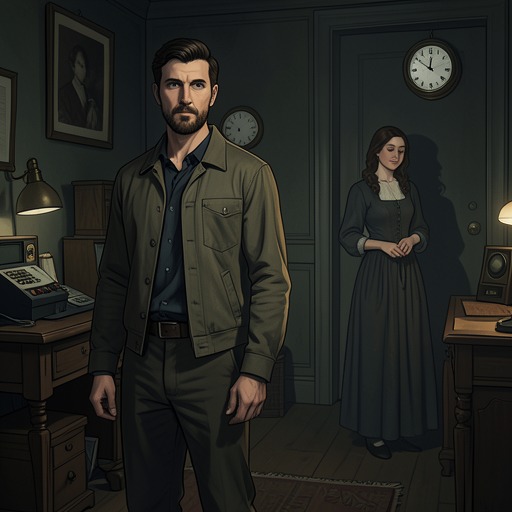
Annie Pangborn
Needful ThingsAnnie Pangborn is Alan Pangborn’s wife and Todd’s mother, whose death in a car crash becomes the source of Alan’s enduring grief and self-reproach. At first, Alan believes her death may have resulted from an illness he failed to recognize; only much later does he discover that the crash was deliberately caused. The shift from medical tragedy to an act of violence reopens his loss and propels him toward revenge.
Identity and Family
Annie works at You Sew and Sew, the shop Polly Chalmers opened. Alan remembers that she had begun experiencing headaches a little over two years before her death. She rarely discussed them, much as Polly avoided talking about her arthritis, and the family’s ordinary routines initially gave Alan little reason to recognize how serious Annie’s condition had become.
Annie and Alan had children together, including Todd, who was ten when he died. Alan had once made home movies of family life: the children toddling through the living room, Annie bathing them, birthday parties, and family outings. In those films, the family waved or mugged for the camera. The recordings preserve a domestic history that stands in painful contrast to Alan’s final memory of Annie and Todd: his wave from a study window as they left in the Scout.
Illness and Missed Signs
Early in 1990, Alan noticed that a family-size bottle of Anacin 3, containing 225 caplets, had gone from nearly full to almost empty. Annie explained that she had knocked it over while wiping the bathroom counter and thrown away the tablets after they spilled into the sink. At a coffee meeting, Alan asked her about the aspirin. Because he was a police officer accustomed to detecting deception, he watched her closely and held her hands across the table as he asked for the truth. Annie acknowledged that her headaches were worse and that she had taken many aspirin, but maintained that the bottle had also spilled. Alan believed her.
Later, Alan understood that he had accepted a partial admission as a complete explanation. He believed Annie may have been taking at least twenty aspirin a day, a level that would have persuaded him to seek a neurologist in Portland or Boston if he had understood it then. Instead, he made an appointment with Ray Van Allen. Van Allen performed reflex and vision tests, examined Annie’s eyes, and sent her to Oxford Regional for an X-ray, but did not discover the tumor. Alan did not blame him for the missed diagnosis; his own regret centered on having failed to press Annie further and on having been less observant with his wife than he was with people he questioned as a police officer.
The Crash and Its Medical Explanation
On a day in March, Annie and Todd took the old Scout to Hemphill’s Market for errands. Alan was in his study when they left. He looked out the window and waved; Todd waved back before getting into the vehicle. It was the last time Alan saw either of them alive. The Scout crashed on Route 117, about three miles from the house and less than a mile from the market. The State Police estimated from the wreckage that Annie had been driving at least seventy miles per hour, though Alan remembered her as a careful driver.
The autopsy revealed a brain tumor about the size of a peanut cluster. Van Allen later told Alan that Annie may have suffered a seizure that caused her to lose control of the car. Alan learned from Van Allen’s expression, rather than a direct explanation, that the tumor might have been operable if it had been found earlier. Seeking firmer answers after three weeks of sleepless anguish, Alan consulted a Portland neurologist named Scopes, presenting his questions as part of a police investigation. Scopes confirmed that brain tumors can cause irrational behavior and suicidal impulses, sometimes arising after deliberation lasting only seconds or a minute. Alan’s questions included whether a person in such a state might take someone else along.
Todd had been wearing his seatbelt; Annie had not. That difference became one of the details Alan could not set aside. He knew Annie always wore her belt, even on a short drive, and wondered whether its absence indicated that she had intended to die and take Todd with her. Yet he also reasoned that, if she had made such a decision, she might have asked Todd to unbuckle as well. The evidence did not settle the question. His uncertainty persisted beside the aspirin bottle and the tumor, turning ordinary details into unresolved tests of what he could have known.
Alan’s Grief and the Hidden Cause
Alan’s grief returns as an interior voice associated with duty and guilt. He recalls that, when Annie’s trouble began, he would have described himself as distracted, but the memory suggests a deeper struggle to hold onto his sanity. His thoughts repeatedly return to the morning of the crash, the missed symptoms, the seatbelt, and the possibility that Todd suffered before dying. The questions persist even when he understands that certainty may be impossible.
Much later, while Alan is investigating the events surrounding Needful Things, Leland Gaunt leaves him a letter promising that the questions about the last moments of Annie and Todd’s lives will soon be answered. Alan plays the unlabelled videotape Gaunt has left. Its shaky footage shows Route 117 and the familiar grove of pines, before the roadside trees bear the scars of the crash. Alan recognizes that the tape was filmed on the day his family died. He sees Annie in the Scout, wearing the paisley scarf she had worn that day, and Todd in his Star Trek shirt.
The footage overturns Alan’s earlier uncertainty about the cause. A lime-green Challenger bumps the Scout; the impact is not hard, but Annie speeds up, misses the curve, and veers toward the trees. Alan recognizes Ace Merrill as the person responsible for the pursuit. The sequence confirms that the collision was not simply an unexplained accident caused by Annie’s illness. Her tumor and possible seizure remain part of the circumstances, but the videotape exposes deliberate interference as the decisive cause of the crash.
Narrative Significance
Annie is largely present through Alan’s memories, the physical clues he reinterprets, and the home movies that preserve her family life. This mediated presence makes her absence central to the story: Alan’s police habits help him notice the aspirin bottle and interrogate Van Allen, yet they cannot restore what he failed to ask while Annie was alive. His investigation first turns grief into an unanswered medical question, then into knowledge of a crime.
The revelation also changes the direction of Alan’s response. For much of the story, he is caught between self-blame and the fear that Annie may have acted deliberately. The tape supplies a responsible perpetrator and converts that uncertainty into a desire for revenge against Ace Merrill. Annie’s death therefore remains both a personal loss and the hidden history that Gaunt exploits: by offering Alan evidence of what happened, he turns the past into leverage over Alan’s next choice.