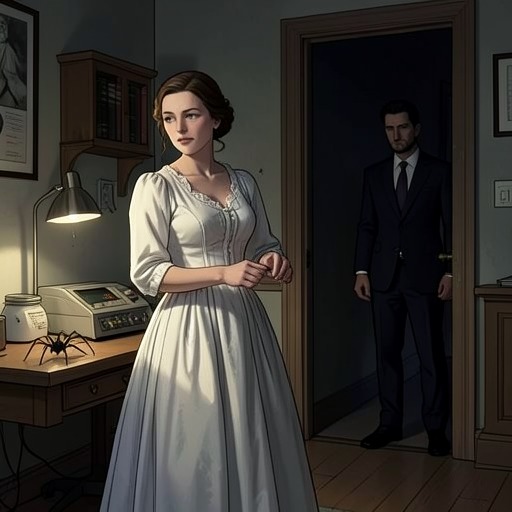
Azka charm
Needful ThingsThe Azka charm is a small silver ball on a fine chain that Leland Gaunt gives Polly Chalmers, presenting it as help for her painful hands. Its promise is inseparable from its terms: improvement accumulates with continued wear, while taking it off supposedly restores the pain immediately. A concealed object meant to relieve suffering thus also makes relief dependent on remaining within Gaunt’s arrangement.
Appearance and Offer
The charm is small enough to make barely a bulge beneath a blouse and sweater, and its silver is said not to rust. Gaunt advises Polly not to remove it, even to shower, framing constant wear as both harmless and necessary. Because the pendant can be hidden under ordinary clothing, Polly expects that she need not answer questions about it; she particularly imagines that Alan Pangborn, skeptical of superstition, would find the idea amusing, while Nettle Cobb might be awed by a genuine magic charm.
Polly accepts Gaunt’s invitation to give it a chance. The exchange is tentative rather than an expression of settled belief: she laughs at the explanation, and Gaunt joins her, acknowledging how implausible it sounds while insisting that he wants to help. Her private question about who had told him of the charm’s effects preserves a note of doubt even as she agrees to wear it.
Claimed Operation and Cost
Gaunt describes the Azka’s benefit as cumulative. According to his account, the wearer becomes a little better each day, so the supposed relief grows over time rather than arriving all at once. The charm’s silver construction is made part of the reassurance: because it will not rust, there is no practical reason to take it off.
The condition turns that offer into a dependency. If the charm is removed, Gaunt says, the wearer’s former painful state returns immediately; restoring the pendant does not restore the lost progress immediately, but requires days or perhaps weeks. The promised cure therefore depends on uninterrupted possession and wear, while a moment of removal carries a sharply unequal cost. The story gives this account as Gaunt’s explanation, not as an independent verification of how the object works.
Wearing the Charm
Later, when Alan visits Polly in bed, the chain and silver ball are beneath her cotton nightgown. The charm shifts against Alan’s chest and then tumbles down between her left breast and armpit. In that intimate moment, the object that Polly had expected to keep unremarked becomes briefly tangible to someone else, even though the passage does not show Alan identifying it or asking about it.
Polly tells Alan that her hands are a little better, then breaks off before continuing. She says it was nothing and that she thinks she can sleep now that he is there. The scene places her reported improvement, her concealed pendant, and her closeness with Alan together without explicitly assigning her relief to the charm. It also leaves her interrupted thought unresolved: the reader sees the object under her nightclothes, but not what she had begun to tell Alan.
Narrative Significance
The charm makes Gaunt’s bargain material and intimate. Its size permits concealment, its chain keeps it against Polly’s body, and its promised benefit is measured in the easing of a real, recurring pain. Yet the terms make comfort conditional: the wearer is told that relief can be lost at once and recovered only through continued compliance. The object therefore joins care to control without requiring an overt threat.
Its brief displacement in bed gives that arrangement a quiet visibility. What Polly can keep hidden beneath her clothes moves into Alan’s physical awareness, while her own statement that her hands are somewhat better offers only a limited confirmation of change. The charm’s significance lies in this tension between private bodily relief and the dependence built into Gaunt’s promise; the available scenes establish its terms and Polly’s wearing of it, but do not settle the full extent or source of its effects.