Castle Rock
Needful ThingsCastle Rock is the small western Maine town whose reassuring routines become the ground on which Leland Gaunt’s influence turns private grievances into public violence. At first, its seasonal calm and familiar civic life seem to promise that any quarrel will pass; by the final night, bombs, gunfire, and fire have shattered that confidence, and Alan Pangborn and Polly Chalmers leave a town that is gone.
Setting and Seasonal Rhythms
The novel introduces Castle Rock in October, a time its residents favor after summer visitors have left for New York and Massachusetts. Western Maine can feel forgotten once the lake-cottage season ends, but that quiet gives the town back to its year-round inhabitants. The opening perspective invites a returning resident to sit on the Town Common’s bandstand steps, where the view takes in much of downtown. Even the splinters there carry a local story: maintaining the steps is Hugh Priest’s responsibility, but he has not done the work, and his drinking is widely known.
Castle Rock’s self-image is gentler than its occasional conflicts. The town’s entrance sign calls it a good place to live and grow; the lake, tree-lined surroundings, and view toward Vermont from Castle View help sustain that claim. Summer visitors may quarrel over Sunday newspapers, and fights sometimes break out in the parking lot of The Mellow Tiger, but these disturbances have traditionally ended when the visitors go home or the weekend passes. The town’s habitual answer to irritation is that the aggrieved person will get over it—a compact expression of confidence that roughness is temporary and social life will right itself.
Civic Life and Familiar Frictions
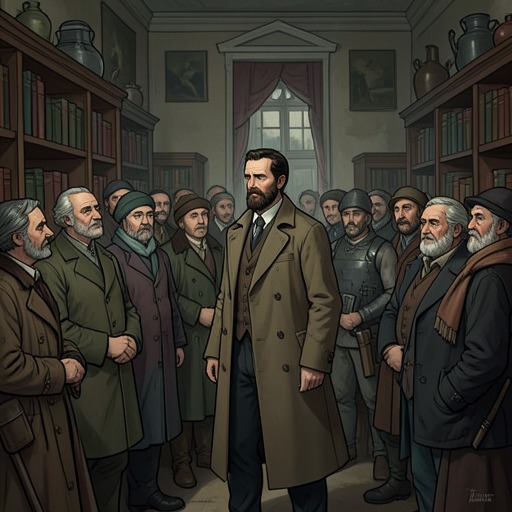
Castle Rock’s intimacy makes it both communal and exposed. Residents bump into one another, gather on the Town Common, eat at Nan's Luncheonette, and sit on the benches outside the Municipal Building. Secrets can be kept, but doing so takes effort in a place where people know one another’s habits. The town is not free of tensions: an argument between Catholics and Baptists over Casino Nite, teasing directed at Slopey Dodd because of his stutter, and Alan Pangborn’s grief are all present before the larger crisis. The early warning is that these problems, serious as they seem locally, will pale beside what is coming.
The town’s public institutions are shown through ordinary work as well as crisis. The Castle Rock Sheriff's Office can be nearly empty on a Saturday morning: Norris Ridgewick is away fishing, Seaton Thomas is visiting his sisters, Sheila Brigham is helping her brother prepare a letter about Casino Nite, and Andy Clutterbuck is somewhere on duty. The scene locates civic life in a small network of named people and overlapping responsibilities. Likewise, the selectmen and selectwoman share one full-time secretary, Ariadne St. John, a detail that underscores the modest scale of local government.
The town’s everyday disagreements also have a geography beyond its center. South Paris, eighteen miles northeast, is described as a small mill town, part of a Maine landscape where places bear names borrowed from far-off cities and countries. Castle Rock is therefore both particular and representative: a close community in a largely rural region, connected to other small towns but shaped by its own relationships and local memory.
Warning Signs and the Turn to Disorder
The change from tolerable friction to danger is first registered as a feeling that something in Castle Rock is slipping out of control. The unease is difficult to explain, but it gathers force as ordinary tensions accumulate. On Columbus Day, October 14, the town wakes to unusually warm weather; residents discuss it in groups at the Town Common, Nan's, and the Municipal Building. Their explanations range from distant oil fires in Kuwait to the ozone layer, while longtime residents insist that such warmth is unprecedented for the second week of October. The unusual day gives the town’s familiar talk a new, unsettled undertone.
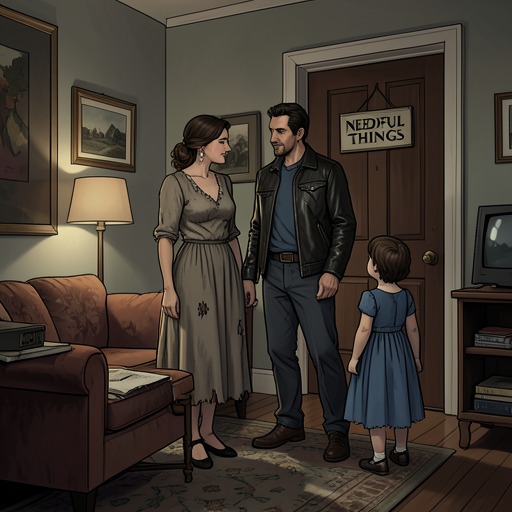
As the week proceeds, Gaunt’s shop and the bargains made there draw private desires and resentments into a widening web. A customer can treat an object as a private secret: Polly Chalmers, for instance, considers wearing a small charm beneath her clothes, anticipating that Alan might dismiss it and that Nettle Cobb would be impressed. But the bargains do not remain separate from the town around them. Gaunt tells a customer that the people being sought are everywhere in town, while Alan senses that an unseen force is working against the community. By the time Brian Rusk tells him that the disorder was planned by the man Alan had never quite managed to see, the earlier foreboding has become an explanation: the town’s crisis has been deliberately engineered.
The town’s deterioration is not presented as one isolated disturbance. Personal feuds and civic divisions converge; Castle Rock’s residents turn against one another, and the usual assurances that people will get over their anger no longer hold. The novel’s structure makes the contrast central: the same compact social world that once made ordinary life familiar allows suspicion and retaliation to spread through connected households, institutions, and streets.
The Final Night and the Town’s Destruction
On October 15, 1991, Castle Rock’s disorder reaches its catastrophic culmination. The violence unfolds across the town while different people pursue separate conflicts. Frank Jewett, for example, is on the courthouse steps searching for George T. Nelson; the explosions, gunfire, and other disturbances matter less to him than his personal confrontation. Elsewhere, a religious fight on Castle Avenue stops when Henry Payton and Reverend William Rose see a fireball to the south. Their sudden attention to the larger disaster briefly breaks the battle’s immediate spell: the town’s many local conflicts are being overtaken by its destruction.
The bombing of the bridge known to residents as the Tin Bridge gives the catastrophe a precise time and place. At 7:38 p.m., on Tuesday, October 15, a timer reaches zero. The electrical spark triggers the blasting cap and dynamite before the bell can do more than begin to ring. A familiar crossing becomes part of the coordinated attack, converting the town’s everyday infrastructure into an instrument of the plot.
The damage is visible in the town’s fires and rubble, and Alan accepts responsibility for what has happened. His admission that the destruction is his fault does not undo it; it registers the weight of a sheriff who has failed to prevent the violence overtaking the place he serves. As the cruiser carries Alan and Polly up Castle Hill toward Castle View, they look back together at Castle Rock burning below. They continue beyond the hill and take Route 119. The closing image makes the loss final: the town is gone, carried away into darkness.
Narrative Significance
Castle Rock is more than the setting for the novel’s bargains and violence. Its opening identity rests on endurance: seasonal routines return, visitors leave, fights end, and wounded feelings are expected to fade. The catastrophe attacks that civic faith at its root. When Gaunt’s influence turns private wants into antagonisms, the town’s closeness no longer guarantees mutual understanding; it becomes a network through which hostility can travel.
The novel also makes the contrast between familiar and catastrophic time part of the town’s meaning. Ordinary landmarks—the bandstand steps, the Town Common, the sheriff’s office, the bridge, and Castle View—first orient everyday life and later frame its collapse. The story begins with an invitation to look across downtown and ends with Alan and Polly looking back at a burning town. That movement from shared view to irreversible departure gives Castle Rock’s destruction its force: the place that seemed able to absorb any passing trouble cannot survive the disorder that has been assembled within it.