Castle Rock Baptist congregation
Needful ThingsCastle Rock Baptist congregation is the Protestant community led by Reverend William Rose, whose campaign against the Catholic Casino Nite helps turn a dispute over a church fundraiser into a town-wide religious feud. Its actions are both organized and public: letters to the local paper, posters denouncing gambling, and a preacher’s appeal to the law give collective form to an antagonism that had previously surfaced through gossip, taunts, and competing Sunday sermons.
Identity and Religious Setting
The congregation belongs to the small-town religious landscape in which the churches coexist without ever being entirely at ease with one another. Periods of peace give way to quarrels, and the account presents the Baptist-Catholic relationship as a standing local tension rather than a disagreement invented from nothing by the Casino Nite controversy. The event makes that underlying division unusually visible and gives it a specific object: a Catholic-sponsored evening of games and gambling.
The opposing event is planned for the Knights of Columbus Hall, with proceeds intended to help pay for repairs to the roof of Our Lady of Serene Waters. The Baptist objection is not simply to a private gathering. To Reverend Rose and his congregation, church-supported gaming is a religious and moral offense, while the Catholics regard the planned nickel-and-dime games as harmless entertainment and a practical fundraiser. Those contrasting descriptions turn the same activity into a test of what each church believes the other may legitimately do.
Opposition to Casino Nite
Reverend Rose seeks to stop the event through public pressure. He funds the DICE AND THE DEVIL flyers himself, and Wanda Hemphill and women from her sewing circle help put them up around town. The poster’s emphatic language makes the Baptist position immediate and theatrical: Casino Nite is framed not as a modest charitable fundraiser but as a danger with religious consequences. The campaign carries the congregation’s objection beyond church walls and into shared public space.
Rose also takes the dispute to Alan Pangborn. He returns to demand that the chief forbid Casino Nite, invoking both decency and the law, and brings an abridged copy of Maine’s Code of Laws as support for his appeal. His insistence places the congregation’s moral opposition in a civic register: rather than treating the gathering as merely distasteful, he presses the town’s law-enforcement authority to prevent it. Alan does not simply accept that demand, and the confrontation shows that the Baptists’ campaign cannot secure its preferred outcome by moral assertion alone.
The congregation’s public argument is answered by the Catholic side through its own letters and declarations. In the weekly paper, the two churches’ representatives trade accusations of spiritual condemnation; the letters column becomes the one place where Catholics and Baptists still address one another. The paper’s expanded debate does not produce a considered compromise. It turns into a shouting match, as each side’s language hardens the division it claims to defend.
Escalation and Group Mobilization
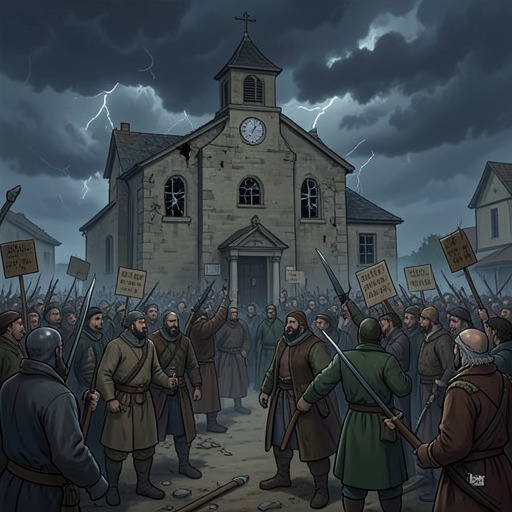
The conflict becomes more dangerous through a cumulative sequence of actions. Before the October crisis, the hostility had usually remained partly hidden: ethnic jokes and malicious talk in church groups, children’s schoolyard taunts, and rhetorical attacks from one pulpit to the other. There had also been ugly incidents, including eggs thrown at a parish hall during a Baptist Youth Fellowship dance and a rock thrown through a rectory window. These incidents show that the public argument rests on a longer history of antagonism, even when it has not yet become open confrontation.
Casino Nite deepens that anger. The Daughters of Isabella organize the Catholic countercampaign; more posters go up and are torn down, while an editorial urging restraint on both sides is ignored. Once Reverend Rose receives an obscene anonymous card addressed to him as a Baptist, the prospect of a confrontation seems harder to avert. The card claims to speak for loyal Catholics and threatens to stink up Rose and his allies if they continue opposing Casino Nite. The account identifies it as a trigger in an already volatile dispute, not as proof that the congregation itself wrote or authorized the threat.
The reciprocal framing is visible in another anonymous message, which condemns Catholic worship and declares that there will be no dicing with the devil in Castle Rock. Its language casts the Catholics as agents of damnation, just as the first card presents the Baptists as the enemy. In this atmosphere, insults and accusations are readily treated as statements on behalf of whole religious groups. The congregation’s opposition thus occupies a dangerous public field in which authentic campaigning, hostile caricature, and anonymous provocation become difficult to separate.
Members, Allies, and the Limits of Leadership
Rose is the congregation’s central public voice, but the campaign depends on other people to circulate and sustain it. Wanda Hemphill writes many of the Baptist letters to the Castle Rock Call, and her sewing-circle associates help distribute the flyers. Their work turns an individual preacher’s anger into an organized public presence. The congregation’s position is therefore communicated not only from the pulpit but through recurring print and street-level activity.
The opposition’s firmness also appears in the actions of Father John Brigham’s supporters. Sheila Brigham helps her brother prepare another letter explaining why Casino Nite is harmless and describing Rose as irrational. The exchange indicates that both sides are preparing arguments for the paper rather than yielding the public forum to the other. At a Sunday homily, Brigham uses gardening metaphors to warn that Baptists who intrude into the Catholic “carrot-patch” will face resistance; Wilma Jerzyck hears the threat beneath the mild delivery. The congregation is not depicted as a unified body committing a single act of violence, but as one party in a widening struggle whose rhetoric and mobilization make collective hostility easier to intensify.
Significance in the Town’s Breakdown
The Baptist campaign matters because it makes a local religious disagreement legible as a contest over morality, law, and communal authority. Casino Nite is a small fundraiser in material terms, yet the opposing churches treat it as evidence of the other side’s character and spiritual standing. Posters, letters, sermons, and anonymous cards convert that difference into a recurring public confrontation. The ritual of arguing through the weekly paper does not contain the conflict; it gives the antagonism a continuing platform.
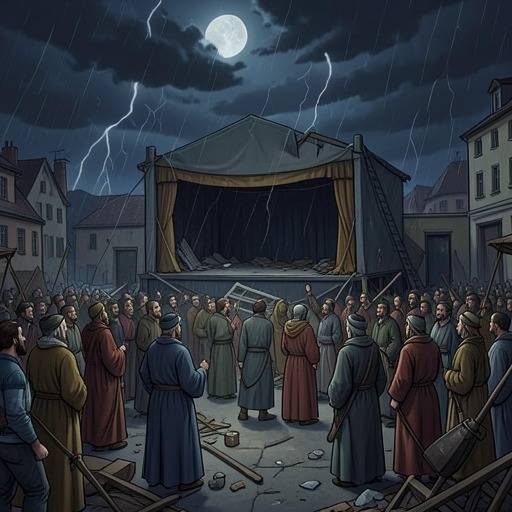
The congregation’s role is consequently part of a broader pattern of escalation rather than a self-contained cause of the town’s disorder. Longstanding Baptist-Catholic suspicion supplies the background; the Casino Nite campaign intensifies it; and deliberately crude or threatening messages make the prospect of a physical confrontation more immediate. The episode exposes how organized religious advocacy can be pulled into a cycle in which each side interprets the other’s conduct as collective aggression. In Castle Rock, a dispute that might have remained a bitter argument becomes one of the strands in the town’s accelerating social breakdown.