Castle Rock United Baptist Church
Needful ThingsCastle Rock United Baptist Church is the base of Reverend William Rose’s influential Baptist congregation and the principal setting for the anti-Casino Nite campaign. Its pulpit gives an old Catholic–Baptist rivalry a public voice; later, a timed stink bomb hidden in the choir turns that rivalry into a grotesque emergency, with Rose himself overcome in the crush to escape.
The Church and Its Congregation
Rose had led the church since May 1983 and was both popular and energetic, despite his bigotry and his taste for cruel wit. His first sermon, titled “Why the Catholics are Hellbound,” established the polemical course he continued to follow: he accused Catholics of worshipping Mary rather than Jesus and repeated lurid claims about the Inquisition, the papacy, and the Vatican. The church thus appears not merely as a meeting place but as an institution whose pulpit helps sustain and sharpen the town’s sectarian antagonism.
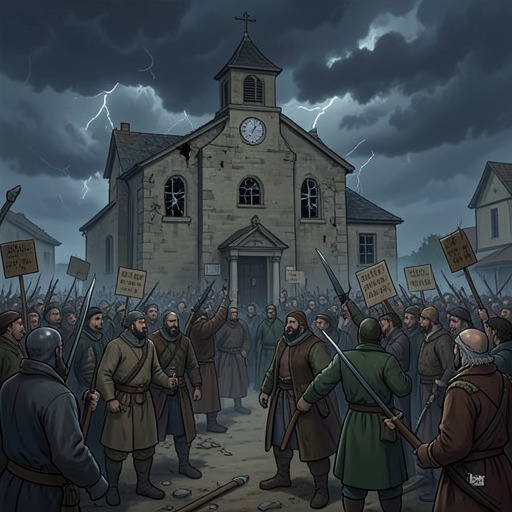
Rose’s congregation organized as the Baptist Anti-Gambling Christian Soldiers of Castle Rock. More than seventy people attended its fourth meeting, a strong turnout after attendance had dropped at earlier gatherings. The obscene anonymous card delivered through the parsonage mail slot had revived interest and alarm. Rose noticed that Don Hemphill, his dependable ally, was absent, but the meeting proceeded amid a controversy that had begun to command attention even as violence elsewhere unsettled the town.
Casino Nite and the Sectarian Dispute
The immediate controversy concerned Casino Nite, planned by Catholics at the Knights of Columbus Hall to raise money for repairs to the roof of Our Lady of Serene Waters. Father John Brigham had conceived the event, while the Daughters of Isabella took up its organization. Rose objected to church-supported gambling and demanded that Alan Pangborn prohibit the event, appealing first to decency and then to the law with a copy of Maine’s legal code in hand.
The dispute drew on a much older hostility. Before October, it had surfaced in pulpit attacks, malicious gossip, children’s taunts, and occasional acts such as eggs thrown at a parish hall and a rock thrown through a rectory window. Casino Nite deepened the anger. Rose’s opposition campaign included letters to the Castle Rock Call and DICE AND THE DEVIL posters; the Catholic response, led by Betsy Vigue, met it with its own organizing and counter-posters. An editorial urging restraint had little effect, and the newspaper expanded to sixteen pages to accommodate a debate that had become more shouting match than reasoned exchange.
The anonymous card sent to Rose intensified the confrontation with crude insults and a threat to stink him and his allies. A separate anti-Catholic warning framed Casino Nite as a religious abomination and demanded that it stop. These provocations made each side’s suspicions easier to confirm: hostility presented as a message from the opposing camp could be taken as proof of collective malice, further narrowing the space for compromise.
The Stink-Bomb Attack
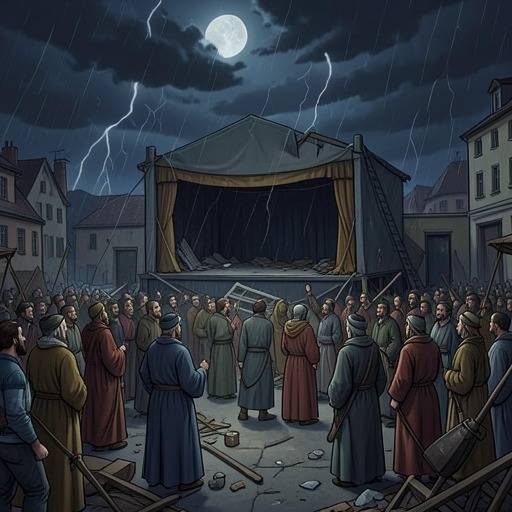
During the Baptist meeting, a box concealed in the church choir began to hiss. Like the box placed in the Daughters of Isabella Hall, it contained a timer that had been ticking through the afternoon; this one had been planted by Sonny Jackett. A powerful stench poured through grilles in its sides, driving the congregation toward the exits and converting a gathering organized around moral opposition to gambling into a scene of bodily panic.
Rose never made it to the vestibule because people were packed in front of him. He turned back into the church, tried to call to the others, vomited instead, tangled his feet, and struck his head on a pew. Nan Roberts pulled him up by the armpits and urged him out through a window, since the crowd risked choking inside. The church, ordinarily the platform for Rose’s denunciations, became a trap from which he needed rescuing.
Significance
The church’s role links religious speech to the town’s broader breakdown. Rose’s sermons and organizing turn sectarian prejudice into sustained public mobilization, while the stink bomb makes that conflict physically immediate. The attack does not resolve the Casino Nite dispute; it shows how a controversy that began over fundraising and religious propriety has become entangled with anonymous threats, reciprocal suspicion, and acts of sabotage. The church’s choir, a place associated with worship, conceals the timed device that brings the congregation’s rhetoric crashing into disorder.