Castle Rock explosives
Needful ThingsCastle Rock explosives are the dynamite, blasting caps, timers, and wiring used by Danforth Keeton and Ace Merrill to carry out a bombing campaign against Castle Rock. Their significance lies in the way they convert a concealed financial crime and manufactured hostility into material destruction: the explosives move from a municipal paper trail to a hidden stockpile, then into timed devices planted across town as civic order collapses.
Supply and Concealment
The plot’s explosive supply is foreshadowed in an official Castle Rock fund-release form. While examining the contents of a van, Danforth Keeton recognizes the typed description of goods to be supplied as sixteen cases of dynamite. The form ties the planned attack to the town’s own accounts and to Keeton’s public office: the weapons have been ordered through a municipal transaction rather than appearing as an unrelated cache. Keeton’s recognition turns the van’s otherwise puzzling contents into evidence of a plan, and he laughs at what he has discovered.
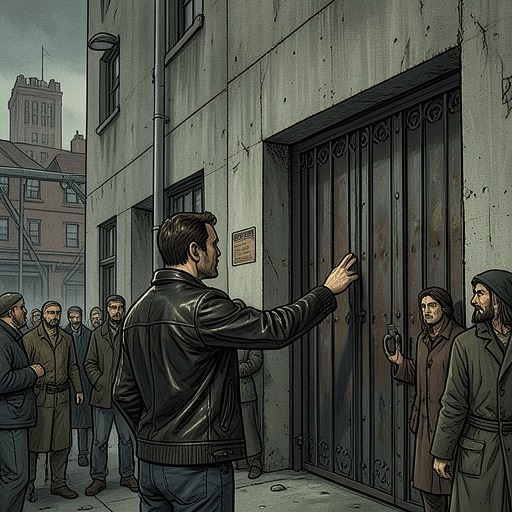
The explosives are also stored in a locked municipal shed marked with red diamond-shaped high-explosives signs. Keeton produces the key, and Ace Merrill sees the air-conditioned interior and its stacked crates of commercial dynamite. The protected, organized stockpile is a sharp contrast with the improvised appearance of the later bombs. The cache gives the conspirators enough explosive material for a town-wide operation, while the key places access in the hands of Keeton, the official whose financial and psychological crisis has become bound up with the attack.
Assembly and Placement
The bombs are assembled from ordinary commercial materials and practical components. At the Tin Bridge, Ace places a blanket-wrapped package between two structural struts, connects the blasting cap to a stick of dynamite using exposed wire ends, and sets the timer’s large white dial to forty minutes. The device begins ticking before he crawls out from under the bridge. The scene makes the threat precise and mechanical: a small timed mechanism is set against a familiar piece of town infrastructure, with the delay separating the act of planting the charge from its detonation.
Ace and Keeton then drive slowly along Main Street in heavy rain, posing as occupants of a television news van while State Police cars pass without stopping them. They leave small packages at several locations. At the Samuels Funeral Home, beside the barber shop, they put a timer and five sticks of dynamite near the doorway; Ace breaks the glass pane, and Keeton hands him a prepared bomb bound together with wire. Ace throws it through the opening, where it lands by the barber chair with its timer counting down from twenty-five. They also leave a package in Galaxia and push another into the bank’s night-deposit slot. These placements extend the threat from a bridge to businesses and a financial institution, making the explosives instruments of indiscriminate civic disruption rather than a single targeted attack.
Detonation and Immediate Consequences
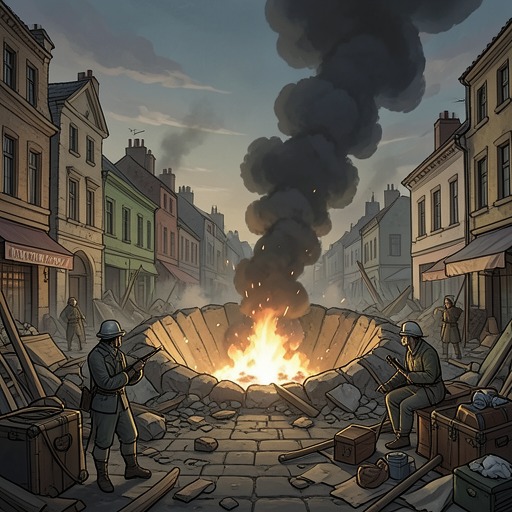
At 7:38 p.m. on Tuesday, October 15, 1991, the timer beneath Castle Stream Bridge reaches zero. A tiny electrical spark crosses the bare wires, triggers the blasting cap, and ignites the dynamite. The bridge—known to residents as the Tin Bridge, though it is made of old iron—lifts from the bank in a ball of fire, rises roughly ten feet, then crashes back amid broken cement and flying metal. Its north end twists loose and the structure falls askew into the swollen stream; the south end comes to rest on an elm already brought down by lightning.
The blast interrupts the fight between Castle Rock’s Catholics and Baptists on Castle Avenue. The combatants, with State Police officers among them, stop and turn toward the fire at the stream. The explosives thus alter the course of the conflict even before the later charges detonate: the distant blast briefly draws divided groups’ attention away from one another and toward the town’s shared destruction.
The bombs at the barber shop and funeral home later explode while Keeton, Ace, and Norris Ridgewick are together in the street. The blasts create the opening Ace has been waiting for. He draws his automatic pistol and shoots Norris in the shoulder, injuring his lung and breaking his collarbone; a second shot strikes the brick close to Norris’s head. The explosives’ role therefore extends beyond physical damage to buildings: their timed detonation provides cover for an armed attack on the lawman confronting the conspirators.
Narrative Function
The explosives give visible, material form to the town’s breakdown. Earlier, Keeton’s embezzlement is a matter of accounts, letters, and a fund-release form; once the dynamite is discovered and deployed, the paper trail has become a threat to bridges, businesses, and people. The movement from bureaucratic record to explosive charge links private wrongdoing to public consequence without making the violence abstract: each timer is placed at a particular site, and each detonation changes what characters can do next.
The objects also expose the campaign’s dependence on coordination and opportunity. The locked shed supplies the dynamite, timers and alligator clips make the charges workable, the van conceals the movement of the bombers, and the rain and passing police vehicles shape the conditions under which the packages are planted. Yet the devices do not remain a hidden threat: the bridge blast announces the campaign to the whole town, while later explosions turn its timed design into immediate cover for gunfire. Castle Rock explosives are thus both the physical means of the bombing campaign and the mechanism by which the plot’s larger civic conflict becomes an irreversible sequence of destruction and violence.