Castle Rock religious riot
Needful ThingsThe Castle Rock religious riot is the violent culmination of the town’s escalating Catholic–Baptist hostility over Casino Nite. A dispute about whether a planned church fundraiser is proper or permissible is turned into a crisis of collective identity: anonymous insults and a staged attack intensify suspicion until both congregations mobilize, meet in the street, and draw even state police into the fighting. The riot shows how Leland Gaunt’s wider campaign of manipulation can convert existing grievances into public disorder, though the conflict also depends on the participants’ own choices to treat provocation as proof and violence as a response.
Causes and Escalation
The dispute begins with the Catholics’ plan to hold Casino Nite at the Knights of Columbus Hall. The Reverend William Rose objects to the event and asks Alan Pangborn, then chief, to withhold official sanction. Rose calls it gambling for money; Pangborn explains that participants pay a donation, receive an equivalent amount of play money, and later bid on donated goods rather than cash prizes. The procedural distinction does nothing to settle the religious objection, and the disagreement becomes a public contest over the moral character of the other congregation.
The hostility gathers force through competing accusations. A crudely worded anonymous message purporting to come from Catholics tells Baptists to stop opposing Casino Nite and insults their faith. Another hostile message invokes anti-Catholic religious language, accusing Catholics of idolatry and damnation. The specific authorship and staging of these provocations are part of the broader manipulation of Castle Rock; their effect is to make a dispute over one event appear to confirm a much older, shared grievance. The town’s account describes anger deepening from the day the Daughters of Isabella announced Casino Nite, until the inflammatory messages make a confrontation seem increasingly difficult to avoid.
The Attack at the Baptist Meeting
At the fourth meeting of the Baptist opposition, more than seventy people gather. As the assembly is brought to attention, a concealed box in the choir begins hissing and releases a powerful stink. The attack turns a tense meeting into a scene of panic. A second hissing sound from the rear of the hall, accompanied by thunder, increases the confusion; in the disorder, Antonia Bissette is fatally injured without the crowd noticing at first.
The death changes the gathering’s stakes. Antonia had neither bought anything from Gaunt nor taken part in his games, yet she becomes a casualty of the conflict those games have helped inflame. When the Catholics and the Daughters of Isabella later assemble in the parking lot, the groups’ leaders meet in the rain, and Betsy Vigue clings to Father John Brigham in grief. Albert Gendron’s response is to urge the Catholics toward retaliation. At the Baptist side, William Rose and other leaders move at the front of an angry procession through the rain. The two groups are no longer merely arguing over a fundraiser: they approach one another as opposing crowds.
The Street Fighting
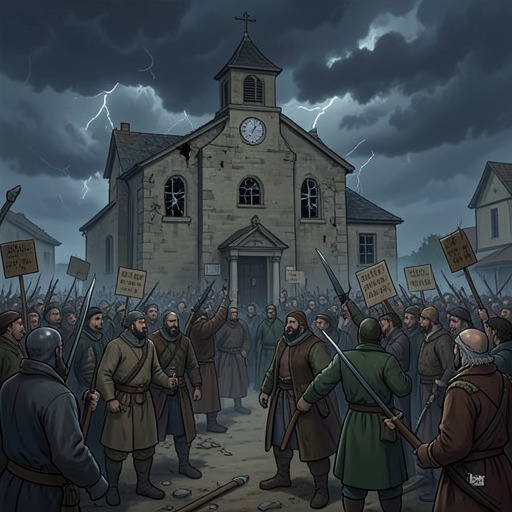
Father John Brigham leads the Catholic charge, and the Baptists advance to meet it. Near the foot of Castle Hill, the two groups collide in a fight that abandons any restraint. The confrontation is not limited to the original congregants: police cars arrive, and state troopers attempt to break up the combatants. Their commands are ignored, and the officers themselves are pulled into the brawl.
The riot’s scale and disorder are underscored by the inability of authority to stand outside it. One trooper draws his weapon but is struck by a projectile associated with one of Gaunt’s special-sale items before he can fire. The other responding police vehicles add their flashing lights to the rain-darkened scene, but their arrival does not restore control. The street has become a setting in which religious labels, personal anger, and the spectacle of group action overwhelm the ordinary boundary between civilian conflict and police intervention.
Interruption and Renewed Conflict
The fighting pauses when a distant fire brightens the end of town near Castle Stream. For a moment, Catholics, Baptists, and nearly a dozen state policemen all turn toward the blaze. The brief shared attention does not reconcile the opposing groups; it only interrupts the immediate struggle.
Nan Roberts then cries that the Catholics are using dynamite. Within seconds, the fighting resumes, spreading into multiple skirmishes along Castle Avenue. The accusation reconnects the riot to the town’s wider bombing crisis and converts the explosion from a common object of attention into fresh grounds for suspicion. The interruption therefore produces no settlement: violence returns in a more fractured form, with the participants divided into scattered fights rather than a single advancing crowd.
Consequences and Significance
The riot grows out of a specific dispute about Casino Nite but is sustained by a broader mechanism: religious language defines the opposing congregation as morally dangerous, anonymous messages make hostility appear mutual and organized, and the stink-bomb attack turns suspicion into immediate panic. The death of Antonia Bissette demonstrates that the consequences reach beyond the people who bought from Gaunt or knowingly joined his games. When the two congregations finally meet, their leaders’ calls and gestures of grief exist alongside decisions to charge and retaliate.
The episode also reveals the fragility of civic order in Castle Rock. State police arrive, issue commands, and attempt to intervene, yet they are absorbed into the melee; a flash of fire can briefly suspend the brawl, but a shouted accusation is enough to restart it. The riot is thus neither a simple doctrinal debate nor an isolated fight. It is a turning point in the town’s breakdown, where manufactured provocation and existing sectarian resentment become collective violence, and where a momentary common focus gives way almost at once to renewed division.