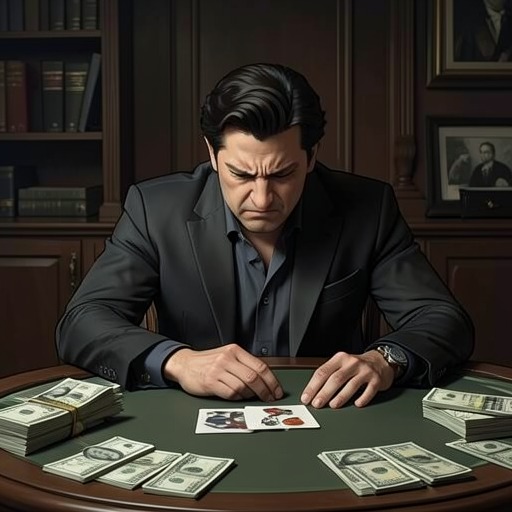
Compulsive gambling
Needful ThingsCompulsive gambling is the private compulsion at the center of Danforth Keeton’s public and financial collapse. It begins with a modest win at Lewiston Raceway, but the excitement of the track soon matters more than the money; as losses mount, Keeton borrows from the town’s petty-cash fund, falsifies and conceals records, and faces an audit of the accounts he has compromised.
First Win and the Pull of the Track
Keeton’s first visit to Lewiston Raceway yields just over three hundred dollars. The immediate success becomes the origin of his gambling obsession. When he returns the following week, he loses sixty dollars of his earlier winnings and scarcely cares. The attraction is not simply the prospect of profit: Keeton is drawn to the charged anticipation of each race and the crowd’s excitement, a feeling he recognizes as both intensely alive and dangerous.
That recognition makes the compulsion more troubling to him, not less. Keeton regards the track as a place where people wager money and temporarily surrender their judgment. Having seen what instability can do within his family, he fears the pull the racetrack exerts on him. He knows he has been unable to leave before the last race, even once reaching nearly to the exit turnstiles before turning back. For three years, he stays away, preserving the image of a controlled man with a planned career.
Political Success and Escalating Losses
The restraint ends in 1984, when Steve Frazier retires and Keeton is elected Head Selectman. He celebrates at the track, moves up to the ten-dollar betting window, and loses $160. He tells his wife the next day that the loss was $40. Returning a week later to win back what he has lost, he nearly recovers the money, but the attempt instead leads to a $210 loss the following week.
That deficit would show up in the checking account, so Keeton takes $100 from the town’s petty-cash fund to cover part of it. The act links his private gambling to the public office he holds: town money becomes a means of concealing losses incurred for his own sake. Keeton minimizes the amount, but the borrowing establishes a pattern in which each effort to cover a shortfall creates a more serious exposure.
By the summer of 1989, he is attending the races constantly through the second half of July and all of August. His wife, Myrtle, initially suspects another woman, then feels relieved when she concludes he is going only to the track. The gambling keeps him away from home, where he can be tyrannical, and she assumes the household accounts mean he cannot be losing much. In fact, the apparent stability conceals how deeply Keeton has dipped into town funds.
Concealment and the Audit
Keeton’s professional accounting skill helps him maintain the appearance of order, but it cannot permanently hide the diversion of money. By autumn 1990, the arrangement is beginning to come apart. Hoping to recoup his losses, he has found a bookie who will accept larger bets than the racetrack itself will handle; the change in scale does not improve his luck.
The state’s demand for an audit brings the concealed gambling losses into direct conflict with Keeton’s official responsibilities. The requested review is comprehensive, extending beyond tax records to revenue-sharing, town expenses, road maintenance, law-enforcement and parks budgets, and the records of a state-funded experimental tree farm. Keeton keeps Bureau of Taxation correspondence and his replies in a locked filing-cabinet drawer. Although the replies bear the initials of Keeton and his secretary, Shirley Laurence, she typed none of them. His attempt to manage the correspondence privately thus becomes another part of the concealment surrounding the accounts.
Gambling continues to supply brief reversals of fortune. With Winning Ticket, the tin horse-racing game he has acquired from Leland Gaunt, Keeton runs old Derby races against the results printed in a racing-history book. The horses assigned the names of actual winning horses repeatedly finish first. So absorbed is he that he spends the day replaying races from years earlier, only realizing at four o’clock that ten new races are scheduled that evening at Lewiston Raceway.
The next night, every horse he has selected with the game wins, including Malabar, a thirty-to-one shot in the tenth race. Keeton returns to Castle Rock with more than $18,000 from the bookie and hides the money in an envelope inside the Winning Ticket box, which he puts at the back of his study closet. After months of poor sleep and confusion over the audit, he sleeps well and wakes with a tentative idea for addressing it. The win momentarily restores his sense of possibility, but its proceeds remain concealed alongside the device that helped him choose the bets; it does not resolve the public-accounting crisis.
Public Evidence and Significance
The pressure of the audit turns Keeton’s hidden financial misconduct into a source of acute fear. When he gathers Bureau of Taxation letters and his own replies, he fights an impulse to destroy them and sorts the correspondence instead. The papers are evidence of a problem he has tried to keep private, while the state’s audit threatens to trace the town’s accounts across departments and funds.
The accusation becomes explicit on a warning slip: under the heading for other violations appears the single word “EMBEZZLEMENT.” The word names the consequence that Keeton’s gambling has been generating beneath his successive attempts to win back money and conceal losses. His story therefore distinguishes the original compulsion from the choices made to finance and hide it. The track’s excitement may explain why he returns, but Keeton’s use of public money, his private handling of official correspondence, and the looming audit show how his dependence becomes a matter of political responsibility as well as personal ruin.