Frank Jewett
Needful ThingsFrank Jewett is the principal of Castle Rock Middle School, a respected school official whose hidden history makes him vulnerable to blackmail and ultimately draws him into the town’s final violence. When Sally Ratcliffe exposes his secret collection and delivers photographs linking him to the abuse of children, Jewett’s public standing and private fear collide; his attempt to confront the blackmailer George T. Nelson ends with both men killed in the Municipal Building explosion.
Identity and Position
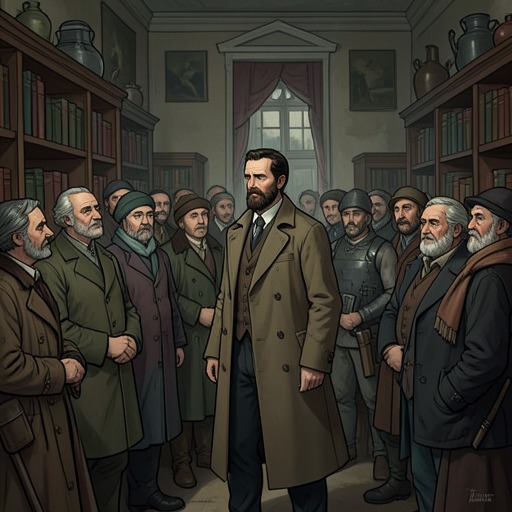
Jewett is introduced through his role at Castle Rock Middle School. Sally Ratcliffe sees him in Room 6 during a meeting with teachers involved in coaching fall and winter sports; the scene places him among the adults responsible for the school’s activities and establishes his ordinary public position before his concealed past comes to light.
That respectable role is sharply at odds with the evidence later found in his office. A locked lower desk drawer contains a stack of magazines depicting boys, which Sally discovers after forcing the drawer open. The revelation is not merely that Jewett has kept illicit material hidden: the books foreshadow the photographs and secret history that will make him vulnerable to exposure and coercion.
The Exposure at School
Sally’s visit to Jewett’s office is part of the prank she has been recruited to carry out for Leland Gaunt. She places a manila envelope bearing Jewett’s name on his desk, then uses heavy scissors to force the locked drawer. After seeing the magazines, she spreads them through the office. Jewett arrives to find the contents of the drawer displayed where school staff can see them, turning a private concealment into a public crisis.
The envelope contains glossy photographs of Jewett and George T. Nelson at a Boston gathering attended by undressed boys. Nelson’s face has been obscured, while Jewett’s is clear. It also contains a note demanding $2,000, to be delivered to Nelson’s home that evening, and threatening to circulate copies of the photographs around town beneath the Casino Nite posters. The note makes the blackmail explicit: Jewett fears losing his position and facing criminal consequences, while the threat of public exposure gives Nelson immediate power over him.
Nelson, Blackmail, and Retaliation
Jewett’s response moves from shock to anger. He goes to Nelson’s home, tears apart the bedroom, finds half an ounce of cocaine beneath the mattress, and flushes it away. He also defaces a framed portrait of Nelson’s mother. These acts are retaliation, but they do not resolve the threat; instead, they make Jewett anticipate that Nelson will come looking for him. Jewett decides he cannot leave without completing the confrontation and considers using a gun from the house’s cabinet—or a steak knife if he cannot get to the guns.
The two men meet again during the violence engulfing Castle Rock. Jewett has been waiting for Nelson near the courthouse, focused on finding him even as explosions, gunfire, and other disturbances unfold nearby. When they finally face each other, both have pistols. Jewett accuses Nelson of blackmailing him and insists that Nelson could have asked him for money instead of threatening to destroy his life. Nelson denies knowing what Jewett means and taunts him over the harm he has done to Nelson’s parakeets and mother’s portrait. Their exchange exposes how thoroughly the friendship has become a contest of grievance, fear, and retaliation.
Ending and Narrative Significance
For several minutes, Jewett and Nelson stand opposite one another on the courthouse steps, armed and poised for a confrontation. Then they begin to grin in mutual disbelief and move toward each other, one stepping up and the other down. The gesture suggests that the quarrel might give way to an embrace, but there is no time for the reconciliation to take shape: the Municipal Building explodes, vaporizing both men where they stand.
Jewett’s trajectory binds the town’s broader pattern of manufactured debts and retaliatory acts to a secret that predates Gaunt’s manipulation. Gaunt’s scheme makes Jewett’s exposure part of the chain of pranks and vendettas, but Jewett’s past and his choices in response remain his own. His last movement toward Nelson briefly interrupts their armed hostility; the explosion instead makes their death the final consequence of violence that has overtaken Castle Rock.