Henry Payton
Needful ThingsHenry Payton is a State Police lieutenant whose work in Castle Rock moves from forensic investigation to an increasingly desperate effort to manage a townwide breakdown. He gives Sheriff Alan Pangborn crucial evidence that challenges the local account of a dog’s killing, later takes over the murder case, and ultimately confronts violence that overwhelms ordinary police control.
Identity and investigative role
Payton serves with the State Police and is an experienced counterpart to Alan Pangborn. Maine’s Criminal Investigation Department handles murder investigations, a procedure that can leave local and county officers responsible for preserving evidence until state investigators arrive. That division of authority shapes Payton’s relationship with Pangborn: he comes to help the sheriff, but the case ultimately falls under his own agency’s jurisdiction.
The division is not merely administrative. Local officers know that evidence handling during the interval before the state team arrives will be scrutinized, while state authorities are expected to direct the murder investigation. Payton’s eventual assumption of the case therefore places him inside an existing institutional tension: Pangborn remains responsible to the community and has developed the local investigation, but Payton must take the lead once he arrives.
Evidence that changes the case
Payton contacts Pangborn early one morning and reports that the evidence makes it highly unlikely Wilma Jerzyck killed Nettle Cobb’s dog. The dog’s examination, conducted by veterinarian John Palm, provides a restricted time of death because the animal died almost instantly after being struck through the heart with a corkscrew. The detail gives investigators a firmer timeline than the town’s accusation alone can provide.
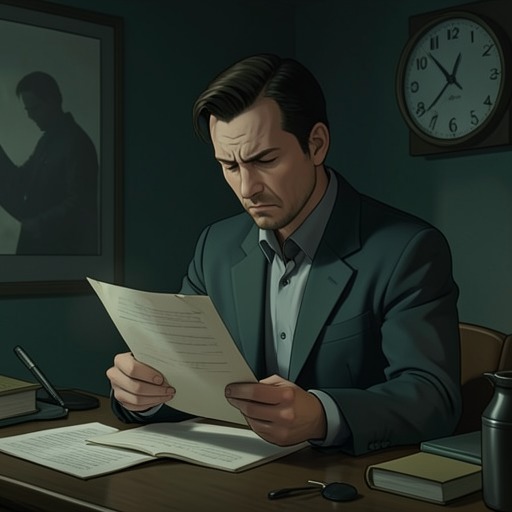
The threatening note associated with the earlier mud-throwing incident is another point of comparison. Peter Jerzyck supplies a handwriting sample from his wife, and the writing does not match the note. Payton explains that the Augusta handwriting expert has not yet completed the examination, but the copies before him already contradict the assumption that Wilma wrote it. Together, the timing evidence and handwriting discrepancy weaken the case against her and suggest that someone else has been manipulating the apparent clues.
Payton also reports bloody fingerprints on the inside doorknob of Nettle’s front door, apparently left by the person who went out after killing the dog. The prints are blurry; partial fragments have been sent to the Federal Bureau of Investigation for attempted reconstruction, a process expected to take a week or ten days. While waiting, Payton compares them with Wilma’s prints, which the Medical Examiner’s office had supplied. His conclusions remain provisional, but the investigation is being pursued through evidence rather than simply accepting the accusation circulating in town.
He tells Pangborn that investigators may also have a witness to the rock-throwing incident. Pangborn asks to wait until school lets out before questioning the child, agreeing that frightening him would be counterproductive. The exchange shows Payton and Pangborn coordinating across agencies while trying to protect a potentially vulnerable witness from the pressure of the investigation.
Taking over the murder case
When Payton arrives in Castle Rock, Pangborn is already questioning Clut. Payton tells him kindly that he is taking the case, and Pangborn accepts the change in command. Rather than treating the transfer as an end to their cooperation, Pangborn immediately asks Payton to establish an important point as soon as possible. The handover preserves the partnership even as responsibility shifts to the state investigator.
Payton’s work is also threaded through the practical difficulties of communication and coordination. A message from him prompts Pangborn to return the call to the Oxford Barracks; later, Sheila struggles to connect Pangborn with Payton before Pangborn’s personal line lights up. Such interruptions place the investigation inside the ordinary machinery of phones, dispatch, and interagency contact, machinery that will become less reliable as the town’s crisis worsens.
Police authority under pressure
At the Sunoco station, Payton arrives to find two more people dead, one white and one Black. He demands to know what has happened. The question registers both the scale of the emergency and his inability to make sense of a scene that has outrun the investigation he came to assist.
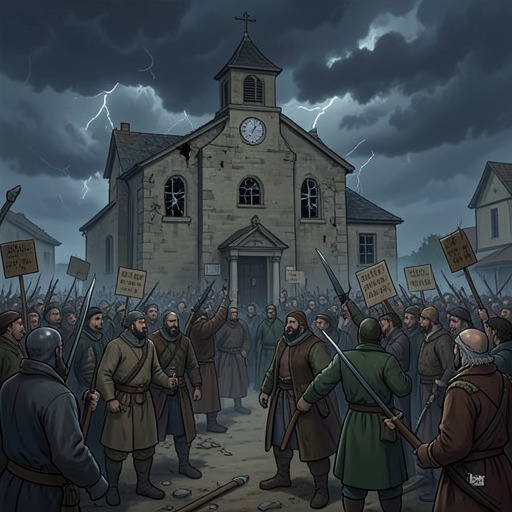
As violence spreads, radio communication becomes difficult. Trooper Morris tries to reach Payton, and when contact finally resumes Payton responds in a weary, frightened voice. Elsewhere, State Police cruisers race through the streets in opposite directions. Pangborn sees their movement as frantic but purposeless and concludes that Payton has lost control of the unfolding events, if control had ever been more than an illusion. The contrast is stark: the cruisers signal official activity, yet their scattered motion no longer amounts to command.
Payton nevertheless tries to reassert public authority during a lull in the fighting. He pushes aside Tony Mislaburski, cups his hands, and begins ordering the crowd to recognize that the police are in charge. The attempt is direct, but the surrounding disorder has already made the limits of an officer’s voice plain: an order can be issued even when the conditions for obedience have collapsed.
Aftermath and significance
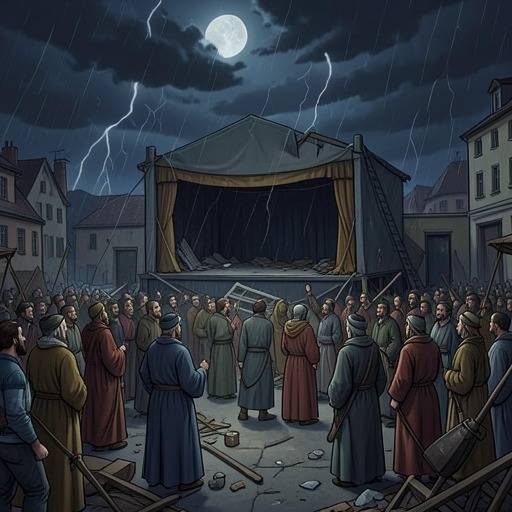
During the fighting on Castle Avenue, where the Catholics have gained the advantage, the combat stops when a fireball appears to the south. Payton stands by his cruiser with his gun lowered, watching the distant blaze. The cessation does not come through an effective police resolution; the catastrophe elsewhere interrupts the conflict and turns the crowd’s attention away from one another.
In the aftermath, Payton arrives beside Pangborn and asks what happened. His shocked expression suggests that the night has unsettled more than his understanding of the immediate events; he appears to be a man approaching substantial changes in how he lives or thinks. He is also among those connected again with the divided community: Nan Roberts has an arm around his waist as Catholics and Baptists drift away, some separately and some together, while Father John Brigham supports Reverend William Rose. The image places Payton not only among the officers who failed to contain the violence but among the people left to reckon with its human consequences.
Payton’s arc is therefore defined by the distance between investigative competence and civic control. He can assess a time of death, compare fingerprints and handwriting, and take lawful command of a murder case; those methods expose the weakness of the accusation against Wilma Jerzyck. But when Castle Rock’s violence becomes collective, information, jurisdiction, and police presence cannot restore order. His final shock marks the personal cost of witnessing that collapse and the possibility that it will change him.