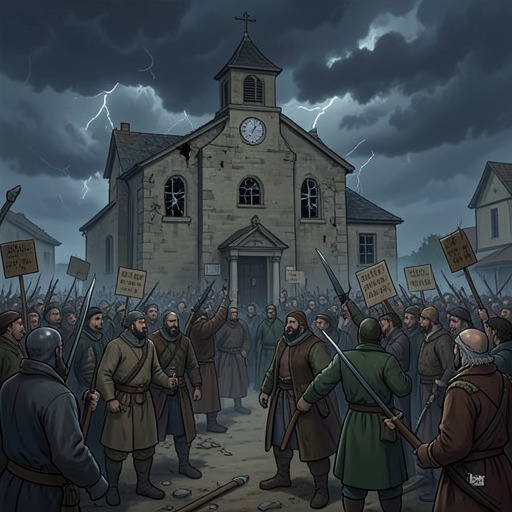
Our Lady of Serene Waters
Needful ThingsOur Lady of Serene Waters is the Catholic parish whose proposed Casino Nite becomes a public test of religious tolerance, local authority, and civic restraint in Castle Rock. Planned as a fundraiser for roof repairs, the event draws the parish into a widening conflict with the Baptist congregation; its associated halls and members also make it a setting within the town’s later disorder.
Parish and Community
Our Lady of Serene Waters is described as a small, attractive church on the route into town from Castle View. Father John Brigham serves as its priest. The Daughters of Isabella, a Catholic women’s organization, take the lead in organizing the parish’s Casino Nite, while Father Brigham originates the proposal. Their plan is to hold the event on the last Thursday of the month at the Knights of Columbus Hall, with proceeds intended to help pay for repairs to the church roof.
The proposed evening is presented as modest in scale: participants make a small donation and receive play money, then prizes are auctioned at the end. The suggested prizes include household goods such as a VCR, toaster oven, vacuum cleaner, and china. The distinction between this arrangement and wagering actual money becomes central to the dispute, but does not reassure those who regard the activity as sinful.
Casino Nite and the Baptist Dispute
The Catholic plan provokes the Reverend William Rose and his congregation. Rose opposes gambling on religious grounds and also argues that Casino Nite violates Maine law. He returns to Sheriff Alan Pangborn to demand that the event be prohibited, bringing a pamphlet containing the state’s code of laws. Pangborn explains that he has consulted a local attorney and that the state attorney general’s response supports his view: the law does not prohibit the event as organized. He treats the question as one of both legal authority and religious liberty, distinguishing Rose’s moral objection from a legal basis for stopping the parish’s fundraiser.
Pangborn refuses to forbid Casino Nite, while cautioning Rose not to cross the line from public criticism into infringement on others’ rights. He notes that Rose may speak from the pulpit and that people may post notices or write letters, but that the parish and its organizations are likewise free to hold an event not expressly barred by state law. The disagreement therefore becomes more than a dispute over games: it tests whether the sheriff will use public authority to enforce one congregation’s religious judgment against another.
The conflict is reciprocal. Father Brigham and Rose already dislike one another, and their exchanges carry the history of earlier antagonism. The Baptist campaign against Casino Nite includes flyers, while the Catholics prepare a public response through letters defending the event. Brigham’s sermon uses garden imagery to warn against Baptist interference and signals that Catholics will resist rather than withdraw. The parish’s fundraiser thus becomes the immediate focus of a broader denominational rivalry.
Parish Hall and Townwide Consequences
The Daughters of Isabella Hall beside the church is more than a planning venue. It is the organization’s meeting place, and its posted notice invites members to help plan Casino Nite. In a later episode, Myrtle Keeton enters the empty hall carrying a ticking metal box and a sealed letter under instructions from Leland Gaunt. She places the box in one of the brightly painted compartments used by children for lunches and schoolwork, then leaves the letter beneath the chairwoman’s agenda so the activities chair, Betsy Vigue, will find it. The ordinary arrangements of parish life—children’s compartments, meeting materials, and a sign-up sheet—are turned into part of Gaunt’s scheme against the Catholic group.
The parish community also appears through its members’ practical responses to escalating hostility. Albert Gendron, a prominent Catholic and longtime supporter of Our Lady of Serene Waters, receives a threatening notice at his dental office. He contacts Father Brigham to warn him that the dispute may become more dangerous. Brigham answers that the Catholics will not simply accept intimidation. Their exchange shows how the religious conflict has moved beyond sermons and publicity into a cycle of threats and contemplated retaliation.
Narrative Significance
Our Lady of Serene Waters anchors a conflict in which the language of morality and legality is repeatedly used to claim authority over other people’s choices. The parish’s plan is a small fundraiser, yet it attracts a campaign to suppress it; the resulting antagonism offers Gaunt an existing division to exploit. The church and its hall remain recognizable centers of worship, charity, and association, but those same institutions become vulnerable when suspicion and resentment reshape community life.
The contrast is especially sharp in the parish hall. It is prepared for a meeting about a harmless-seeming event and furnished with the everyday objects of children’s and congregational life, yet Gaunt uses that familiar setting to deliver a threat. The parish’s significance therefore lies not only in its role in the Catholic–Baptist dispute, but also in how the novel shows ordinary civic and religious spaces being drawn into the town’s larger breakdown.