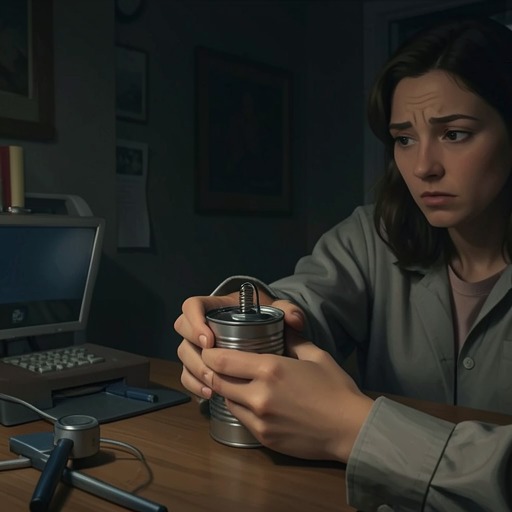
Tastee-Munch can
Needful ThingsThe Tastee-Munch can is Todd’s prank toy, carried by Alan Pangborn through the destruction of Castle Rock and finally used against Leland Gaunt. Its decisive transformation—from a keepsake Alan clutches for comfort to the instrument of a supernatural attack—makes the can both a physical turning point in the confrontation and a vessel for Alan’s memory of his dead son.
Identity and Earlier Use
The can contains a spring-propelled novelty snake, the sort of trick Todd loved. Alan has a history with it: after returning alone from Portland, he opened it in the Municipal Building parking lot and released a crepe-paper snake. The can’s joke was familiar, ordinary, and bound to a child’s affection for a harmless surprise. Alan kept it, as Annie had said he should because Todd would only be young once.
That family history is central to what the object becomes. The can is not introduced as a weapon or as evidence of Gaunt’s nature. It is a modest toy, whose meaning comes from the people attached to it and from Alan’s continued possession of it after loss. Its later power depends on the abrupt breach of that ordinary expectation: when Alan opens it again, the snake is briefly real.
A Keepsake in the Ruined Town
During the bombing of the video-game parlor, debris storms around Alan’s car in the middle of Main Street. His right hand reaches for the can and holds it on his lap, almost as if for comfort. The gesture occurs as Polly Chalmers urges him to stop the engine and listen, warning that if he leaves there will be nothing left to return to. The town is coming apart around them; Alan’s grip on the small object offers a sharply intimate counterpoint to the public violence.
The can is also conspicuous because Alan does not try to conceal it. When he speaks to Polly about Annie’s seatbelt, he tightens his hands around it, while Gaunt fails to notice it. That contrast matters: the object is visible, yet its significance remains unread by the adversary. Alan’s attention to it is connected to his recollection of Annie and Todd, and to the evidence that lets him recognize what happened to his family.
The Snake and the Reversal
Alan tells Polly that Annie had not been wearing her seatbelt on the day of the crash, but that the tape shows her belt still buckled. The discrepancy brings his understanding into focus: Gaunt was responsible for the crash. Alan turns toward Gaunt beneath the green canopy, steps toward him with the can, and spins off the lid before Gaunt can react.
The snake springs out, and for a few seconds it is no longer a crepe-paper novelty. It is much longer than the earlier trick snake, its skin iridescent and its body marked with red and black diamonds. It strikes Gaunt’s coat and repeatedly sinks its fangs into his neck. The can’s contents have crossed, however briefly, from the harmless and familiar into the genuinely dangerous. The transformation turns Alan’s private keepsake into an active force in the scene, interrupting Gaunt at the moment Alan confronts him with the truth.
The effect is fleeting. Once Gaunt throws the snake to the sidewalk, it is again five feet of spring wrapped in faded green crepe paper. Alan does not know whether anyone else saw its living form, but he is certain Gaunt did. The object’s strange power is therefore registered through both its bodily consequence—blood from three pairs of punctures in Gaunt’s neck—and the uncertainty surrounding the supernatural event itself.
Distraction and Significance
While Gaunt is occupied with the snake, he drops his hyena-hide valise. Alan uses the opening to take it, moving with his customary speed and dexterity; by the time Gaunt bends to retrieve it, the case is on the pavement between Alan’s feet. The toy does not defeat Gaunt on its own, but it creates the brief distraction that lets Alan gain possession of the valise and shift the advantage in their confrontation.
The can’s role gathers together the scene’s personal and material stakes. A toy retained from Todd’s childhood first provides comfort amid a town’s destruction, then helps Alan uncover and act on the truth about Annie and Todd’s deaths. Its return to an apparently cheap novelty after the attack does not erase what it has done: the ordinary object has been made consequential through memory, timing, and a momentary eruption of the unreal. The prank works precisely because Gaunt—and the reader—has reason to expect only a joke.