Todd's snake-in-a-can prank toy
Needful ThingsTodd's snake-in-a-can prank toy is a cheap gag that becomes a focal point of Alan Pangborn's grief after Todd's death. Forgotten in the glove compartment of Alan's station wagon, it reappears not as a harmless novelty but as a physical remnant of his son: Alan opens it, the spring-loaded snake leaps out, and Todd's remembered laughter gives way to silent, exhausted crying. The toy makes loss tangible while carrying Alan toward the harder recognition that he had been too distracted to see what was happening at home.
Identity and Origin
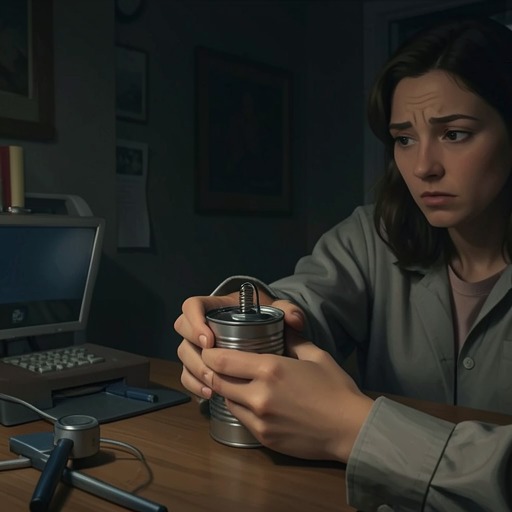
The toy is a round can labeled TASTEE-MUNCH MIXED NUTS, with a compressed green snake inside. When its lid is twisted off, a metal spring sends the fake snake outward; Alan later identifies it as cheap green crepe paper wrapped around the spring. The contrast between the innocent food label and the sudden mechanical trick is the joke's entire design: a familiar container promises one thing, then startles its unsuspecting opener with another.
Todd had wanted to buy this particular gag with his allowance. Alan objected, invoking his father's proverb that the fool and his money soon parted, but Annie overruled him. Her response turned the purchase into a small family story: she teased Alan for sounding like a Puritan, asked whether he had not enjoyed similar tricks when young, and reminded him that Todd's love of jokes had a family history. Alan had been embarrassed into a grin, which Annie noticed, as she so often noticed what others missed.
The can belonged to a world Todd loved: the Auburn Novelty Shop, where he would have lived if allowed, and its collection of cheap tricks, including joy buzzers, sneezing powder, dribble glasses, soap that colored the hands, and plastic dog turds. Among these amusements, the snake-in-a-can was the last joke Todd ever bought in the store he considered the world's finest. That ordinary detail gives the object a precise place in his boyhood rather than leaving it as a generic keepsake.
Discovery and Use
Nineteen months after Todd and Annie have died, Alan finds the can by accident. He is reaching into the station wagon's glove compartment for his citation book, an unbreakable habit even when he is driving to Portland to testify in court, when his hand strikes a tubular object and knocks it onto the floor. The car already bears the weight of memory: Alan has realized that the beers are not the real problem, because he has spent the day riding with the ghosts of his wife and younger son. The overlooked toy gives that grief a concrete shape.
Under the arc-sodium light, Alan recognizes the can and remembers Todd pleading to spend his allowance on it. He twists off the lid. The five-foot compressed green snake springs out, hits the windshield, and rebounds into his lap. Alan hears Todd's laughter in his head and begins to cry. The gag works mechanically, but its effect has inverted: the surprise no longer produces shared amusement; it releases the sorrow Alan had been carrying among the family's unremoved possessions.
After wiping his face, Alan slowly pushes the spring-loaded snake back into its can, screws on the top, and bounces the object thoughtfully on his hand. He considers throwing it away, but cannot do so that night. Instead, he returns it to the glove compartment and shuts the hatch. The gesture neither resolves his grief nor discards the reminder; it puts the toy back among the car's accumulated traces of the dead.
Memory, Regret, and Consequence
The can carries two distinct memories of Todd. One is the playful boy who tried the prank on everyone and once nearly scared Norris Ridgewick into a heart attack; Alan remembers laughing so hard he nearly wet himself. The other is the son whose remaining time Alan did not understand when he scolded him for being clumsy over a stain on the car seat. Alan recalls that it was the sort of remark he would never have made had he known Todd had less than a month to live. The toy brings the laughter and the missed final month into the same scene.
The object also summons Annie's presence. Alan remembers her laughter when he told her about Todd's antics, and her gift for humor and perspective, which had more than once been his salvation. But the recollection turns against him: Annie was not as lively near the end, and Alan's attention had been occupied by other troubles, including the case involving Thad Beaumont and the strain surrounding Beaumont's family. The narrative links the toy's return to Alan's dawning accusation that he had been too busy to notice what was happening at home. The can does not prove a different outcome; it exposes the burden of imagining one.
Even after Alan puts the toy away, the remembered prank persists. His depression turns the happy image of Todd startling people into a reproach: Todd was lively and great, Annie was lively and great, and Alan fears that he failed to see their suffering in time. The gag's repeated physical concealment and sudden emergence echo the way the car's contents keep returning to view. Alan thinks he has reached the end of clearing away possessions, only to discover one more remnant, and then another.
Narrative Significance
The toy changes status when it is found. In Todd's hands it was a novelty meant to produce surprise and laughter; in Alan's hands, after Todd's death, it becomes an object that refuses to remain merely useful or amusing. Its cheapness is part of its force: a spring, paper, and a tin can preserve the small domestic decision of whether a boy could spend his allowance, along with Annie's teasing and Alan's embarrassed grin. The material thing holds details that grief cannot reduce to an abstract sense of loss.
The scene's emotional reversal is built into the prank. A container that appears to hold mixed nuts releases a fake snake, and the burst of comic motion gives way to a quiet collapse. Alan does not throw the toy away or make it perform again; he carefully returns it to the can and leaves it in the glove compartment. That unresolved act makes the object an emblem of grief's recurrence: the past can be shut away, but it remains there to be encountered again, carrying both a son's laughter and a father's regret.