Victory rat trap
Needful ThingsThe Victory rat trap is a spring-loaded device turned into a weapon of humiliation when it is hidden inside a gift box for Norris Ridgewick. Its concealment makes the moment of discovery the trap’s defining action: what looks like a wrapped present becomes a steel jaw clamped onto Norris’s fingers, exposing how the town’s pranks have crossed into physical violence.
A Gift That Conceals Its Function
Someone leaves a box on Norris’s desk, wrapped in light-blue foil paper and tied with a blue velvet ribbon. A square white envelope tucked beneath the ribbon contains a typed card: “!!!!!JUSTA REMINDER!!!!!” Norris wonders who might be reminding him of something; Alan Pangborn and his mother come to mind, though his mother has been dead for five years. The note turns the package into a deliberately ambiguous message before its contents are known.
Inside the white cardboard box, tissue paper covers a flat object with raised ridges. When Norris reaches in, his forefinger strikes a protruding metal tongue. The heavy steel jaw snaps shut on the tissue and the first three fingers of his right hand. The cheerful wrapping, enigmatic card, and hidden mechanism form a single deceptive presentation: the gift’s appearance invites Norris to handle it, while its actual purpose is to injure him.
Injury, Retaliation, and Material Evidence
The trap tears the index fingernail away, leaving a bleeding crescent of raw flesh, while its bar bruises Norris’s fingers and their swelling begins despite the cold water. In pain and shock, he first bangs the trap against the side of John LaPointe’s desk instead of simply releasing its steel bar, making the device dangerous even after its concealed mechanism has been exposed. Once free, he sees the Victory rat trap for what it is: not a reminder or present but a loaded weapon disguised as one.
Norris returns to the deserted bullpen, picks up the sprung trap, and places it in the gift box in his desk’s top drawer. He throws away the tissue, blue wrapping paper, ribbon, and bow, concealing the presentation while retaining the object itself. He decides not to tell Alan Pangborn or anyone else what happened; anticipating their judgment, he imagines the incident would confirm that he had been foolish enough to put his hand into a loaded trap. Instead, he holds his wounded hand against his chest and resolves to handle the matter himself, on his own terms and in his own time.
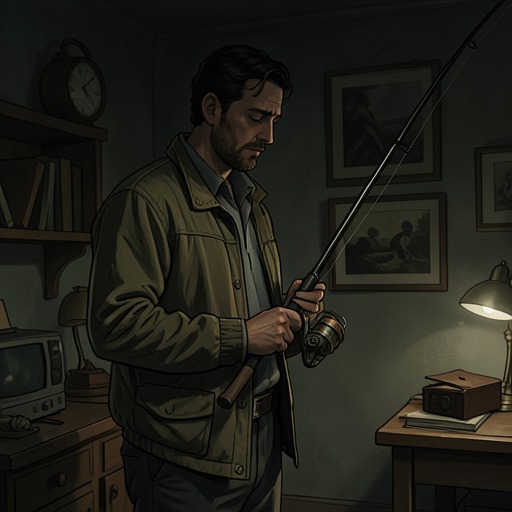
The trap’s threat reaches beyond the injury. Norris abruptly worries that the attacker may also have gone to his house, where his Bazun fishing rod is not locked away but merely leaning in the shed beside its reel. The thought connects the booby-trapped gift to the possibility of further damage and makes the rat trap a warning as well as an assault. Its ordinary mechanical action—spring, metal jaw, caught fingers—turns a household device into a deliberate instrument of intimidation, while Norris’s choice to keep it signals that he is no longer treating the attack as a harmless prank.
Place in the Town’s Exchange of Pranks
The trap belongs to a pattern in which a purchase at Needful Things carries a hidden obligation: customers pay not only money but also a promised prank, and a seemingly petty transaction can set another act of retaliation in motion. Leland Gaunt tells Nettle Cobb to finish paying for her lampshade by playing a trick on Danforth Keeton, assuring her that Keeton will blame someone else. Elsewhere, Everett Frankel buys a pipe for twelve dollars and a prank on Sally Ratcliffe, while Slopey Dodd acquires a pewter teapot for seventy-one cents and promises to trick Lester Pratt. The exchanges make mischief seem like an ordinary part of doing business, but their concealed targets and consequences erode the boundary between a joke and an attack.
That progression culminates, for Norris, in a real steel jaw rather than an embarrassment or inconvenience. The trap’s disguise preserves the outward form of a present even as its hidden mechanism makes the act physically dangerous. Its material reality also resists the social cover of a prank: after the injury, Norris keeps the sprung device in his desk rather than reporting it or dismissing it as a joke. The object thus marks the point at which the town’s manufactured retaliations become bodily harm, and his private decision to deal with it himself threatens to carry that violence forward.
Prank, Obligation, and Escalation
The Victory rat trap sits at the violent end of a system in which Leland Gaunt makes customers pay partly by promising to play tricks on other people. The bargain can be framed as a harmless prank: when Nettle Cobb hesitates over her obligation to play a trick on Danforth Keeton, Gaunt assures her that Keeton will think someone else did it. Yet the target and the act are built into the price, turning a purchase into a debt that travels outward from the shop. Other customers accept similar terms: Everett Frankel buys a pipe for twelve dollars and a prank on Sally Ratcliffe, while Slopey Dodd pays seventy-one cents for a pewter teapot and promises to trick Lester Pratt. Gaunt later reminds Slopey that the time has come to finish paying. The pattern makes the trap’s presentation as a gift especially telling: the violence arrives wrapped in the same social disguise as a joke or favor.
The device changes what that pattern means. A prank may begin as a secret obligation or a means of humiliating its target, but the Victory rat trap leaves Norris with a torn fingernail, blood, swelling, and a lasting bruise. It converts an exchange of concealed favors into direct bodily injury. Norris keeps the sprung trap rather than dismissing the attack, but hides the wrapping and tells no one, resolving to deal with the matter privately. The object is therefore both evidence of escalation and a possible spur to further retaliation: a familiar household mechanism becomes dangerous when concealed, while Norris’s secrecy lets the threat persist outside public view.