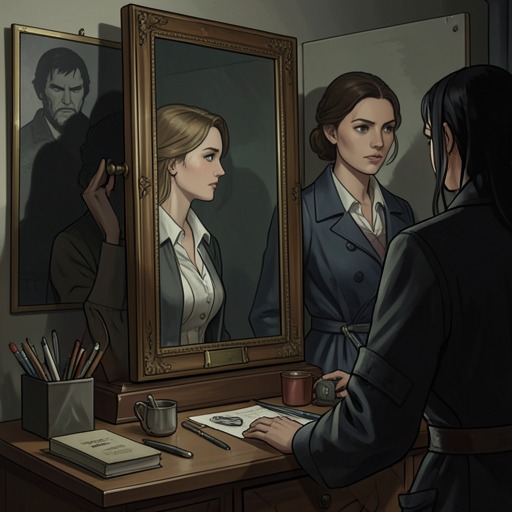
forged letter sent to Polly
Needful ThingsThe forged letter sent to Polly is a piece of planted evidence that turns private doubt into a weapon against Polly Chalmers and Alan Pangborn. Its false address supplies the clue that exposes Leland Gaunt’s involvement, while Polly’s eventual recognition of the deception reveals the deeper harm: for part of a day, fear made her accept the letter’s accusation and withhold from Alan the chance to answer it.
The Letter and Its Address
Polly finds the envelope among the day’s ordinary mail after returning home. She has folded the letter back up and put it inside, but in the night its presence becomes difficult to ignore. Beside a Princess telephone with oversized keys she no longer needs, the envelope looks like one more routine piece of correspondence. Polly compares her initial acceptance of it to a cuckoo egg left in another bird’s nest: because the letter was already lying with the catalogs and a cable-television solicitation, she had treated it as though it belonged there. The ordinary setting is part of the deception’s force; nothing about the delivery itself had made her question it.
The letter is supposedly a photocopy concerning Polly’s past and her connection with San Francisco child-welfare authorities. Its address, however, names its recipient as “Ms. Patricia Chalmers,” not Polly. That detail strikes at the identity she had used in San Francisco, where she had gone by Polly and had signed her applications Polly Chalmers, without a middle initial. The address is therefore more than a clerical oddity: it invites suspicion about whether the information could have come through the official search the letter implies.
Polly considers that Alan might have written to the agency under her legal name, or supplied both Patricia and Polly. She knows that bureaucratic records can preserve an outdated name, as in the case of a friend whose University of Maine correspondence still uses her maiden name after twenty years of marriage. But the envelope’s precise choice of Patricia does not fit an ordinary records search well enough to quiet her doubts. The discrepancy turns the letter’s own attempt at credibility into evidence against it.
How the Deception Unravels
Polly connects the false name to a fact Gaunt had learned: Nettle Cobb’s full name was Netitia Cobb. Gaunt knew both that Nettle’s familiar name concealed another one and that Polly could be addressed as Patricia. The connection identifies him as the person with the intimate, irregular knowledge needed to make the forgery persuasive. The letter’s apparent access to personal information is not proof of a trustworthy source; it is a trace of Gaunt’s manipulation.
That recognition also helps Polly test the accusation against what she knows of Alan. She acknowledges that he would not go behind her back as the letter claimed. Yet she cannot simply excuse herself as having seen through it all along. She asks herself whether she had truly believed the allegation, and answers that she had: only for half a day, but long enough. Her response makes the letter’s success measurable not by lasting conviction, but by the interval in which suspicion overruled trust.
Consequences for Polly and Alan
The letter had already shaped Polly’s behavior before she understood its source. She had not told Alan what was making her angry, nor given him a chance to explain; instead, she had accepted the accusation. In retrospect, she identifies another pressure operating beneath the false story: she was terrified that Alan would discover the truth about the azka and force her to choose between him and it. The forgery thus exploits an existing fear rather than creating every doubt from nothing. It gives that fear a plausible external cause and directs it toward the person Polly loves.
Once Polly recognizes the deception, the physical letter changes meaning. She crushes it in her hand despite a warning twinge in her arthritic fingers, then throws the crumpled paper to the floor in revulsion. A moment earlier it had carried the authority of an official-looking message; now it is a discarded object whose address and claims expose the intrusion behind it. The gesture marks a recovery of judgment, but not an undoing of the harm: Polly has already seen how readily the lie could make her withdraw from Alan.
Narrative Function
The letter makes identity itself part of Gaunt’s method. A name that Polly had used to separate her San Francisco life from the identity Patricia is made to feel like a vulnerability, while Gaunt’s knowledge of both names turns familiarity into a tool of coercion. The forged document borrows the appearance of institutional correspondence, but its decisive clue is not a hidden revelation about Alan; it is the mismatch between its address and Polly’s lived history.
Its role also depends on the difference between evidence and trust. The letter appears to offer documentary proof, yet Polly’s reasoning about names, addresses, and bureaucratic records exposes how uncertain that proof is. What finally matters is her recognition that she knows Alan well enough to reject the accusation. The deception briefly displaces that knowledge, showing how Gaunt can make a private relationship vulnerable by placing a manufactured story between two people and relying on fear to keep them from speaking directly.