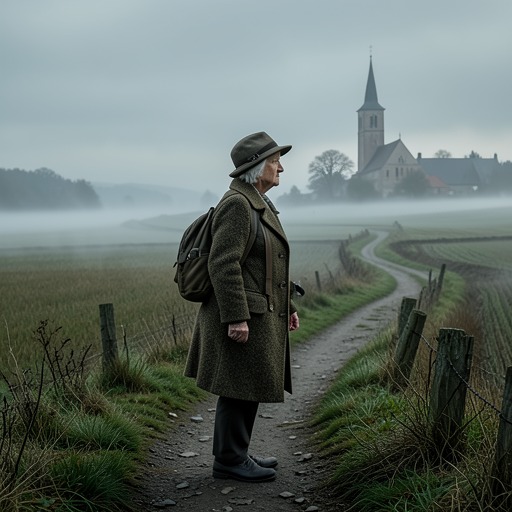
Elizabeth Temple's boulder attack
NemesisElizabeth Temple's boulder attack is the attempted killing that turns a seemingly remote accident at Bonaventure into the decisive exposure of Clotilde Bradbury-Scott's long campaign of concealment. A large boulder was rolled down the hillside onto the path below, striking Elizabeth Temple and leaving her fatally injured. The attack was designed to look like a natural fall, but later testimony shows that it was a deliberate assault intended to silence a woman who was beginning to understand what had happened to Verity Hunt.
Causes and Background
Elizabeth Temple was a retired headmistress and a woman of considerable scholarship and influence. Her work had centered on education, especially on the capacities and futures of girls, and retirement had not ended the authority she exercised among those who knew her. Her death therefore represents more than the loss of an individual: it removes an intelligent, independent witness whose knowledge might have connected the old crime involving Verity Hunt with the present investigation.
The danger arose from Temple's growing recognition that Verity's death could not have been suicide. She had understood, or was beginning to understand, that the word “Love” concealed something frightening in the story of Verity Hunt and Michael Rafiel. Miss Marple eventually concluded that Temple might have learned what Verity had written or said to her, and that a meeting between Temple and Archdeacon Brabazon could have brought their separate knowledge together. Clotilde Bradbury-Scott feared precisely that convergence of evidence. In Miss Marple's reconstruction, Temple had to be prevented from meeting the Archdeacon because together they might have reached an assessment of the truth.
The Attack on the Hillside
The incident occurred when a boulder crashed down the hillside, an occurrence that could be explained away because such falls had happened before, although only at very long intervals. The apparent accident acquired a different meaning through the account given by Joanna Crawford and Emlyn Price. They had been climbing from the lower main path along a rough track that curved around the hill when Joanna saw a figure high against the skyline.
Joanna's account described the figure trying to roll a large boulder forward along the ground. The stone rocked, began to move slowly, and then gathered speed as it descended. Elizabeth Temple was walking along the main path directly below and had reached the point beneath the slope when the boulder struck her. The attacker might have failed, since the stone could have missed its target, but the attempt succeeded with fatal force. The evidence thus changes the event from an unpredictable natural accident into a carefully chosen attack whose success depended on gravity, position, and timing.
The witnesses could not establish the attacker's sex. Joanna thought the figure might have been a man, but could not be certain. The identifiable details were clothing rather than face: jeans or trousers and a lurid red-and-black check polo-neck jumper. The figure turned and disappeared almost immediately after setting the stone in motion. Those details preserve the uncertainty surrounding the scene while also supplying a physical link to the killer's preparation and escape.
Temple's Final Clue and Death
Elizabeth Temple did not recover from the injury. An hour and a half after the attack, she died without regaining consciousness. Her last communication nevertheless gave the event a name that transformed its symbolic force. When Miss Marple questioned her, Temple referred to the “Stone of Death,” and then urged her to find out about Verity. The word “Verity” itself prompted Miss Marple to recognize the connection with Verity Hunt, whose name also carried the meaning of truth.
The dying reference binds the physical weapon to the suppressed history it was meant to protect. The stone is not merely the instrument of Temple's death; it is the sign of a truth crushed from above and the clue by which that truth begins to rise again. Temple's inability to speak further makes her fragmentary words an act of witnessing under extreme constraint. Her death closes her access to the investigation, but her final clue redirects it toward Verity Hunt and away from the theory of accidental death.
Investigation and Consequences
Miss Marple ultimately identifies the boulder attack as Clotilde Bradbury-Scott's third murder. In her account, Clotilde was physically strong enough to roll the boulder and sufficiently powerful within the local social world to rely on the accident explanation. The method also suited the larger pattern of her crimes: direct violence was combined with manipulation of appearances, so that death could be mistaken for misfortune or attributed to another person.
The attack was connected to the earlier murder and concealment of Verity Hunt, the substitution of Nora Broad's body for Verity's, and the attempt to secure Michael Rafiel's conviction. Verity had been given a painless overdose and hidden beneath the fallen bricks of the greenhouse at The Old Manor House, while Nora Broad had been strangled, disfigured, dressed in Verity's clothes, and supplied with Verity's personal effects so that the body would be identified as Verity's. By killing Elizabeth Temple, Clotilde sought to protect that entire structure of deception from a witness capable of joining its scattered parts.
The attack therefore produces a reversal in the investigation. What first appears to be a freak geological event becomes evidence of agency; what seems to be a separate modern tragedy becomes part of a ten-year history of possessive love, substitution, and concealment. Temple's death cannot restore the information she might have shared, but the circumstances of her death confirm that the hidden past remains active and that someone is prepared to kill again to preserve it.
Narrative Significance
Elizabeth Temple's boulder attack occupies the meeting point between gothic terror and detective reconstruction. The hillside supplies an apparently impersonal, overwhelming force, while the investigation reveals a human will directing that force. A landscape associated with rare natural danger is converted into a weapon, and the ordinary distinction between accident and murder becomes the central question of the scene.
The event also exposes the political use of the dead body and the crime scene. Verity Hunt's fate had depended on hiding one body and turning another into false evidence; Elizabeth Temple's death attempts to remove the living interpreter who could decode that arrangement. Clotilde Bradbury-Scott's violence is consequently aimed not only at bodies but at identity, memory, and the production of public truth. Yet the plan fails completely. Temple's final words, Joanna Crawford's observation, and Miss Marple's patient reconstruction allow the “Stone of Death” to become an instrument of revelation as well as destruction.