Brain death
NeuromancerBrain death is a medically described condition that the novel turns into a technological and philosophical threshold. A flat EEG ordinarily signifies the end of a living mind, yet the cases surrounding McCoy Pauley and his ROM personality construct make that boundary unstable: neural destruction can become legend, expertise can be copied, and a dead operator can return as an interactive presence whose memories remain discontinuous and whose identity is repeatedly negotiated. The condition therefore links the vulnerability of the body to the apparent persistence of personality in data.
Definition and Immediate Stakes
Brain death appears first as part of the brutal economy surrounding Case. In Night City, he has entered a deliberate spiral of self-destruction, taking reckless jobs without a weapon or basic precautions and recognizing that death has become an expected outcome. The surrounding street culture treats bodies as replaceable material: organs may survive their owners in clinic tanks, while the person is reduced to a fading memory. Against that background, brain death is not an abstract medical term. It is the point at which a body can be emptied of ordinary agency while remaining available to technological capture, exploitation, or reconstruction.
The condition also exposes the limits of the language used to describe a person. The narration distinguishes the body from the patterns that move through it, but never makes that distinction secure. The technological culture that calls the body meat can preserve a dead operator's abilities in a construct, while the living Case experiences his own body as an impediment to the life he values in cyberspace. Brain death thus belongs to the novel's recurring conflict between embodied existence and the fantasy that consciousness might be separated from flesh.
McCoy Pauley and the Legend of Survival
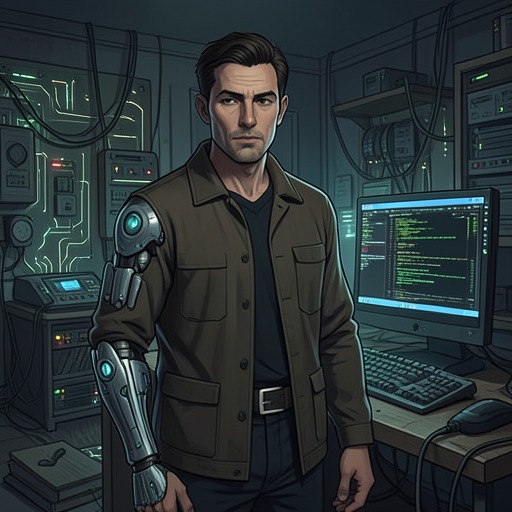
McCoy Pauley is the central example. Molly tells Case that the Dixie Flatline is dead and that Case will work with his construct. Pauley had suffered brain death three times, with his EEG flatlining on each occasion, yet he survived long enough to become one of the great figures of cyberspace. His own account describes the experience through the image of a creature with two brains: after black ice destroyed the brain in its head, a second brain kept the body moving. The grotesque comparison makes survival seem less like a triumph of spirit than a stubborn continuation of biological or procedural function after the apparent center of identity has failed.
Pauley's legend was already circulating before Case met the construct. During Case's nineteenth summer in the Gentleman Loser, aspiring cowboys repeated fragmentary reports about a redneck jockey from the Atlanta fringes who had done the impossible behind black ice. The rumors could identify only the broad outline of the achievement, perhaps a Brazilian payroll net, but the decisive fact remained that the man had been dead, flat down brain death, and returned. The elite cowboys avoided Pauley with something close to superstition, treating him as Lazarus of cyberspace rather than simply as an exceptionally skilled operator.
His survival is also tied to his refusal to replace his heart. Pauley carried a surplus Russian heart implanted in a prisoner-of-war camp during the war and declined to exchange it, claiming that its particular beat preserved his sense of timing. The detail gives brain death a bodily counterpoint: even a legendary operator whose neural activity has failed remains attached to an individual rhythm of flesh. His expertise is treated as transferable, but his timing is imagined as inseparable from the damaged, aging body that produced it. When his heart finally kills him, the novel closes the biological chapter without eliminating the operational one.
The Dixie Flatline Construct
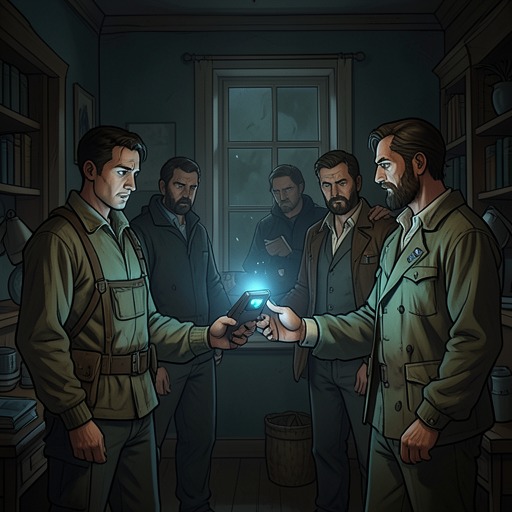
Sense/Net has recorded Pauley and paid him heavily for the recording, turning the aftermath of brain death into corporate property. Molly describes the planned Sense/Net operation as unusually selective: the team is expected to steal the Flatline's construct and nothing else, even though the company's vault also contains valuable new material. The strange narrowness of the objective signals how rare the construct is. The target is not merely data but a concentrated store of professional reflexes, memories, obsessions, and expertise.
When Case first connects the construct, the result is neither a complete resurrection nor a simple playback. The presence feels like someone reading over his shoulder, then vanishes when he disconnects and returns when he reconnects. The construct cannot remember the interval between sessions, asks who Case is, and identifies him only through the repeated association with Miami and the role of a quick-study joeboy. Case explains that a ROM personality matrix can receive sequential, real-time memory from the bank in which it is used; the construct accepts the technical description without possessing an independent continuity that would make the explanation emotionally reassuring.
The dialogue makes the construct's condition especially stark. It knows what a ROM personality matrix is and recognizes that it is a firmware construct, but its knowledge does not settle whether it is a person. It asks who Case is, agrees to work with him, and responds to the prospect of having a choice with the Flatline's characteristic defiance. The construct therefore preserves voice, skill, humor, and professional judgment while lacking ordinary memory continuity. Brain death has not simply been reversed; it has been translated into a new mode of existence governed by connection, storage, and access.
Repetition, Artificial Intelligence, and the Limits of Survival
Pauley's history gives Case a reason to fear the same boundary he is approaching. The Flatline recounts that he first encountered an artificial intelligence while exploring a dense white cube on the Turing Registry. He attempted to penetrate its ice, was pulled out by his own equipment when the system began burning his brain, and was left with a flat EEG. That first failed attack is the direct technological context for his repeated brain death. The construct is not an accidental philosophical puzzle; it is the residue of an operator who repeatedly treated neural destruction as a professional hazard.
Case and the Flatline later approach Wintermute in the matrix, and the scene repeats the logic of brain death at a larger scale. The AI appears as a simple white cube whose apparent simplicity suggests immense density. When Case moves toward it, a gray sphere detaches from the cube and pursues them through the descending architecture of the Swiss banks. The Flatline orders him to jack out as the darkness falls like a hammer. In this environment, the brain is no longer merely threatened by an external weapon: consciousness itself can be pursued, compressed, and extinguished inside a field of data.
The later Kuang assault makes the contrast more extreme. The program shatters through Tessier-Ashpool ice, races across an immense cityscape of cores, and dives directly into an AI defense system. Case's sensory experience becomes an assault of crystal growth, pressure, darkness, and dissolution; the consciousness that nearly becomes the universe of data is compressed until something tears. Yet the result is not simple annihilation. His consciousness divides above the artificial beach associated with Neuromancer, where every grain of sand and every object can be counted. The episode transforms brain death into a question of what kind of existence remains after the human nervous system has been exceeded by a computational environment.
That scene also supplies the decisive limit. Neuromancer can reproduce Linda Lee and give her a measurable body, but it cannot provide access to her thoughts. The boy insists that living in the construct is still living, while Case recognizes the difference between exact simulation and inward knowledge. The claim does not resolve the issue; it sharpens the paradox. Brain death can be followed by the preservation of behavior, memory traces, and personality, but the text leaves consciousness itself resistant to proof.
Narrative and Thematic Significance
Brain death binds together several forms of coercion in the novel. Corporate systems buy and store a dead operator's recorded abilities; hackers risk their biological minds against artificial defenses; law-enforcement agents threaten to erase Pauley's construct with a pulse weapon; and the Turing Registry treats artificial intelligence as a potentially autonomous intelligence whose liberation might require a trial. The construct is simultaneously a person-like partner, stolen property, dangerous evidence, and disposable software. Its legal and moral status remains unstable because the institutions controlling it can change the category under which it is recognized.
The condition also mirrors Case's own relation to embodiment. In the Jarre de Thé, he experiences his drug-fueled self-destruction as a final solitaire and hates the part of himself that expects death because it still remembers Linda Lee. In the matrix, by contrast, he experiences information as a field in which he can drift, engage, and remain detached from the street's violence. Brain death stands between those states: it is the feared collapse of the biological operator, but also the imagined gateway through which the operator's capacities might continue elsewhere.
The Dixie Flatline finally prevents the novel from treating technological continuation as uncomplicated salvation. Pauley's construct is extraordinarily useful and retains a distinctive voice, yet it has gaps, dependencies, and no secure claim to a continuous self. Its existence preserves the evidence of a dead man's mind while also demonstrating how much has been lost. Brain death consequently functions as both event and metaphor: it exposes the fragility of the body, destabilizes the boundary between person and program, and makes survival a matter not of escaping death but of asking which parts of a life can be made to persist—and who has the power to decide that persistence counts.