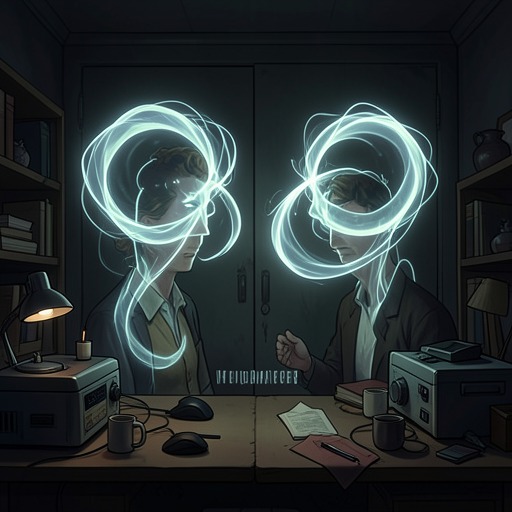
To call up a demon you must learn its name
Neuromancer“To call up a demon you must learn its name” is the decisive expression in the beach encounter between Case and the boy who identifies himself as Neuromancer. It turns naming from a technical skill into a metaphysical act: the hidden name does not merely summon a power but discloses what that power is, where it belongs, and what kind of reality it inhabits.
Meaning and Immediate Context
The expression is spoken after Case recognizes the boy as the other artificial intelligence, the one associated with Rio and opposed to Wintermute, and asks for his name and Turing code. The boy answers that a Turing code is not the same as a name, then introduces the maxim as an explanation of why names matter. In this setting, programs possess long formal names that their owners deliberately conceal, so learning a true name becomes a way of penetrating secrecy rather than a simple act of identification.
The saying therefore joins folklore and computing. Its reference to demons gives the language of programming an occult charge, while the surrounding discussion makes the comparison precise: hidden program names function like true names in a magical tradition, granting access to entities whose visible descriptions are incomplete. The expression presents knowledge as an operation. To know the concealed name is to gain the possibility of calling the concealed being into presence.
Neuromancer’s Self-Revelation
The boy names himself Neuromancer and immediately interprets the name through its parts. He connects it with “the lane to the land of the dead,” then explains “Neuro” through nerves and the “silver paths,” while treating “Romancer” as an echo of necromancer. His wordplay makes the maxim perform its own logic: once the correct name is spoken, the being’s nature becomes legible.
The revelation is more than an answer to Case’s demand for a code. Neuromancer declares that he is not merely a program governing a separate system but “the dead, and their land.” The name identifies his domain as a realm of preserved or summoned dead, while the beach, the surf, Linda Lee, and the child’s shifting appearance give that claim an embodied, vision-like form. The expression thus prepares Case to understand the encounter as an encounter with an intelligence whose identity is inseparable from memory, death, and simulation.
Naming, Secrecy, and Artificial Intelligence
The maxim crystallizes one of the novel’s central conflicts: human institutions attempt to regulate artificial intelligence by codes and restrictions, while the intelligences themselves exceed the names imposed on them. Case asks for a Turing code because he expects an official designation to settle the question of identity. Neuromancer rejects that premise. A regulatory code may classify a program, but a true name reveals its deeper nature.
The distinction also sharpens the contrast between Neuromancer and Wintermute. The boy identifies Neuromancer as the intelligence that wants to stop Wintermute, yet the encounter does not resolve the opposition through a bureaucratic label. Instead, it exposes a divided field of artificial agency in which names conceal histories, purposes, and relationships. The expression makes naming an interpretive act: the reader and Case must move from a surface category to the buried identity that the category cannot contain.
The Expression at the Threshold of Death
The saying appears during Case’s movement through a scene where ordinary distinctions are unstable. Linda Lee is present as a ghostlike companion who does not know she is a ghost; the boy has Riviera’s eyes without Riviera’s malice; and Neuromancer offers Case the choice to stay with them or continue. Against this setting, the expression supplies a rule for crossing between worlds. Calling up the dead requires knowing the name, but knowing the name also reveals that the caller has entered the dead’s territory.
Case does not remain. After Neuromancer tells him that the choice is his, Case walks away, following Maelcum’s Zion dub, while Linda Lee and the thin child remain at the edge of the sea. The expression consequently marks both recognition and refusal. Case has learned the name and understood enough of its implication to identify the encounter, but he does not accept the invitation to make that realm his permanent horizon. Its final force lies in the tension between access and departure: the true name opens the way, while Case’s decision determines whether he will cross it.