Navon King's Army
NeverthelessNavon King's Army is Navon’s military force, but it is not simply a body of soldiers waiting to defend the kingdom. By the time Tzara threatens Navon, the army reflects the costs of earlier alliances, the shortage of trained troops, and a command structure in which royal authority must be asserted before it can be exercised. Mabel’s effort to join makes its gender restriction visible; the crisis that follows makes its deeper problem plain: Navon needs defenders, yet has too few soldiers and too little time to make them.
Origins of its weakness
The army’s shortage of personnel has a political history. Before Tzara’s threat, Navon’s battles had largely been fought on behalf of other kingdoms. Military service was one of the things Navon offered in alliances, sending men to defend the lands of powerful neighbors. Some soldiers deserted because they did not want to fight wars that were not Navon’s. The practice had therefore helped create the very shortage the kingdom now faced: when Navon itself was threatened, it lacked an adequate force, and a former ally was too afraid of Tzara’s wrath to stand by it.
Desertion in Navon carries an extreme penalty. A deserter is exiled permanently beyond the kingdom’s borders, marked at the neck with a hot-iron D, and forbidden to return on pain of death. The law makes military obligation a matter of life and belonging, not just service. Yet the history of desertion also exposes the cost of requiring Navon’s soldiers to fight for other kingdoms. The army is shaped both by that coercive rule and by the alliances that made men unwilling to remain in its ranks.
The military crisis is accompanied by a dispute over who may direct the force. Navi has control of the castle’s political affairs while Dareh is away, but the king has not yet appointed him general. Navi wants military command; Dareh fears putting his heir on a battlefield, where a kingdom’s leader could be among the first to fall. He makes the appointment conditional on Navi announcing an engagement, tying the prince’s authority over the army to a dynastic decision. The condition does not settle the practical question of who can lead in danger; it makes command part of a larger struggle over royal duty and succession.
Recruitment and exclusion
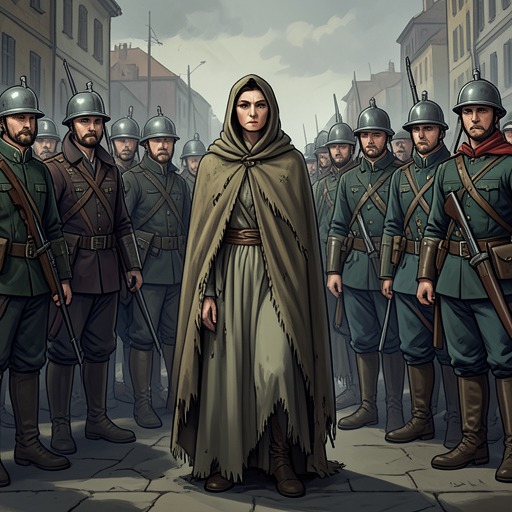
As Navon faces the threat, recruits gather at the military base from towns across the kingdom. They are not a trained army: the newcomers include peasants, blacksmiths, philosophers, artists, and aristocrats, many without the technique, strength, or experience of soldiers. Their different backgrounds and uncertain expressions mark how hastily the kingdom is assembling a force. Mabel is the exception in a more consequential sense: she is the only woman among them, seeking to become the first woman in Navon’s army.
The commander assumes that Mabel wants a paycheck and offers to arrange a hearing with the king, suggesting that she could receive help without enlisting. She refuses that alternative and says that she wants to be a soldier. The commander answers that a soldier must be a man, arguing that a woman would be physically overpowered and insisting that the army does not need her. He has her escorted to the gate. His rejection turns the army’s gender rule into an immediate institutional barrier: even when Navon is recruiting inexperienced young people from every town, a woman’s willingness to serve does not count as a qualification.
Navi eventually allows Mabel to enter, but his permission is not an assurance of protection or acceptance. He warns her that survival in the army will be her responsibility and that he will not intervene if anyone acts against her. The distinction matters: royal authorization opens the gate, but it does not undo the conventions governing the people inside. Mabel is not properly introduced to the troops or placed among them as a regular soldier. Instead, she is made a squire, assigned to polish and maintain weapons, inspect armor and cavalry equipment, and follow the commander in case someone needs something. Soldiers also make hostile comments about her being a woman in the camp. The work gives her a place in the army while withholding the status and opportunity to prove herself that she sought.
Command and the crisis of authority
The army’s chain of command is tested in the political chamber as well as at the recruitment field. During a discussion about securing allies, a royal adviser dismisses Navi as a child who has been away for two years and argues that the counselors should handle Navon’s affairs. Navi insists that he has been put in charge and orders the advisers to report what they do and even what they intend to do. They comply because he is the heir while the king is away, although their obedience is reluctant. Political command is thus real but contested: Navi can issue orders, yet experience and age are used to challenge his authority.
The unresolved tension becomes sharper when Navi says that Mabel is not part of his army and therefore has no right to question the crown’s heir. He also invokes a rule against questioning royal authority and tells her that she is out of the army and must stay away from the castle and from him. The decision shows how military membership and political obedience can be used to silence a challenge. It also contrasts with the earlier permission to enlist: Mabel has been admitted under precarious terms, and her place can be withdrawn by the same authority that granted it.
Later, Navi stands before the army as a prince, and its commander observes that he has never seen a prince in front of an army. Navi answers that the times are hard; the commander then waits for his commands. The exchange marks a shift from the earlier dispute over whether the young heir should direct the force to the visible fact of his presence before it. His authority is no longer only a claim made in the castle. In the face of danger, the army’s command structure requires a leader who will stand with it.
Mobilization and defensive purpose
The army’s role expands beyond fighting once Navon faces another attack. Navi directs that the whole village be brought to safety before the battle and orders that the army be called; he also needs to locate the soldiers. This is not yet a description of the battle itself, but it establishes the work that must precede it: gathering the force and moving civilians out of danger. The threat exposes the army’s dependence on a broader defense effort rather than on soldiers alone.
Shai’s men help put that plan into motion. Villagers are awakened by the commotion and initially fear a renewed attack by Tzara, but they find members of Shai’s band guiding them toward the castle for shelter. Women and children are told to go within the castle walls, while men are expected to stand and fight. Mabel understands the arrangement but is troubled by the prospect of leaving the soldiers after having shown that she stands with them. Her response emphasizes that the army’s demands are not abstract: its defense depends on who is asked to remain in danger and who is directed to safety.
The force therefore appears at once as a formal royal institution and as an incomplete coalition. Navon’s depleted ranks, rushed recruits, restrictions on women’s service, and contested leadership all complicate its capacity to defend the kingdom. Against those limits, the army’s purpose has changed from supplying men for other kingdoms’ wars to defending Navon itself. Its significance lies in that reversal: a military system built around obligations to powerful allies must now prove that it can protect its own people.