Tenerife outlaws
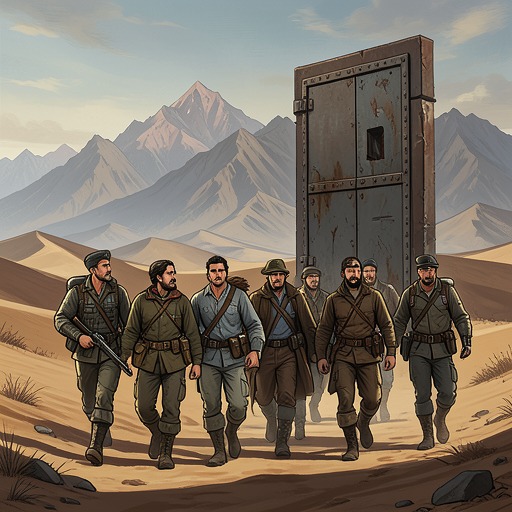
NeverthelessThe Tenerife outlaws are exiles who live beyond Navon’s authority and, through Shai’s efforts, become an essential force in the kingdom’s defense against Tzara. Their importance lies in the reversal at the heart of their position: Navon has cast them out, but when invasion threatens, they choose to defend the land that rejected them. They do not enter the story as a conventional royal unit or as a force motivated solely by payment; they bring independent methods, mutual deliberation, and a claim to belonging that the kingdom’s institutions have denied them.
Identity and Work Beyond Navon
The group is introduced through Shai’s practical description of its work. He calls its members something like bounty hunters or mercenaries: people hired to perform services others do not want to handle. Their tasks include rescuing people, capturing murderers, and recovering stolen money. The range matters. They are not presented only as fighters; they operate at the margins of formal authority, taking on work that can be described as bureaucratic as well as dangerous.
That work has a price. When Shai first proposes that the group fight for Navon, he acknowledges that such an undertaking would require money. Later, when Navi asks what the outlaws demand in return for joining the defense, Shai answers that they want nothing and are not doing it for money. The two exchanges show a change in the terms of the proposal rather than a simple contradiction: Shai recognizes the material cost of organizing armed service, but the group’s eventual commitment is not framed as a paid contract. Its choice to fight carries a purpose beyond earnings.
Exile, Homeland, and the Forest Refuge
The outlaws’ estrangement from Navon has a political history. Navon’s deserters are not merely dismissed from military service: the kingdom marks them with a brand, expels them permanently, and treats their return to Navon’s soil as a capital offense. The punishment separates them from society and leaves them to survive beyond the border. The narration also connects desertion to Navon’s former alliances: the kingdom sent soldiers to fight other kingdoms’ battles, and some men deserted rather than fight wars they considered unrelated to them. Now, when Tzara threatens Navon, an allied kingdom is too afraid of Tzara’s wrath to stand by it. The outcasts’ position therefore reflects the costs of a political order that once spent its soldiers abroad and then left its own defense short of men.
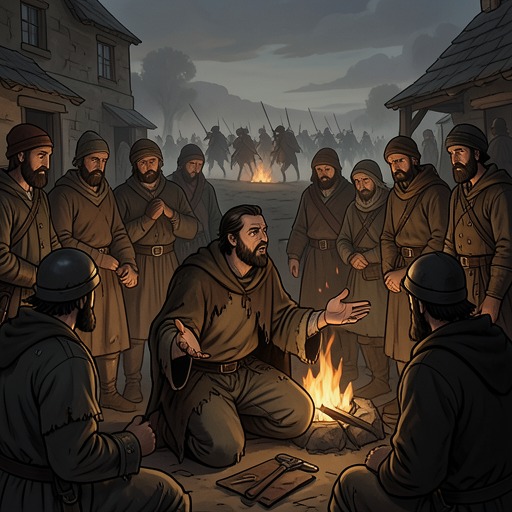
The outlaws’ refuge makes their separation visible. Mabel and Shai travel on horseback through a narrow canyon and climb to a high forest peak, where the group is concealed from the king’s attention. The gathering place is a converted wooden house furnished with tables, drinks, candles, and a fire; it is described as a forest hideaway rather than an official establishment. This shelter stands apart from Navon’s castle, which occupies a hill and is approached through forested terrain and a stone bridge. The contrast is not simply between a secure center and a dangerous wilderness: the forest refuge is also where a possible defense of the kingdom is being organized.
Alastair, Mabel, and the Question of Return
At the meeting, Mabel’s arrival unsettles the room. The men stop talking and turn their attention to her, and Alastair, the group’s leader in this encounter, asks why a girl has come. Shai explains that Mabel is from Navon and may intercede with the king on their behalf. Her presence makes the proposed alliance tangible, but the welcome is conditional: the group’s response depends on what Shai says, and Mabel is initially treated as a potential risk rather than as an equal participant.
Alastair’s answer to the suggestion of going home exposes the wound beneath that skepticism. He responds ironically to the idea that the exiles might return to the ruler who banished them, then insists that they will defend their land while Navon defends its own. His exchange with Shai turns the subject toward family: Alastair points out that Shai’s relatives have not come to visit or provide for him during his years in exile. The passage does not resolve those personal estrangements. Instead, it makes clear that loyalty to the land does not mean reconciliation with the authority or family ties that exile has broken. The outlaws can refuse a return to their former lives and still decide that Navon is worth defending.
From Separate Forces to a Coalition
Shai’s proposal is not simply to supply a few more fighters. He tells Mabel that a meeting will bring outlaws with disagreements together to protect Navon. The men in Tenerife had considered fighting Tzara alone, but Shai argues that two forces together are stronger than one. He wants Mabel to see the meeting and to show both sides that cooperation is possible. His plan responds to the same military weakness Navi confronts, but it broadens the meaning of alliance: strength can come from people outside the nobility and outside the royal army, not only from powerful kingdoms bargaining over protection.
The distinction matters in a kingdom under pressure. Navi favors exchanging Navon’s best products for political alliances, while his counselors warn that neighboring kingdoms are exploiting Navon’s vulnerability and that concessions could bind it to unfavorable conditions. The kingdom has already lost the support of an ally frightened of Tzara. Against that background, Shai’s initiative offers a different basis for defense: the outlaws are not a neighboring court demanding privileges, but exiles choosing to cooperate. Their meeting imagines a collective force assembled across divisions rather than a bargain made only among rulers.
Wartime Service and Significance
The alliance becomes practical when danger reaches the village. Navi decides that the villagers must be brought to the castle and that the army must be called together. As people wake in the night, expecting another attack, Shai’s men are already helping them leave their homes and reach shelter inside the castle walls. The outlaws who once survived outside the kingdom’s boundaries now help protect the people who live within them. Their role is not only to add combat strength; it includes the urgent work of moving civilians out of danger.
That service gives the organization’s arc its defining force. The outlaws remain shaped by exile, and the narrative does not suggest that their past treatment has been repaired. Yet their refusal to return to the ruler who banished them is compatible with defending Navon as a homeland. By bringing their own network into cooperation with the kingdom and assisting its villagers during an invasion, the Tenerife outlaws expose the limits of a defense built only on royal authority: those excluded from the state can still become among its most consequential protectors.