“Wake up and think about why I’m still here”
Norwegian Wood“Wake up and think about why I’m still here” is the summons carried by Toru Watanabe’s recurring memory of an October meadow: a command to confront survival as the people and selves once present there recede. The phrase turns an increasingly impersonal landscape into a prompt for reflection, and ultimately gives Watanabe a reason to write. Its force rests on a tension: memory summons the dead, but cannot restore them; the living must continue even as their recollections change.
The meadow and the vanishing figures
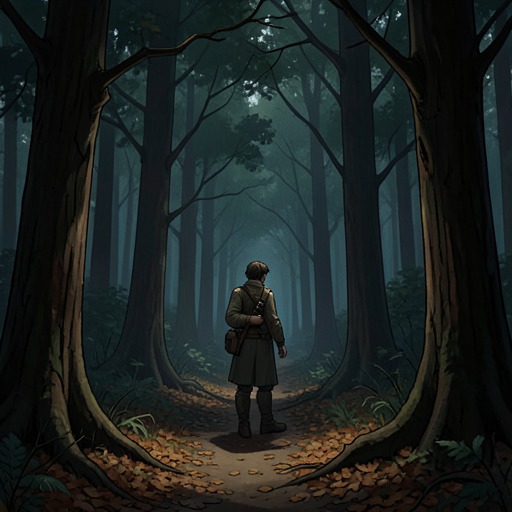
Eighteen years after the walk, Watanabe can recover its setting in fine detail. Rain had washed the summer dust from the mountains, grasses swayed in an October breeze, and distant barking seemed to come from beyond the woods. Two bright red birds darted from the meadow. Yet this precision does not preserve the people who once occupied the scene. When the landscape comes back to him, “No one. Naoko is not there, and neither am I.” The meadow remains while both the young woman beside him and his former self seem to have disappeared.
That absence is more than a failure of recall. At the time, Watanabe was absorbed in himself and in his love for Naoko, not in the scenery. Looking back, however, the smell of grass, the chill of the wind, the line of the hills, and a dog’s bark return before Naoko’s face. The memory reverses its original emphasis: what once served as a backdrop becomes its most durable content, while the people and feelings that seemed central prove difficult to summon.
Watanabe can eventually reconstruct Naoko from particular impressions: her cold hand, smooth black hair, camel-hair coat, and the slight trembling that sometimes entered her voice. At first he remembers her in profile, as they had walked side by side. But this recovered image takes longer to arrive as years pass. What once came to mind in five seconds requires ten, then thirty, then a minute. The meadow’s return therefore measures not just persistence but distance: Naoko is remembered, yet increasingly separated from the place where she once stood.
The summons and the work of writing
Against this lengthening delay, the meadow returns again and again, like a symbolic scene in a film. Each recurrence delivers a kick to some part of Watanabe’s mind. The kick does not hurt; it leaves a hollow echo, and even that echo may fade. Its words are brief and imperative: “Wake up, it says.” The fuller command follows: “I'm still here. Wake up and think about it. Think about why I'm still here.” In context, the voice is not a recovered speech by Naoko. It is what the returning scene seems to say to Watanabe, pressing him to consider the fact of his continued life.
The summons becomes especially forceful at Hamburg Airport, where the kicks are longer and harder than usual. Watanabe gives this experience a concrete consequence: “Which is why I am writing this book. To think. To understand.” He says that he has to put things down in writing before he feels that he fully comprehends them. The phrase thus describes both an emotional demand and the motive for the act of narration: reflection cannot undo loss, but writing lets him examine what survival means rather than leaving it as an unconsidered fact.
Writing is also bound to a promise. Watanabe admits that his memory has grown dim and that he has forgotten many things; he fears that the most important memories might be lost in a dark inner limbo, slowly turning to mud. He nevertheless continues with the imperfect memories he has. The book is “the only way I know to keep my promise to Naoko.” The summons to think about being here is therefore inseparable from the effort to preserve what can still be recalled, even while acknowledging that preservation will never be complete.
The well and the landscape of danger
The meadow’s meaning is altered by an image Naoko spoke of during the walk: the “field well.” Watanabe cannot establish whether an actual well existed. It may have been an image or sign in Naoko’s mind, but after she described it he could no longer remember the meadow without it. The imagined object becomes fused with the remembered place, illustrating how the scene is not a neutral record: it has been shaped by what Naoko said and by what Watanabe learned to associate with her.
He imagines the well at the boundary between meadow and woods, concealed by grass. Its opening is about a yard across; its weathered, muddy-white stones are cracked, and a small green lizard slips into a seam. Nothing marks the edge with a fence or a visible stone curb. Beneath it is only an immeasurable darkness. The well gives the summons a menacing counter-image: the meadow calls Watanabe back to attention, but the remembered scene also contains a hidden danger whose depth cannot be measured. Nature here is not simply a peaceful setting for recollection; its apparent openness holds an unseen absence.
Survival, death, and the limits of memory
The phrase gains further weight from the understanding of death that Watanabe develops after Kizuki’s death. He tries to establish distance from everything and forget, but a vague knot remains inside him. Over time, it takes the form of the thought, “Death exists, not as the opposite but as a part of life.” Death is no longer imagined as a separate domain that leaves the living untouched until the moment it takes them. It is present within life, as familiar and ordinary as objects Watanabe associates with his surroundings.
Naoko’s death makes clear that this understanding cannot console him by itself. During his wandering along the coast, he thinks of her while sleeping on the sand, making fires from driftwood, roasting dried fish, and listening to the waves. Her remembered presence can feel immediate; then the reality that her body no longer exists returns. In memories that seem to place her beside him, death is one element within life, but when that imagined refuge recedes he is left alone with grief. He concludes that no truth, sincerity, strength, or kindness can cure the sorrow of losing someone loved. A truth about death does not remove the need to endure loss.
The meadow’s command does not promise an answer or a cure. Its importance lies in directing attention back to the unresolved question of continued life, while the scene itself shows how imperfect that return must be. In the final contrast, the landscape can come back with almost absolute clarity even as its people fade; writing can keep Watanabe’s promise without defeating forgetting; and insight into death cannot spare him sorrow. “Wake up and think about why I’m still here” is therefore both a summons to reckon with survival and an admission that memory, however carefully written down, cannot bring the dead back.