Ami Hostel
Norwegian WoodAmi Hostel is a mountain sanatorium organized around voluntary convalescence, shared work, and mutual help rather than the usual division between doctor and patient. Reached by a long journey through forest and remote villages, it offers Naoko a place to recuperate beyond Tokyo. Its open gate suggests freedom, but that freedom has a threshold: residents may leave, yet cannot return once they do. The institution’s landscape, routines, and boundaries make it at once a refuge and a deliberately separate world.
Setting and Arrival
Watanabe first learns the address from a letter bearing the return address Ami Hostel. The name prompts him to wonder whether “ami” comes from the French word for friend. He visits the following day, travelling by bus from Kyoto into increasingly remote country. The route winds through a cedar forest that blocks the sun, then opens onto mountain basins, farmland, and small villages. The changing landscape makes the distance from the city tangible before he reaches the institution.
At his stop, there are no houses or fields, only a stream, the bus-stop sign, and a trail. After climbing for roughly fifteen minutes, Watanabe finds a narrow road marked “AMI HOSTEL PRIVATE NO TRESPASSING.” The forest carries isolated sounds, including wings and what may be a distant rifle shot. A low white wall and a wide-open iron gate mark the entrance. The guardhouse appears temporarily unattended: an ashtray contains three cigarette ends, a half-full teacup and transistor radio remain inside, and a wall clock ticks. Beyond it, a car park holds just three vehicles. The route into Ami Hostel thus combines a conspicuous privacy warning with an entrance that is physically open.
The place is also defined by its difference from the city’s crowded institutions. Years later, when Watanabe visits Midori’s father at University Hospital, he encounters noisy corridors filled with visitors and patients, the smell of disinfectant, bouquets, urine, and mattresses, and nurses moving rapidly through the wards. Ami Hostel’s country setting and convalescent purpose offer a sharp contrast to that urban hospital scene, although the novel does not present the sanatorium as a cure for every condition.
A Community for Convalescence
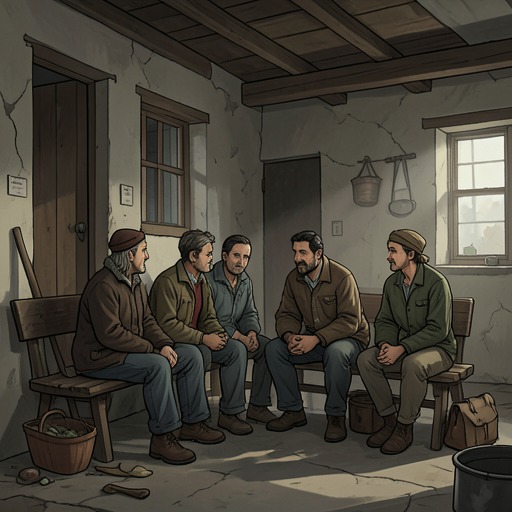
Reiko explains that Ami Hostel is not an ordinary hospital. It has a few doctors who check residents’ conditions and offer advice, but it does not generally administer treatment in the conventional sense. There are no bars on the windows, the gate stays open, and people enter and leave voluntarily. The institution is intended for those suited to convalescence in that form; people who need specialized therapy may be transferred to a specialist hospital.
The community’s origin lies in a summer home donated roughly twenty years earlier. Initially, group therapy took place in the old house. The donor’s son had a tendency toward mental illness, and a specialist proposed a country-based approach in which patients would live together, help with physical labour, and consult a doctor for advice and check-ups. The trial grew into an incorporated operation: more land was cultivated, and the main building was erected five years before Watanabe’s visit. The arrangement is not described as universally successful. Some residents do not improve, while others who could not be helped elsewhere make a complete recovery.
Its defining method is reciprocal assistance. Residents understand themselves as flawed and help one another; doctors remain part of the community rather than standing wholly outside it as authorities. Reiko gives concrete examples: she teaches piano to one doctor, while another patient teaches French to a nurse. In this model, care moves in more than one direction, and daily work and shared competence matter alongside professional oversight.
Layout, Work, and Restrictions
The women’s residential area, Area C, consists of ten identical two-storey houses, each divided into four units with two people in each unit: a capacity of eighty. At the time Watanabe visits, only thirty-two women live there. The houses stand along a gentle slope, their repeated cubical forms, symmetrical fronts, and neat shrubbery giving the area an oddly uniform appearance. Reiko is allowed to walk freely, but the other residents follow individual schedules: exercising, gardening, attending group therapy, gathering wild plants, or doing assigned work. Naoko, Reiko thinks, may be working on new paint and wallpaper.
Ami Hostel supplies much of what residents need without a trip into town. It produces eggs in its own chicken coop and has books, records, exercise facilities, and a convenience store. Barbers and beauticians visit weekly; films are shown on weekends; staff can buy special items in town, while clothing is ordered from catalogues. This practical self-sufficiency is part of the community’s design: daily life is organized within the grounds, not around routine journeys outside them.
The limits on movement are explicit. Residents cannot ordinarily go into town, though special needs such as a dental appointment may make an exception. Anyone may leave Ami Hostel, but departure is final: once a resident has left, that person cannot return. The rule prevents casual comings and goings, but it also gives the open gate a serious consequence. The place permits voluntary participation without promising that its refuge can be resumed after someone crosses out of it.
Landscape, Memory, and Significance
Ami Hostel’s surrounding country is not simply a pastoral backdrop. The approach passes through dark, cold cedar forest, while the wider journey reveals small settlements and cultivated land. On a later walk with Reiko, Watanabe passes a village whose houses have been abandoned for seven or eight years. Reiko explains that residents left because winters trapped them under snow, the soil was poor, and city life offered a better living. The rural landscape therefore contains hardship and decline as well as quiet and distance.
The sanatorium also gives physical form to the novel’s concern with separation and return. Its remoteness takes Naoko away from the city, while Watanabe must make a deliberate journey to see her. The institution’s boundaries are both welcoming and restrictive: the gate is open, but the rule against returning turns departure into a one-way crossing. This structure echoes the wider emotional difficulty of reaching someone whose inner life cannot simply be entered at will.
The novel’s later memories of open landscapes sharpen that contrast without making Ami Hostel a simple symbol of healing. Watanabe recalls a meadow where he and Naoko walked, its grass and distant woods apparently quiet, while Naoko spoke of a frighteningly deep field well that he could not tell was real or imagined. In another remembered landscape, the village’s empty houses register the loss of a community rather than the promise of retreat. Across these places, setting shapes what can be encountered and remembered, but it does not remove danger or grief.
Ami Hostel’s significance lies in the particular balance it sustains: medical supervision without ordinary hospital confinement, care through shared responsibility, and personal liberty bounded by a consequential rule. Its humane method can help some residents and fail others. That qualification matters to Naoko’s story: the sanatorium offers companionship and convalescence, not a guarantee that illness will end or that the losses attached to it can be undone.