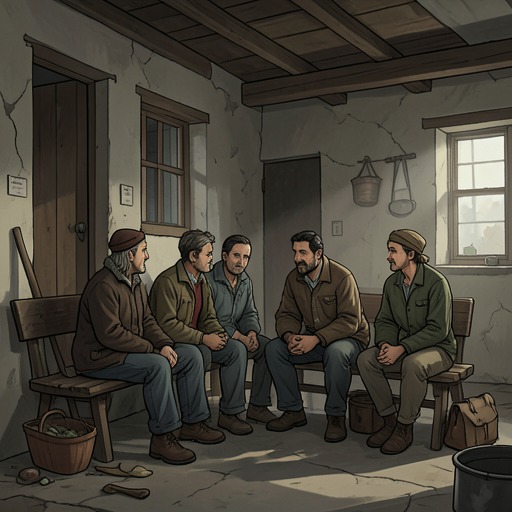
Ami Hostel’s Mutual-Support Approach to Healing
Norwegian WoodAmi Hostel’s mutual-support approach makes convalescence a communal way of life: residents and staff share work and responsibility, and people are asked to acknowledge rather than simply correct their differences. The model offers routine, quiet, and reciprocal care in place of a conventional division between doctor and patient, but its own account recognizes that not everyone recovers and that some residents need specialized treatment.
Convalescence as Everyday Life
Ami Hostel is described as a place for convalescence rather than an ordinary hospital. Doctors hold regular sessions and check residents’ conditions, but they do not administer treatment in the conventional hospital sense. There are no bars on the windows, and the gate remains open: people enter and leave voluntarily, while admission depends on being suited to this kind of recuperation. As Reiko puts it, the convalescence consists of living there—following a regular routine, exercising, keeping apart from the outside world, and breathing clean air in quiet surroundings.
The community’s relative self-sufficiency gives that routine practical shape. Residents have farmland, books, records, exercise facilities, and a convenience store; barbers and beauticians visit weekly, films are shown on weekends, and staff can buy special necessities in town. Residents cannot go into town as a rule, although an exceptional need such as a dentist visit can be accommodated. Anyone may leave, but cannot return afterward. This boundary protects the community’s settled rhythm while making departure consequential rather than a temporary excursion.
Shared Work and Shared Knowledge
The approach grew from an experiment in group therapy. A donor’s son had a tendency toward mental illness, and a specialist proposed that a group of patients live in the countryside, help one another through physical labor, and have a doctor available for advice and check-ups. The operation expanded, cultivated more land, and eventually added a main building. Reiko describes the result without claiming universal success: many people do not get better, while some who could not be helped elsewhere have recovered completely.
Work, recreation, and practical knowledge are distributed across the community. Residents grow vegetables, play sports, and learn from one another; the farm and shared activities make care visible in ordinary tasks rather than confining it to medical appointments. Reiko teaches music and helps in the office, and her role is so difficult to distinguish from staff work that people call her “The Music Doctor.” She has lived at the Hostel for seven years, but is herself a patient. The title captures the model’s deliberate crossing of roles without erasing the fact that residents and staff occupy different positions.
Deformity, Acceptance, and Equality
The Hostel’s account of recovery turns on the idea of “deformity”—the differences and difficulties in how people think, feel, and perceive. When Naoko notices that players in a game seem equally deformed, the doctor in charge tells her that, in one sense, the perception is right: the aim is not simply to correct each person’s difference, but to become accustomed to it and find a place for the pain it causes. He cautions that change cannot be forced overnight and that pressing one issue may disturb another.
This principle shapes the Hostel’s social world. Its residents can live together without hurting one another, Reiko explains, because they know their deformities are present; unlike people outside, they do not proceed unconscious of them. She likens their openness to wearing feathers that identify a tribe. The comparison makes acknowledged difference a condition of belonging, not a mark to conceal before joining the group. Yet the account does not make suffering disappear: residents come there partly to get away from pain they have been unable to accommodate within themselves.
The model also unsettles a strict hierarchy between professional and patient. Reiko says that everyone helps everyone else: residents can teach staff, doctors observe and step in when needed, and staff remain part of the community rather than standing wholly outside it. To participate, a person must want both to help and to be helped, and must be totally honest—neither lying nor glossing over embarrassing facts. Mutuality here is not mere friendliness; it is an explicit practice of reciprocal dependence and candor.
Limits and the Move to Specialized Care
The Hostel’s open, quiet environment is sustained under particular preconditions. About seventy people live there, alongside just over twenty staff members, and the scale and spacious setting make the place feel unusually quiet and almost like the normal world. But the arrangement does not meet every need. Reiko distinguishes this convalescent community from institutions offering specialized therapy, to which some residents may have to go.
Naoko’s course demonstrates that limit. When her condition worsens, Reiko writes that Naoko is generally fine but can become so emotionally unstable that others cannot take their eyes off her; during intense episodes of hearing voices, she shuts down and retreats inward. After Naoko’s mother, Naoko, the doctor, and Reiko discuss the situation, they conclude that Naoko should move to a real hospital for intensive treatment, with a possible return depending on the results. Naoko would prefer to remain at the Hostel, and Reiko expects to miss and worry about her, but agrees that specialized care is the best available course. The decision does not disavow mutual support; it marks the boundary of what this particular form of care can safely provide.
Narrative Significance
The Hostel’s model is presented through lived arrangements—shared labor, exercise, quiet, rules about leaving, and the shifting roles of residents and staff—rather than as an abstract cure. Its insistence that people can help one another while remaining different offers an alternative to treating recovery as correction alone. At the same time, the acknowledged failures of the model and Naoko’s transfer prevent that alternative from becoming a guarantee: communal belonging can support convalescence, but cannot replace every form of treatment.