Ami Hostel’s Principle of Honesty and Mutual Support
Norwegian WoodAmi Hostel’s Principle of Honesty and Mutual Support is the ethic that organizes life in a voluntary convalescent community: its residents are expected to acknowledge their difficulties, help one another, and speak without concealment. The principle makes care reciprocal rather than a service delivered only by professionals, but it does not promise that mutual support will be enough for every crisis.
A community built on shared vulnerability
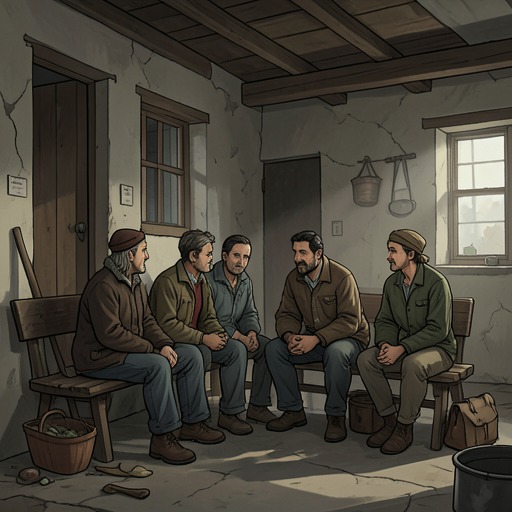
Ami Hostel is not described as an ordinary hospital devoted chiefly to treatment. Its gate remains open, its residents come and go voluntarily, and admission depends on being suited to convalescence. Doctors check residents’ conditions, but the institution’s daily life rests on a wider network of mutual assistance. Reiko, who has lived there for seven years, teaches music and helps in the office; although others call her “The Music Doctor” or “Doctor Ishida,” she explains that she is a patient herself. Her position makes the boundary between staff and residents difficult to maintain.
The community is small in relation to its broad, quiet setting: about seventy residents and just over twenty staff members. Its members play sports together, cultivate vegetables, and share ordinary routines. Reiko’s account gives those routines an ethical meaning: residents are not simply recipients of professional care but participants in a community where, as she tells Toru Watanabe, “everyone is equal - patients, staff - and you.” Help is reciprocal: he can support Naoko, while Naoko and others can help him.
Honesty as a practice of care
Reiko defines mutual support as a decision made in both directions: a person must want to help and also recognize a need for help. The next step is complete honesty—no lying, glossing over, or hiding what might be embarrassing. In her explanation, candor is not an abstract virtue detached from care. It is how people make their actual difficulties available to one another, rather than preserving appearances that prevent assistance.
That expectation can hurt. When Naoko becomes upset and cries, Reiko tells Watanabe that emotional expression is not itself a danger; the greater risk is for feelings to harden and die inside. She urges him to speak honestly even when someone may be distressed, and to think of helping Naoko as a way of seeking recovery himself as well. Her advice makes support a shared undertaking, not a one-sided project in which Watanabe fixes another person while remaining untouched.
Living openly with difference
The principle is grounded in the hostel’s understanding of what it means to be “deformed.” A doctor tells Watanabe that the residents are not there simply to have their differences corrected; they must learn to recognize and accommodate them. People differ in how they think, feel, and see the world, and attempts to force change may create other difficulties. The community offers space to live with the pain of such differences, rather than assuming that they can be rapidly eliminated.
Reiko describes this openness as a condition that distinguishes the hostel from the outside world. Its residents know their vulnerabilities and “wear our deformities in the open”; this shared recognition helps them avoid hurting one another. The image of open display captures both the protection and the cost of the rule: belonging depends not on pretending to be well, but on letting others know where one is vulnerable. The quietness of the community is therefore more than atmosphere; it is a collective effort to live together without concealment or unnecessary harm.
The principle’s limits
Mutual support is not presented as a guaranteed cure. Reiko says some residents recover fully while others do not, and she cannot predict what will happen to Naoko. Her counsel remains honesty and helping one another, but it does not erase uncertainty or substitute for every form of treatment.
That limit becomes concrete when Naoko’s condition deteriorates. After a long discussion involving Naoko’s mother, the doctor, Reiko, and Naoko, the group concludes that Naoko should move temporarily to a proper hospital for intensive treatment, with the possibility of returning depending on the results. She wishes to remain at the hostel, and Reiko expects to miss her, but Naoko’s increasingly unstable emotions and episodes of hearing voices make it difficult to keep her safe there. The decision does not repudiate the hostel’s ethic; it shows that mutual care includes recognizing when the community cannot provide the level of support someone needs. Reiko retains the principle of patience, imagining recovery as the slow unravelling of tangled threads, one at a time, without abandoning hope.